
Genogram relationship lines
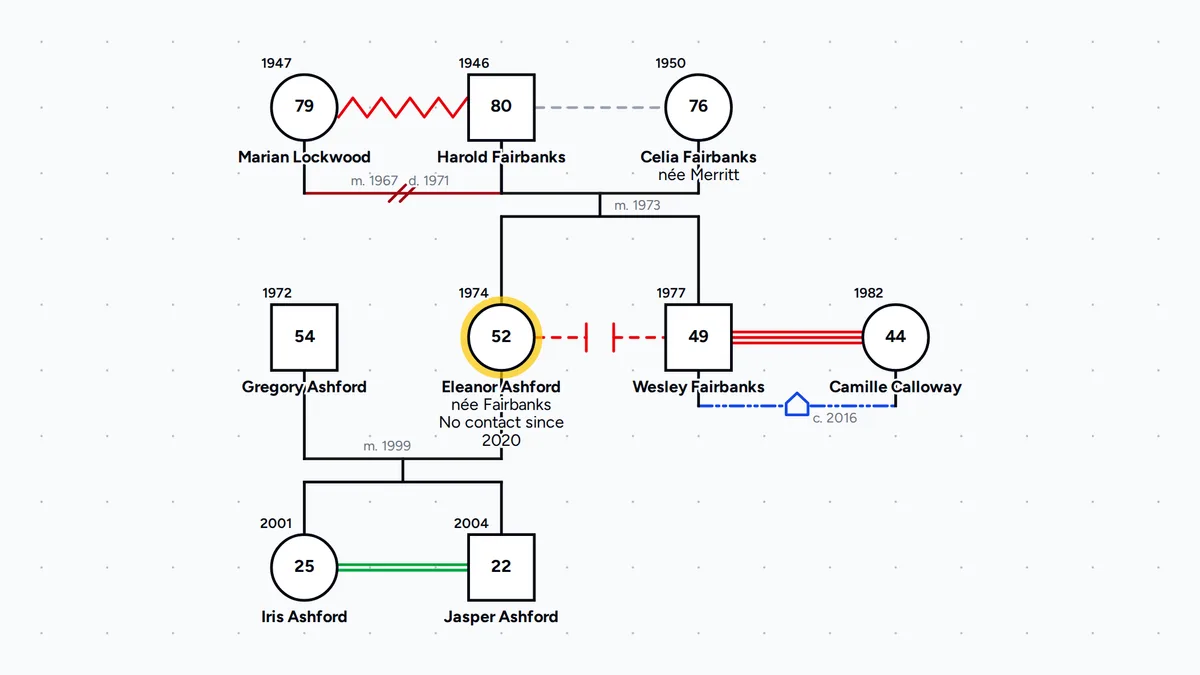
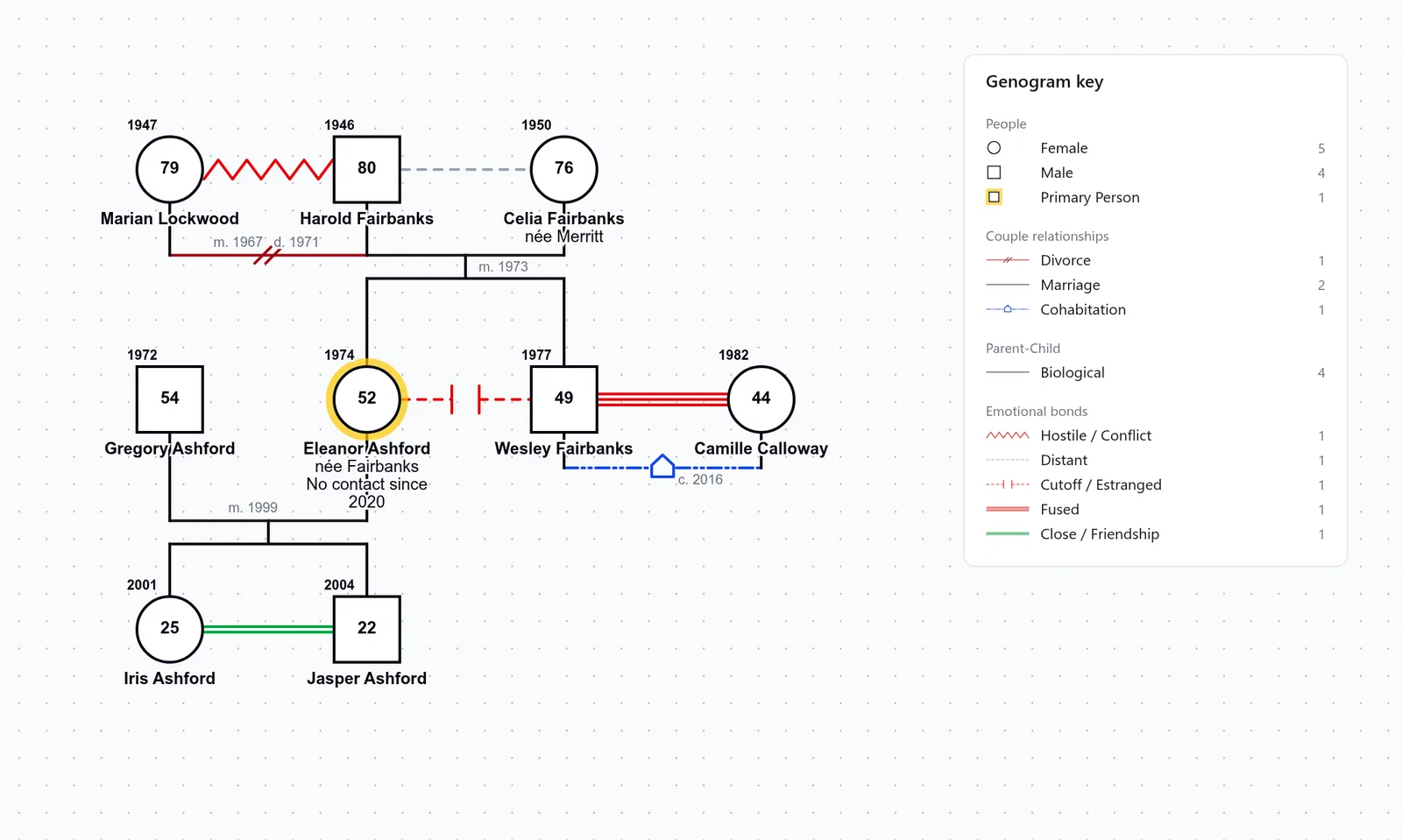
This page shows the Fairbanks family, where Harold's divorce and remarriage, his daughter Eleanor's marriage and his son Wesley's cohabitation are drawn as couple lines, and five bond lines are drawn between the people who are close, distant, hostile, fused or cut off.
Updated October 2026Notation follows McGoldrick, Gerson and Petry, Genograms: Assessment and Treatment (4th ed., 2020)
Cite this diagram
Genogram Pro. (2026, October 20). Genogram relationship lines [Diagram]. https://genogrampro.com/guide/genogram-relationship-lines
Divorce and remarriage
The red line with two slashes is Harold's marriage to Marian, which ended in 1971, and the black line to his right is his marriage to Celia in 1973.
Cohabitation
Wesley and Camille, who have lived together since 2016 without marrying, have a blue dash-dot-dot line with a house between them.
Cutoff
Eleanor and her brother Wesley have had no contact since 2020, so a red dashed line broken by two bars is drawn between them.
Fused
Wesley and Camille's relationship is fused, so three red lines are drawn between them.
Pick the couple line for the kind of union
A couple line is drawn below two partners in the style of their union and labeled with the years it began or ended. A slash through the line is a separation, two slashes are a divorce, and a house on the line means that the couple share a home. The divorce and remarriage genogram example shows these lines after a divorce in which both parents remarried.
Marriage
A solid black line for a legal marriage.
Separation in fact
One backslash, for a couple who live apart without legal action and are still married.
Legal separation
One forward slash, for a separation a court has recognized.
Divorce
Two forward slashes, for a marriage a court has dissolved.
Nullity
Three forward slashes, for a marriage a court has declared void.
Widowed
An X on the line, for a marriage ended by a partner's death.
Engagement
A blue dashed line for a couple who plan to marry.
Engaged and living together
The engagement line with a house, for an engaged couple who share a home.
Engagement ended
The engagement line with one backslash.
Legal cohabitation
A blue dash-dot line with a house, for a registered partnership.
Legal cohabitation, separated in fact
The legal cohabitation line with one backslash and no house, for registered partners who live apart without legal action.
Legal cohabitation, legally separated
The legal cohabitation line with one forward slash and no house, for registered partners whose separation a court has recognized.
Cohabitation
A blue dash-dot-dot line with a house, for an unmarried couple who live together.
Cohabitation ended
The cohabitation line with one backslash and no house.
Non-sentimental cohabitation
A blue dotted line with a house, for people who share a home but are not a couple.
Non-sentimental cohabitation ended
The non-sentimental line with one backslash and no house.
Committed relationship
A blue dashed line with shorter dashes than an engagement, for a long-term couple who neither marry nor live together.
Committed relationship ended
The committed line with one backslash.
Dating
A blue dotted line for a short-term or casual relationship.
Dating ended
The dating line with one backslash.
One-night stand
A widely spaced blue dotted line for a brief sexual relationship.
Love affair
A pink dashed line for a secret or extramarital relationship.
Affair ended
The affair line with one backslash.
Rape or force
A red dotted line for sexual contact without consent.
Other or unknown
A grey dotted line for a relationship whose type is unknown.
Pick the bond line for how two people relate
A bond line can be drawn between any two people, whether they are partners, siblings, a parent and child or in-laws, for the emotional relationship between them. The lines for abuse, control and focus have an arrow that points to the person on the receiving end. Two of these lines are explained in detail on the cutoff symbol and fused relationships pages.
Plain
An ordinary relationship with nothing notable about it.
Indifferent
One or both people are apathetic toward the other.
Distant
The two see little of each other and rarely talk.
Never met
The two have never met, as with an adoptee and a birth parent.
Other
A relationship that fits none of the other lines.
Cutoff
All contact has stopped after a closer relationship.
Cutoff repaired
Contact has returned after a cutoff.
Harmony
A good relationship built on mutual respect.
Close
A bond of shared affection and mutual help.
Very close
A deep friendship with unusual trust and understanding.
Love
Strong affection, from kinship or attraction.
In love
A romantic bond of intimacy, passion and commitment.
Spiritual connection
A spiritual or deep emotional bond.
Discord
At least one sees the relationship as negative, and both think they are right.
Hate
Intense enmity, in which each wishes the other harm.
Hostile
Frequent arguments over major issues, and tension whenever they are together.
Distrust
At least one doubts the other's intentions.
Distant-hostile
Rarely in contact, but hostile when they are together.
Close-hostile
Often in contact, yet they argue and keep secrets.
Fused
An enmeshed, dependent tie in which neither person has much separate identity.
Fused-hostile
Enmeshed and dependent, yet unable to stop arguing.
Violence
Conflict that escalates to physical force.
Distant-violence
Rarely in contact, but violent when they are together.
Close-violence
Often in contact, with arguments that turn violent.
Fused-violence
An enmeshed tie in which violence is used to avoid breaking the bond.
Abuse
Abuse of an unspecified type, with the arrow pointing to the victim.
Physical abuse
Physical harm that is not accidental, with the arrow pointing to the victim.
Emotional abuse
Yelling, shaming or name-calling, with the arrow pointing to the victim.
Sexual abuse
Sexual acts with a child or forced on an adult, with the arrow pointing to the victim.
Neglect
A failure to meet a dependent's basic needs, with the arrow pointing to the dependent.
Manipulative
One person manipulates the other, and the arrow points to the person manipulated.
Controlling
One person controls the other, and the arrow points to the person controlled.
Jealous
One person resents the other's success, and the arrow points to the person envied.
Fearful of
One person is afraid of the other, and the arrow points to the person feared.
Focused on
An unhealthy focus such as favoritism or obsession, with the arrow pointing to its target.
Focused on negatively
Persistent criticism or blame, with the arrow pointing to the person blamed.
Caretaker
One person takes care of the other, and the arrow points to the person cared for.
Fan or admirer
Ardent admiration, with the arrow pointing to the person admired.
Limerence
Intense infatuation and a longing to have it returned, with the arrow pointing to the person desired.
Tell a couple line from a bond line
- Use a couple line for a union. It is drawn below the two partners' symbols and labeled with the union's years, such as m. 1999 for Gregory and Eleanor or c. 2016 for Wesley and Camille.
- Drop children from the couple line. Each child's line starts from the union the child was born to, so Iris and Jasper drop from Gregory and Eleanor's marriage.
- Draw an earlier spouse on the outer side. Harold's first wife Marian is on his left, away from his second wife Celia, so his unions are drawn from left to right in the order they happened.
- Use a bond line for how two people relate. It is drawn straight between their two symbols, like the cutoff between Eleanor and her brother Wesley, and does not mean that they are a couple.
- Draw both when a pair needs both. Harold and Marian have a divorce line for their former marriage and a hostile line for how they get on now.
The couple lines and the emotional bond lines are listed on the genogram symbols chart, beside the person symbols and child lines.
Avoid two common mistakes with relationship lines
Record a divorce on the couple line
A cutoff between former spouses means only that contact stopped. A divorce is drawn as two slashes on the couple line, and because the children's lines still drop from it, each child is tied to both parents.
Use the cohabitation line for a couple who live together
If you draw a solid marriage line between Wesley and Camille, you record a wedding that never took place.
Questions people ask
Read the genogram key guideHow to show relationships in a genogram?
Draw a couple line below two partners for their union, and a bond line between any two people for how they relate to each other. The Fairbanks genogram on this page has four couple lines and five bond lines.
What symbol represents separation?
A separation is one slash through the couple line. In Genogram Pro, a backslash is a separation in fact, where the couple live apart without legal action, and a forward slash is a separation a court has recognized.
What does a fused relationship mean in a genogram?
A fused relationship is a tie so close that the two people have little separate identity, and it is drawn as three red lines between them, as between Wesley and Camille on this page.
What is the symbol for marriage in a genogram?
A marriage is a solid black couple line drawn below the two partners' symbols, labeled with the year of the wedding, such as m. 1973 for Harold and Celia. Their children drop from this line.
How to indicate divorce on a genogram?
Draw two slashes across the couple line and add the year the marriage ended, as in m. 1967 d. 1971 for Harold and Marian. Keep the line itself, because any children of the marriage still drop from it.
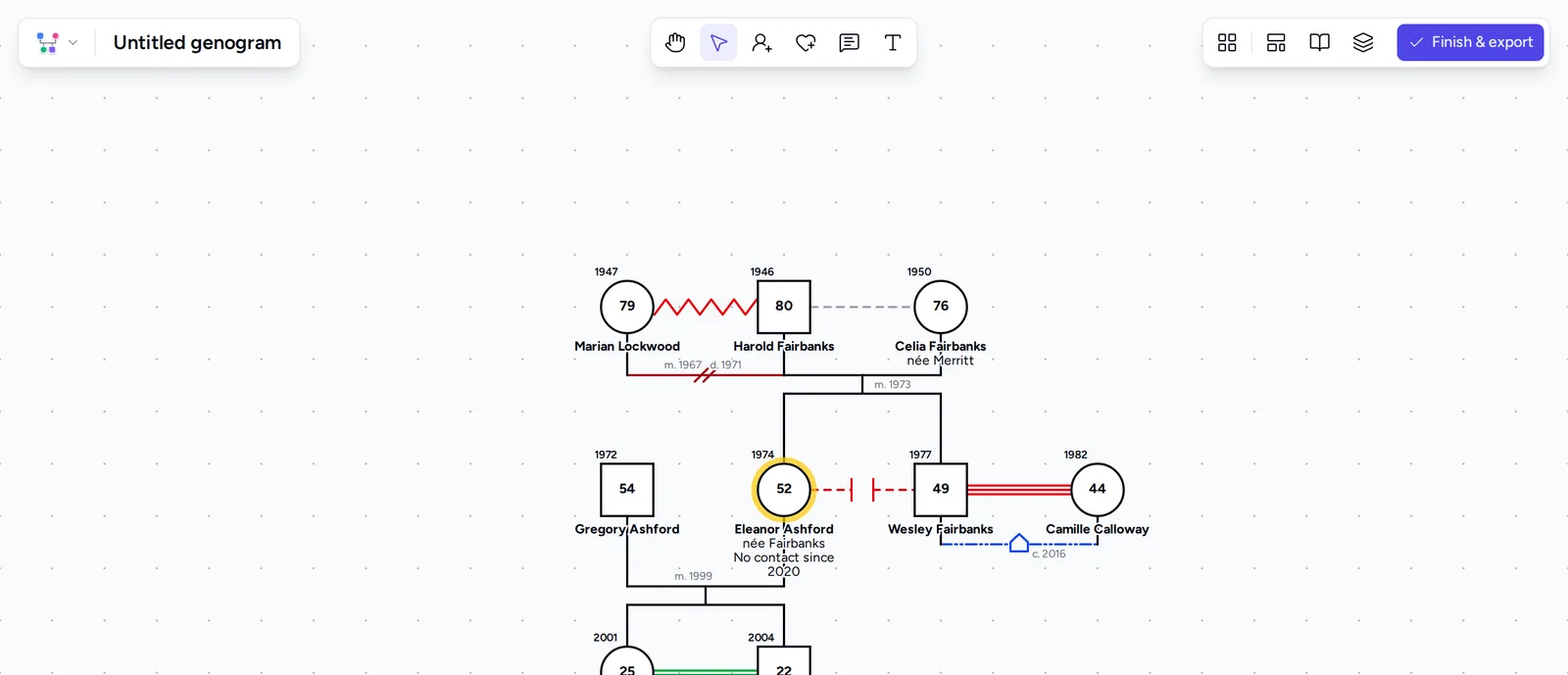
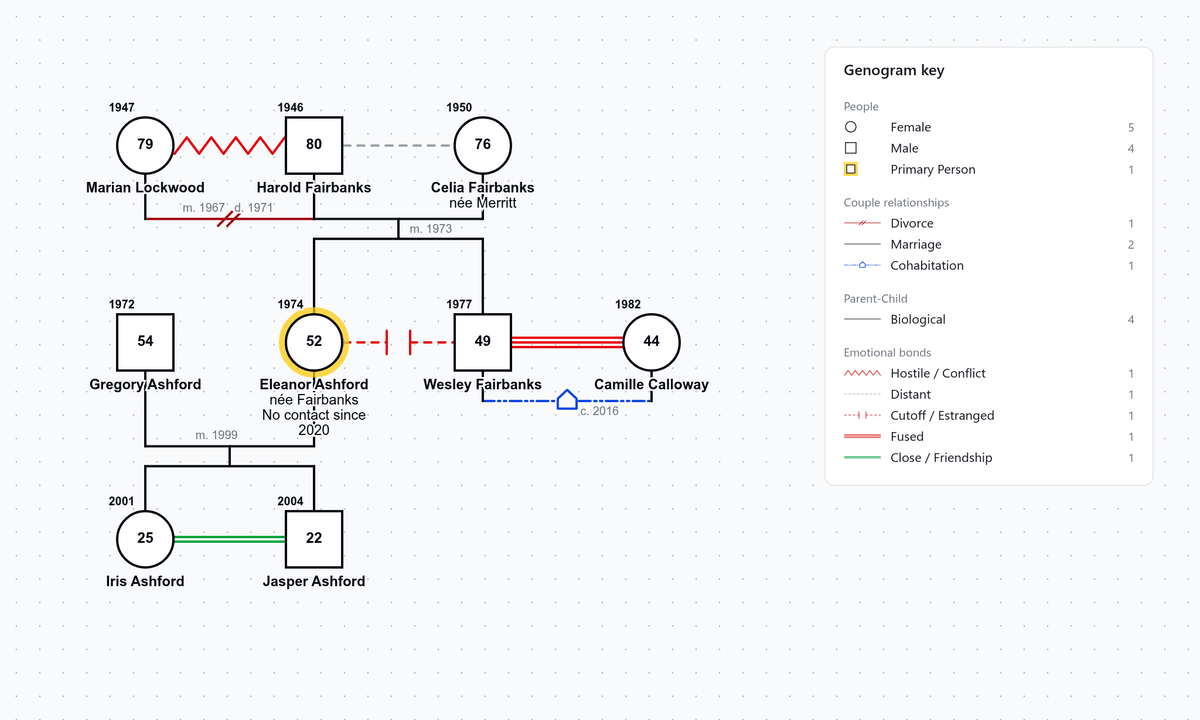
Start your genogram from this example
Open it in the editor, swap in your own names and dates, and export it as a PNG or PDF.