
Table of Contents
What Is an Ecomap?
An ecomap is a visual map of a person or family and the systems around them - work, school, extended family, healthcare, and more. The subject sits at the center, each system is a circle, and the lines between them show where support and strain come from.
Last updated September 2026
A short definition
An ecomap (also written as "eco map") is a diagram that places a subject - one person or a whole family - at the center and draws the external systems they interact with around it. Where a genogram looks inward at family structure across generations, an ecomap looks outward at the environment around a family at one moment in time.
The ecomap comes from social work. Ann Hartman introduced it in the 1970s as a way to picture a family in its social context, and the notation she set out - circles for systems, weighted lines for the connections - is still the standard today.
What an ecomap shows
Every ecomap is built from the same three parts:
- The center subject. The person or household the ecomap is about, drawn in the middle of the page.
- System circles. Each external system - work, school, healthcare, extended family, friends, faith, neighbours, social services - is a labelled circle around the subject.
- Connection lines. A line from the subject to each system shows the quality of that tie. A thick line is a strong connection, a thin or dashed line is a tenuous one, and a hatched line is a stressful or conflicted one. Arrows on the line show the direction energy and support flow: out from the subject, in toward it, or both ways.
Read together, those three parts answer one question at a glance: where does this person draw support, and where do they meet strain?
Ecomap vs genogram
Ecomaps and genograms are companion tools, and the difference is direction.
- A genogram maps the internal structure of a family across at least three generations - who is related to whom, plus medical history and emotional bonds.
- An ecomap maps outward from a single subject to the institutions and relationships around it, at one point in time.
A genogram looks back through the family. An ecomap looks around at the present. For the full picture of the family side, see what a genogram is.
Ecomap examples
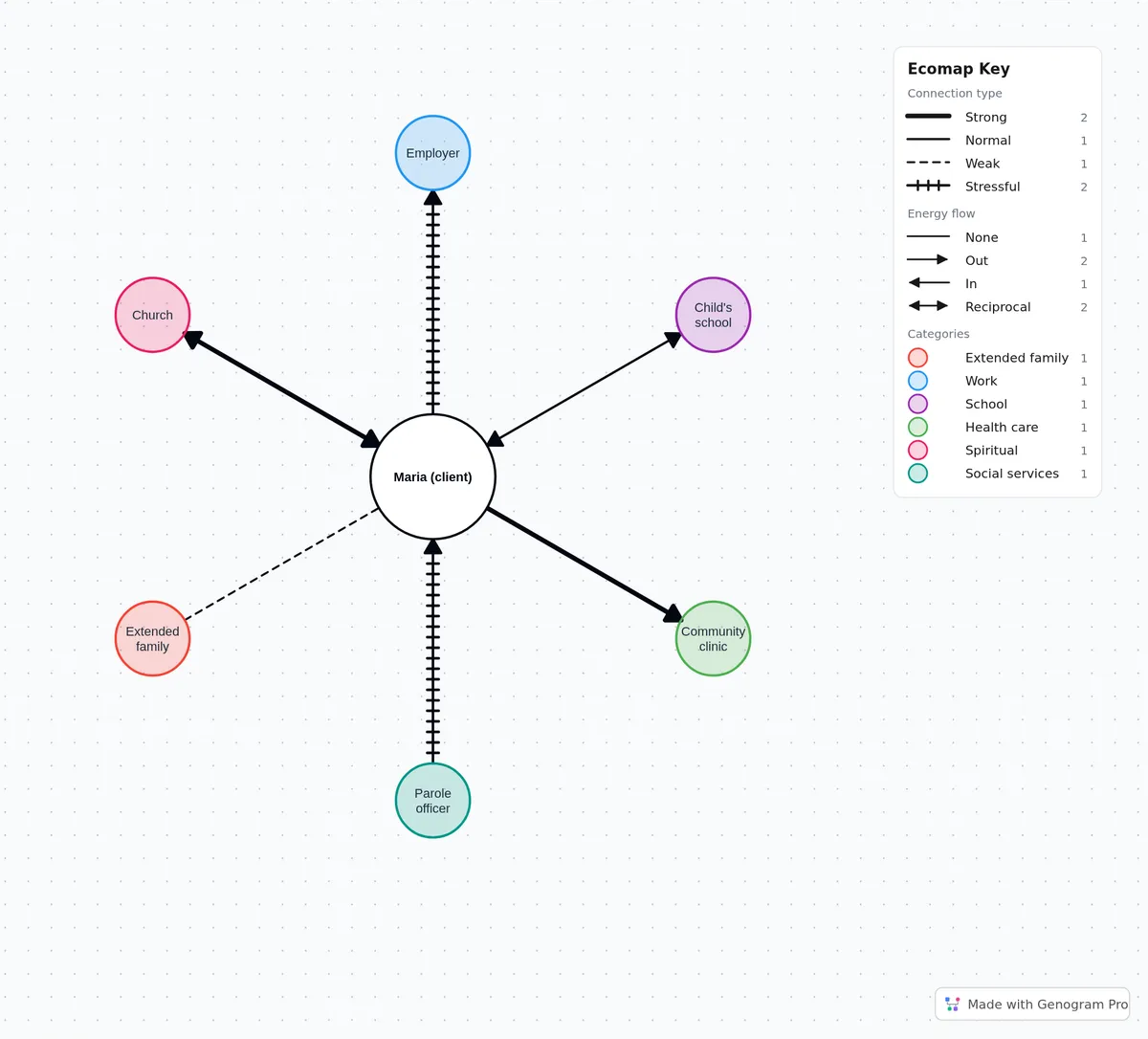
Two more settings make the format concrete:
- A social work intake. A caseworker puts a client at the center and adds circles for their employer, their child's school, a clinic, a parole officer, an extended-family household, and a church. A strong line runs to the church, a stressful line to the parole officer, and a tenuous, dashed line to the estranged extended family. The map shows at a glance where the client is supported and where to focus.
- A family and its services. A household sits at the center, surrounded by the systems the whole family touches - the parents' workplaces, the children's schools, a pediatrician, a sports club, neighbours, and a social-services agency. Arrows show that the family gives a lot of energy to work and school while drawing support back from neighbours and the clinic.
Ecomap templates
An ecomap template gives you the center subject and a ring of common systems already placed, so you fill in the specifics instead of starting from a blank page. Templates are handy for social work and nursing assessments, where the same categories recur from case to case.
The free ecomap maker starts you with a centered subject and the standard system categories - work, school, health care, extended family, friends, faith, and more - so the template work is done before you begin.
Who uses ecomaps
Ecomaps started in social work and stayed there, but the format spread to neighbouring fields:
- Social work. The original use - mapping a client's support network and stressors during intake and case planning.
- Nursing. Community and family-health nurses use ecomaps to picture a patient's support around a diagnosis or discharge.
- Family therapy. Therapists pair an ecomap with a genogram to see both the family and the world around it.
- Education and students. Social work, nursing, and counseling programs teach ecomaps as a core assessment skill, and students build them for coursework and placements.
How to make an ecomap
Building an ecomap takes four steps: place the person or household at the center, add a circle for each system in their life, draw a connection line from the subject to each system, and mark every line strong, tenuous, or stressful with arrows for the direction of support.
To skip the drawing, the free ecomap maker handles the centered subject, system circles, and weighted lines for you, and exports to PNG or PDF with no account.
Ecomaps and genograms together
Because the two tools answer different questions, practitioners often build both for the same family - a genogram for the family across generations, an ecomap for the support around it now. In Genogram Pro a paid document can hold a genogram and its linked ecomaps in one file, so the family's history and its environment sit side by side.
Start with the free genogram maker, then add an ecomap, or read the full genogram guide for the family-mapping side.
Frequently Asked Questions
What is an ecomap?
What is the difference between an ecomap and a genogram?
What does an ecomap show?
What is an ecomap in social work?
How do you make an ecomap?
Is there a free ecomap maker?
Map the support around your client in minutes.
Start an ecomap in your browser. No signup, no install, export to PNG or PDF.