
Genogram Key
The key, or legend, is the box that tells a reader what every shape and line on a genogram means. Print the full key, copy the essentials into an assignment, or let the editor draw one beside your genogram.
Last updated September 2026. Notation follows McGoldrick et al., Genograms: Assessment and Treatment (4th ed., 2020)

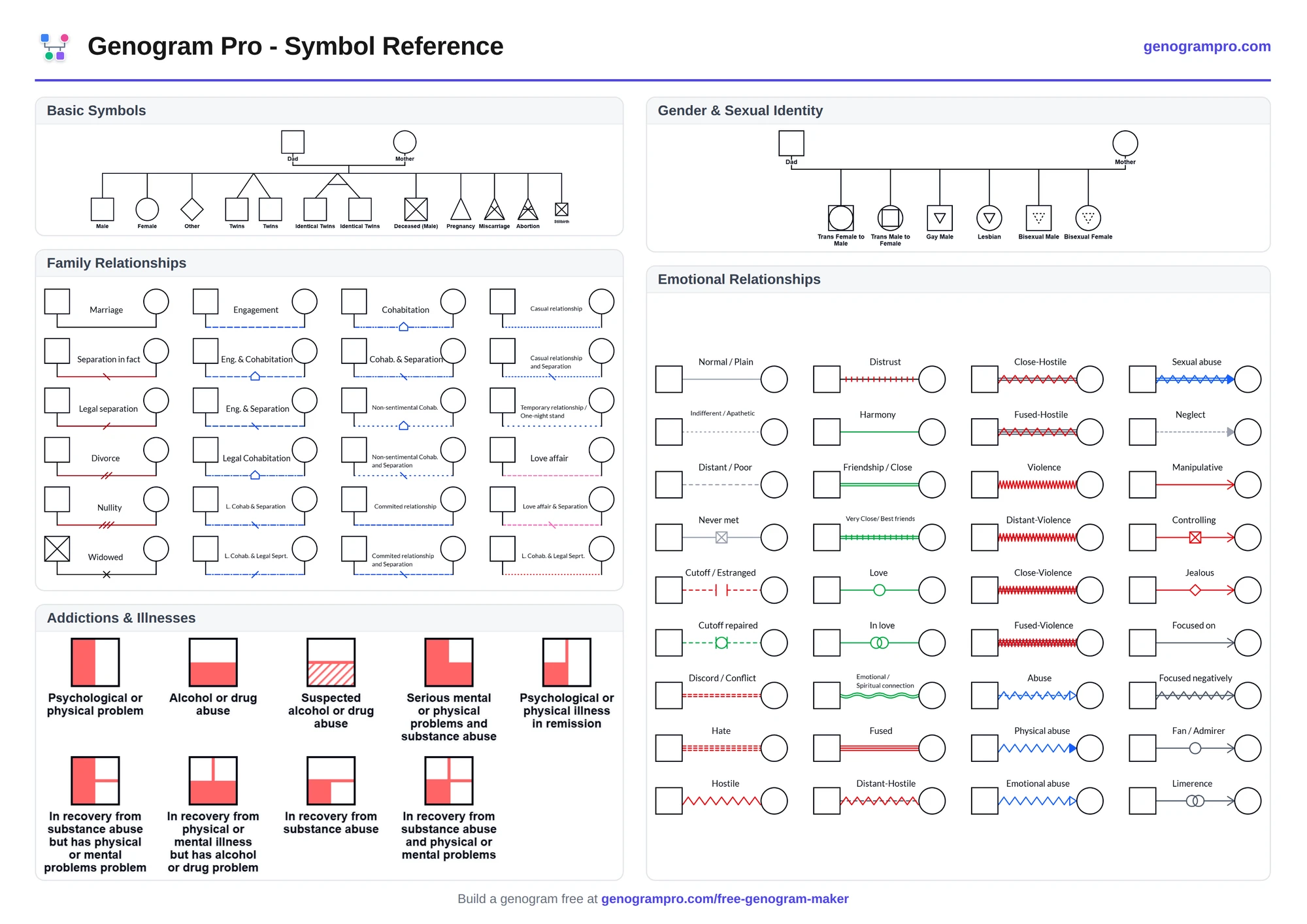
Printable genogram key
Every symbol on one sheet: people, life status, couple lines, emotional bonds and condition fills. Print it for a classroom or pin it above a desk.
The essentials legend
Most assignments and intake genograms need only these. This is the same notation the editor draws, so a key built from it matches the diagram exactly.
People
- Male
- Female
- Unknown or non-binary
- Deceased
Couples
- Marriage
- Separation
- Divorce
- Cohabitation
- Engagement
- Widowed
Parent and child
- Biological child
- Adopted child
- Foster child
Emotional bonds
- Close
- Fused
- Distant
- Cutoff
- Conflict
- Hostile
- Fused and hostile
- Abuse
Genogram legend table
The same essentials as text, for pasting into a report. The complete genogram symbols guide explains all 25 couple lines, 4 parent-child lines and 37 emotional bonds.
| Symbol | Meaning |
|---|---|
| Square | A male |
| Circle | A female |
| Diamond | Unknown or non-binary gender (also used for pets) |
| X through the shape | A deceased person |
| Highlighted / double-lined shape | The index person, the focus of the genogram |
| Triangle | A pregnancy |
| Solid horizontal line | Marriage |
| Horizontal line with two slashes | Divorce |
| Horizontal line with one slash | Separation |
| Dashed horizontal line | Cohabitation or unmarried partnership |
| Solid vertical line | A biological child |
| Dashed vertical line | An adopted child |
| Two children on a shared peak | Twins |
| Green line | A close or positive relationship |
| Red line | Conflict or hostility |
| Three parallel lines | A fused or enmeshed relationship |
| Broken line with two bars | Emotional cutoff or estrangement |
A key on a real genogram
The 3 generation genogram example shows the key in use. It lists only the symbols in that family, counts them, and highlights everyone who shares a condition when you click a row. Every page in the genogram examples collection carries the same key.
Add a key to your own genogram
You do not have to draw the key by hand. The editor keeps a legend that updates as you add couples, bonds and conditions, and the exported PNG or PDF places it beside the diagram. Start from a blank genogram template or a blank canvas.
Build a genogram with an automatic key
Open the free editor, add your family, and export a PNG or PDF with the key already drawn.
free genogram makerFrequently Asked Questions
What is a genogram key?
Is a genogram key the same as a genogram legend?
What should a genogram key include?
Where do I put the key on a genogram?
Is there a printable genogram key PDF?
Ready to Create Your Own Genogram?
Build professional genograms online with standard notation, AI-powered generation, and end-to-end encryption.