
Table of Contents
Genogram Symbols
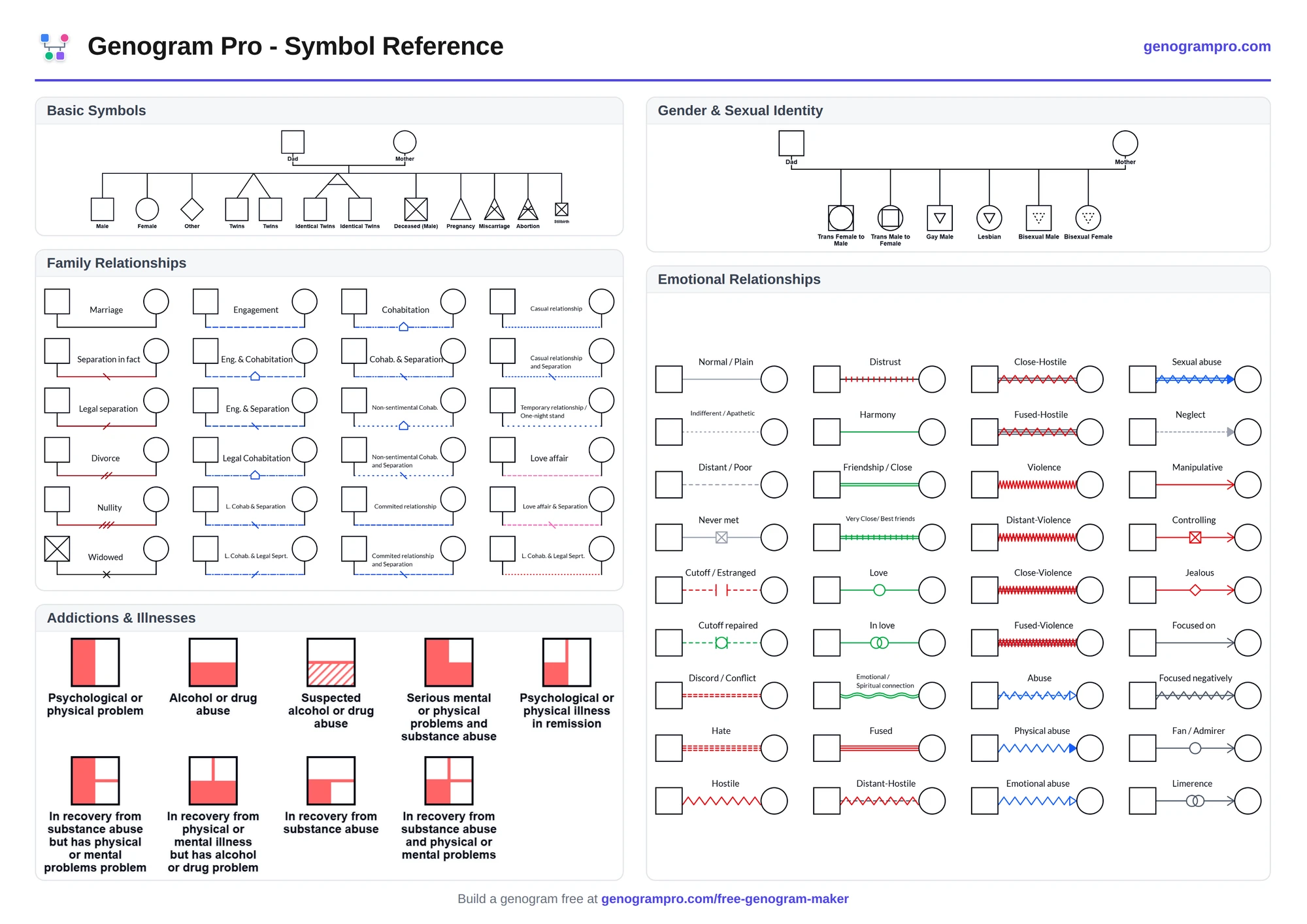
The complete reference for every genogram symbol - person shapes, life status indicators, 25 couple relationship lines, 4 parent-child types, and 39 emotional bond patterns. Based on the McGoldrick & Gerson standard notation.
Last updated September 2026. Based on McGoldrick et al., Genograms: Assessment and Treatment (4th ed., 2020)
One-page symbol reference
Every genogram symbol on a single sheet. Download the printable PDF or the high-resolution PNG.

Prefer to learn by doing? Open the free genogram maker and place these symbols on a canvas as you read.
Still choosing a tool? See how the best genogram software compares on notation support and clinical features.
Need just the legend? Print the printable genogram key or start from one of the blank genogram templates.
Genogram Symbols at a Glance
A genogram uses a small set of standard shapes and lines. Squares and circles are people, horizontal lines connect couples, vertical lines connect parents to children, and colored lines show the emotional quality of a relationship. The chart below is a quick lookup; every symbol and its variants are explained in full further down.
| Symbol | What it means |
|---|---|
| Square | A male |
| Circle | A female |
| Diamond | Unknown or non-binary gender (also used for pets) |
| X through the shape | A deceased person |
| Highlighted / double-lined shape | The index person, the focus of the genogram |
| Triangle | A pregnancy |
| Solid horizontal line | Marriage |
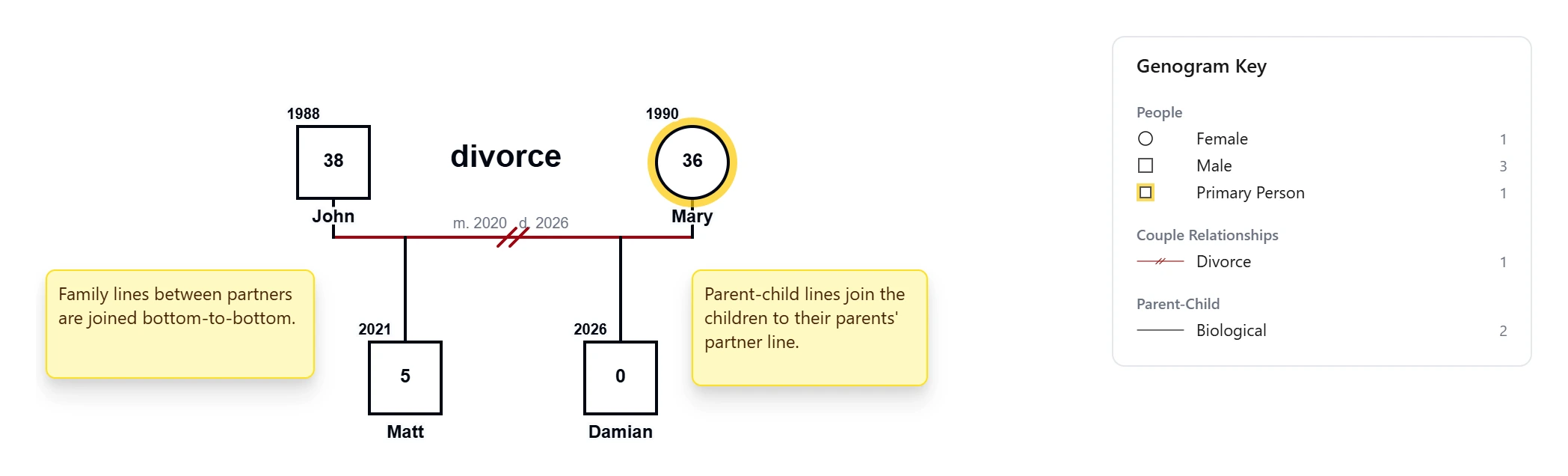
| Horizontal line with two slashes | Divorce |
| Horizontal line with one slash | Separation |
| Dashed horizontal line | Cohabitation or unmarried partnership |
| Solid vertical line | A biological child |
| Dashed vertical line | An adopted child |
| Two children on a shared peak | Twins |
| Green line | A close or positive relationship |
| Red line | Conflict or hostility |
| Three parallel lines | A fused or enmeshed relationship |
| Broken line with two bars | Emotional cutoff or estrangement |
Person Symbols
Every person on a genogram is represented by a shape that encodes their gender. These shapes are the first things you place when building a genogram, and every relationship line, life event marker, and condition indicator connects to them.
Basic Shapes
The three base shapes represent identified gender. Males go on the left of couple pairs, females on the right.
Male
Conventionally placed on the left of couple pairs.
Female
Conventionally placed on the right of couple pairs.
Unknown / Other
Used when gender is unknown, non-binary, or unspecified. Also used for pets.
Transgender Symbols
The outer shape represents identified gender and the inner shape represents biological sex. A square with an inner circle means this person identifies as male and was assigned female at birth.
Trans Male
Square (identified male) with inner circle (biological female).
Trans Female
Circle (identified female) with inner square (biological male).
Sexual Orientation
A small triangle inside the person symbol indicates non-heterosexual orientation. A solid triangle means homosexual, a dashed triangle means bisexual (McGoldrick, 4th ed., p. 65).
Gay Male
Square with solid triangle.
Lesbian
Circle with solid triangle.
Bisexual Male
Square with dashed triangle.
Bisexual Female
Circle with dashed triangle.
Life Status Indicators
Life status indicators are markers added to person shapes to show whether someone is alive, deceased, or unborn. An X drawn through the shape means that person has died.
Alive
Empty (unfilled) person symbol.
Deceased
X drawn through the person symbol. Birth and death dates noted nearby.
Pregnancy
Small triangle shape, placed as a child.
Stillbirth
Smaller person symbol with X overlay.
Abortion
Small triangle with a horizontal dash.
Miscarriage
Small filled circle or X on the parent-child line.
Dates and Age on Symbols
Birth year, death year, and age are recorded directly on or near person symbols. Couple relationship lines can also carry date labels (e.g., the year of marriage or divorce).
Birth and Death Years
Birth year appears above the person symbol on the left. For deceased individuals, death year appears on the right, separated by a dash.
Living person with birth year
Deceased person with birth and death years
Deceased, birth year unknown
Age Display
When enabled, a person's current age (or age at death) appears centered inside the symbol. Age is calculated from the birth and death dates automatically.
Living male, age 65
Deceased female, age at death 62
Living female, age 30
Date Labels on Relationship Lines
Couple relationship lines can include date annotations. Marriage lines commonly show the wedding year (e.g., "m. 1997"), and divorce markers may show the year the marriage ended. These labels appear near the center of the couple line, making it possible to reconstruct a family's relationship timeline from the genogram alone.
Medical Condition Symbols
Medical conditions are shown by filling portions of the person symbol with colors. Each condition gets a unique color, and the symbol is divided into sections (halves, quarters) for multiple conditions. A color-coded legend is always included.
Medical Genogram SymbolsCouple Relationship Lines
Horizontal lines connecting partners. There are 25 couple types in 9 categories. Color tells you the legal status: black for marriage, blue for partnerships (engagement, cohabitation, dating), pink for affairs, red for separation and divorce markers, gray for unknown. The line pattern tells you formality - solid for the most formal, dashed for established, dotted for informal.
Marriage
Solid lines. Black for active marriage, red with slash markers for ended states.
Marriage
Default couple bond. Permanent legal union. Male placed left by convention.
Separation in Fact
Couple has physically separated without legal action. Still legally married.
Legal Separation
Court-recognized separation. Marriage not yet dissolved.
Divorce
Finalized legal dissolution of marriage.
Nullity
Annulment. Marriage declared legally void.
Widowed
Marriage ended by death of a spouse. No slash marks - ended by loss, not choice.
Engagement
Drawn as dashed blue lines with long dashes.
Engagement
Formal commitment to marry. Non-marriage partnership.
Engagement + Cohabitation
Engaged couple living together.
Engagement + Separation
Engaged couple who have separated.
Legal Cohabitation
Drawn as dashed blue with a dash-dot-dash pattern.
Legal Cohabitation
Registered partnership with legal recognition. Living together.
Legal Cohab. + Factual Sep.
Legally registered partners who have physically separated.
Legal Cohab. + Legal Sep.
Legally registered partners with court-recognized separation.
Cohabitation
Drawn as dashed blue with a dash-dot-dot-dot pattern and a house marker.
Cohabitation
Unmarried couple living together in a committed relationship.
Cohabitation + Separation
Cohabiting couple who have separated.
Non-Sentimental Cohabitation
Drawn as dotted blue with wide spacing and a house marker.
Non-sentimental Cohabitation
Living together for practical reasons, not romantic partnership.
Non-sentimental + Separation
Non-romantic cohabitants who have separated.
Committed Relationship
Drawn as dashed blue with medium-length dashes.
Committed (Long-term)
Long-term committed partnership without cohabitation or marriage.
Committed + Separation
Long-term committed couple who have separated.
Dating
Drawn as dotted blue with close spacing.
Casual Relationship / Dating
Informal romantic relationship.
Dating + Separation
Dating relationship that has ended.
Casual / Affair
Temporary relationships and affairs. Affairs use pink to stand out.
Temporary / One-night Stand
Brief or one-time sexual encounter.
Love Affair
Extramarital or secret romantic relationship.
Love Affair + Separation
Affair that has ended.
Other
Rape / Force
Non-consensual sexual contact. Forced relationship.
Other / Unknown
Relationship type unknown or does not fit standard categories.
Parent-Child Lines
Vertical lines from the couple's family bar downward to children.
Biological
The child's genetic parent. Solid line - the default when no other type is specified.
Adoptive
Legally adopted. Dashed line - permanent but not biological.
Foster
Temporary placement. Dotted line - the child may move to another home.
Other / Unknown
Parent-child relationship of unknown or non-standard type.
Emotional Bond Lines
Lines between any two people showing how they actually get along - not their legal relationship, but the emotional reality. In McGoldrick's framework, relationships fall on a continuum from emotional distance, conflict, and cutoff at one end to closeness and fusion at the other. 39 bond types in 11 categories. Color tells you the tone (green = positive, red = conflict, blue = abuse, gray = neutral). More lines means more intensity. Markers like arrows, circles, and zigzags add specifics.
Neutral
Gray lines indicate a relationship that exists but carries nothing particularly warm or hostile about it, like two relatives who exchange Christmas cards but never call.
Plain / Normal
Single solid gray line.
Indifferent
Dotted gray, wide gaps.
Distant
Dashed gray line.
Never Met
Solid gray with X-box marker.
Disconnection
A line broken by gaps - someone deliberately cut off contact. An uncle who has not spoken to his mother in ten years and refuses to attend family holidays is in cutoff, not just distance.
Cutoff / Estranged
Deliberately stopped all contact. Not just drifting apart - one or both people decided to end the relationship.
Cutoff Repaired
Green segmented-cutoff with circle marker.
Conflict
Red lines. These people argue, resent each other, or are openly hostile. Discord means active tension - two sisters who fight at every family dinner. Hostile is more intense and persistent. Distrust is quieter - they do not fight, but neither believes a word the other says.
Discord
Active tension. They argue, disagree, or create stress when they interact.
Hate
Three parallel dashed red lines.
Hostile / Conflict
Ongoing antagonism. Not just arguments - they actively work against each other.
Distrust
Solid neutral line with red interval-cross markers.
Positive
Green lines. One line is basic goodwill - you get along fine. Two lines means genuinely close - you call each other when something happens. Three lines is the strongest, but be careful: three green lines means very close, while three red lines means fused (see Enmeshment below).
Harmony
Basic positive relationship. They get along and wish each other well.
Close / Friendship
Warm and connected, but each person still has their own life.
Very Close / Best Friends
Deep bond. They talk about everything and support each other, but neither depends on the other to feel okay.
Love
Solid green with circle marker.
In Love
Solid green with overlapping circles.
Spiritual Connection
Double wavy green lines.
Enmeshment
Three parallel solid red lines represent two people so entangled that one cannot function independently of the other. A mother who calls her adult son five times a day and falls apart if he does not answer is showing fusion: the boundary between two people has dissolved. Enmeshment is a core concept in Bowen family systems theory.
Fused
One person cannot feel okay unless the other feels okay. Boundaries have dissolved.
Hostile Variants
These combine proximity with hostility - people who are in each other's lives and fighting. Close-hostile is the couple who bicker constantly but spend every evening together. Fused-hostile is the "can't live with you, can't live without you" dynamic.
Distant-Hostile
Dashed gray + red zigzag overlay.
Close-Hostile
Double solid gray + red zigzag.
Fused-Hostile
Triple solid gray + red zigzag.
Violence
A tight red zigzag indicates physical violence in the relationship. The proximity prefix (distant, close, fused) shows how entangled the people are beyond the violence itself, with fused-violence indicating that the relationship is severe and neither person can separate from the other.
Violence
Physical violence in the relationship.
Distant-Violence
Dashed gray + red tight zigzag.
Close-Violence
Double gray + red tight zigzag.
Fused-Violence
Triple gray + red tight zigzag.
Abuse
Blue zigzag with an arrow pointing from the person doing harm toward the person being harmed. Different fill styles distinguish physical, emotional, and sexual abuse. Neglect uses gray instead of blue because it is passive - harm through absence rather than action.
Abuse (General)
Blue zigzag + dashed blue + hollow arrow.
Physical Abuse
Blue zigzag + filled blue arrow.
Emotional Abuse
Blue zigzag + hollow blue arrow.
Sexual Abuse
Blue zigzag + double blue lines + filled arrow.
Neglect
Dashed gray + filled gray arrow.
Control
Solid red with a chevron (arrow-like marker) pointing toward the person being controlled. Dad monitors every dollar Mom spends and checks her phone - that is controlling. A sibling who guilt-trips you into doing what they want - that is manipulative. Fearful of is drawn differently, as a dashed amber line with a filled arrow pointing at the person who is feared, like a child who is frightened of an aggressive stepparent.
Manipulative
Solid red + red chevron.
Controlling
Solid red + X-box + red chevron.
Jealous
Solid red + rhomboid + red chevron.
Fearful Of
Dashed amber + filled amber arrow.
Focused
Gray lines with a chevron. One person is preoccupied with the other, not necessarily in a negative way. A grandmother who talks about her favorite grandson constantly is "focused on." A parent who fixates on everything their teenager does wrong is "focused on negatively." Caretaker is the exception: a green line with a double arrow pointing to the person being cared for, like an adult daughter looking after her aging father.
Focused On
Solid gray + gray chevron.
Focused On Negatively
Gray zigzag + solid gray + chevron.
Caretaker
Solid green + double arrow toward the person cared for.
Fan / Admirer
Solid gray + circle + chevron.
Limerence
Solid gray + overlapping circles + chevron.
Other
Other
Solid gray + question-box marker.
How to Read a Genogram
This reading order matters because a visually striking emotional line can distract from a simpler structural fact, like a divorce, remarriage, or adoptive connection, that explains the family context more directly.
Example: Reading a Family Genogram
Try applying the three steps to the genogram below before reading the walkthrough.
- Structure. Three generations are visible. The top row has two couples: Charles and Dorothy (divorced in 2004, note the slashes), Charles remarried to Evelyn (married 2007), and Arthur and Beatrice (married, Arthur deceased indicated by the X through his symbol). The middle row shows Henry and Fiona (married), plus George. The bottom row has four children: Ian, Julia, Kevin, and Lydia (a pregnancy, shown as a triangle).
- Patterns. Notice how relationship difficulty concentrates around Henry. He has a hostile bond (red zigzag) with his father Charles and a fused bond (triple red lines) with his mother Dorothy. Meanwhile Fiona has a close bond (double green lines) with her mother Beatrice but a cutoff (broken red line) with her brother George. The emotional intensity in one generation connects to the divorce in the generation above.
- Color and detail. Green lines between Fiona and Beatrice indicate warmth. Red lines between Henry and his parents signal trouble: the zigzag with Charles means active hostility, while the triple parallel lines with Dorothy mean fusion (enmeshment). The red dashed break between Fiona and George is a cutoff, meaning they have deliberately stopped contact.
Deep Dives
Specific family situations explained step by step - how to draw them, common mistakes, and real-world examples:
How to show adopted children, biological parents, and blended adoption scenarios.
Representing divorce, separation, remarriage, and blended family structures.
What enmeshment means, how it appears on a genogram, and clinical significance.
Emotional cutoff in Bowen theory, cutoff-repaired, and clinical use.
How to represent identical twins, fraternal twins, and multiples.
Frequently Asked Questions
What is a genogram and what is it used for?
What are the basic genogram symbols?
What do genogram relationship lines and colors mean?
What are the symbols for a genogram?
What is a 3 generational genogram?
Is a genogram a family tree?
What is the easiest way to draw genogram symbols?
Ready to Create Your Own Genogram?
Build professional genograms online with standard notation, AI-powered generation, and end-to-end encryption.