
Genograms in social work
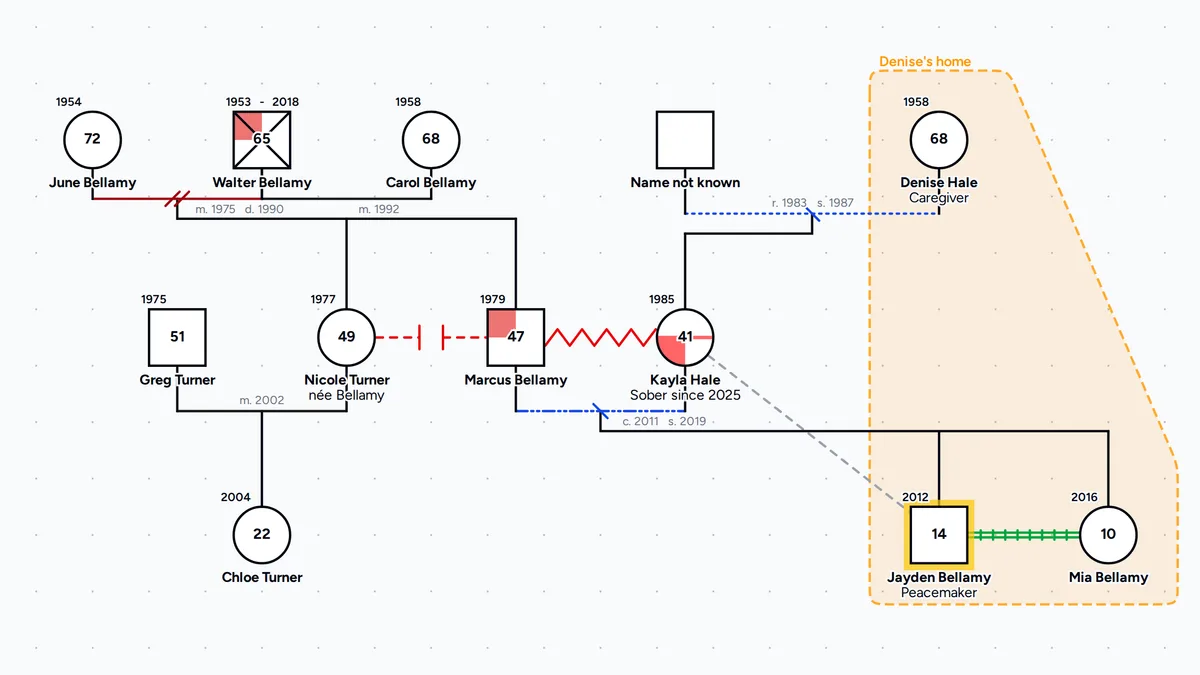
This page shows a social work genogram of the Bellamy family, three generations around Jayden, 14, and his sister Mia, 10, who have lived with their grandmother Denise Hale since 2024. It also shows the ecomap of the same household and what two published social work genogram assignments include.
Updated October 2026Based on McGoldrick et al., Genograms: Assessment and Treatment (4th ed., 2020)
Cite this diagram
Genogram Pro. (2026, October 23). Genograms in social work [Diagram]. https://genogrampro.com/genogram-for-social-work-students
Used by students at
- University College London
- Montclair State University
- Boston College
- Lancaster University
- Louisiana State University
- NC State University
- San Diego State University
- University of Hawaii
- Indiana University
Household
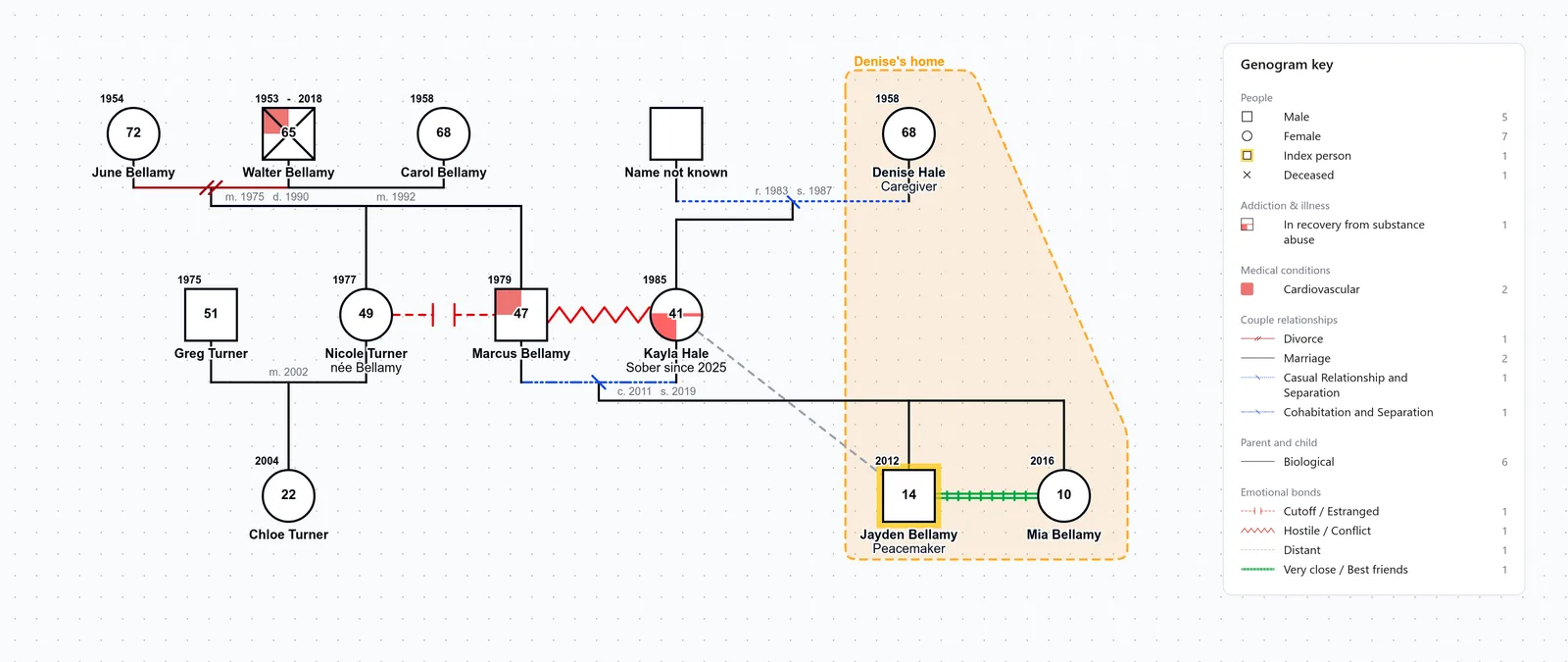
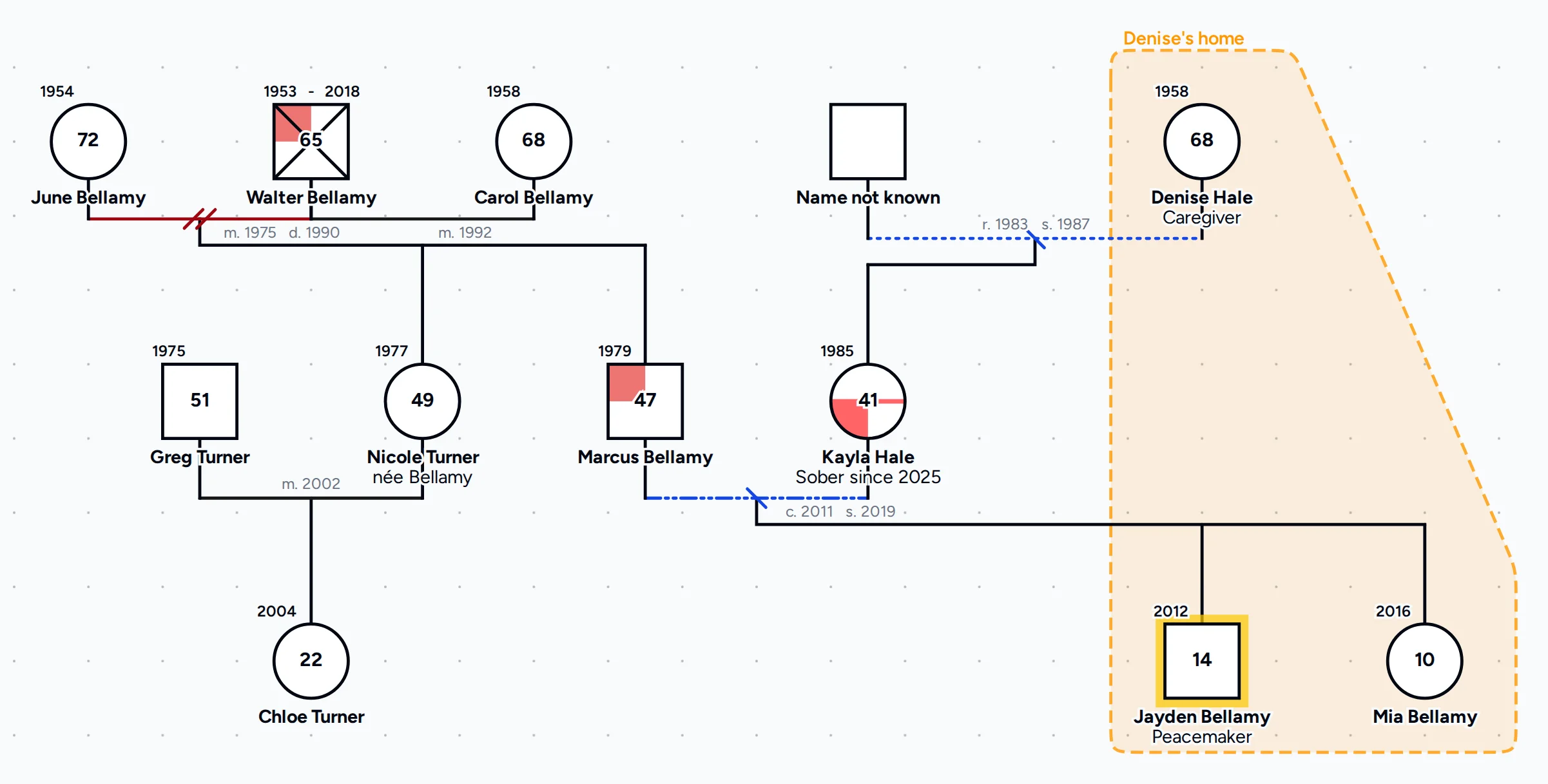
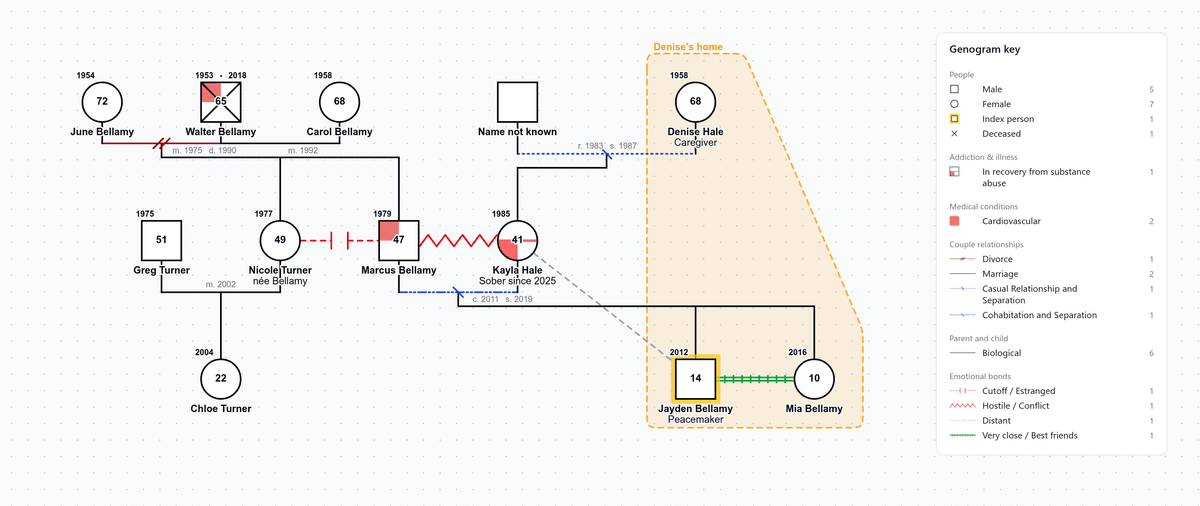
Denise, Jayden and Mia are drawn inside one outline labeled Denise's home, and the note under Denise's name is Caregiver.
Unknown grandfather
Kayla's father is drawn as a square labeled Name not known, with no birth year, so the gap in the family history is recorded too.
Recovery
Kayla Hale's circle is partly shaded for recovery from substance abuse, with the note Sober since 2025.
Cutoff
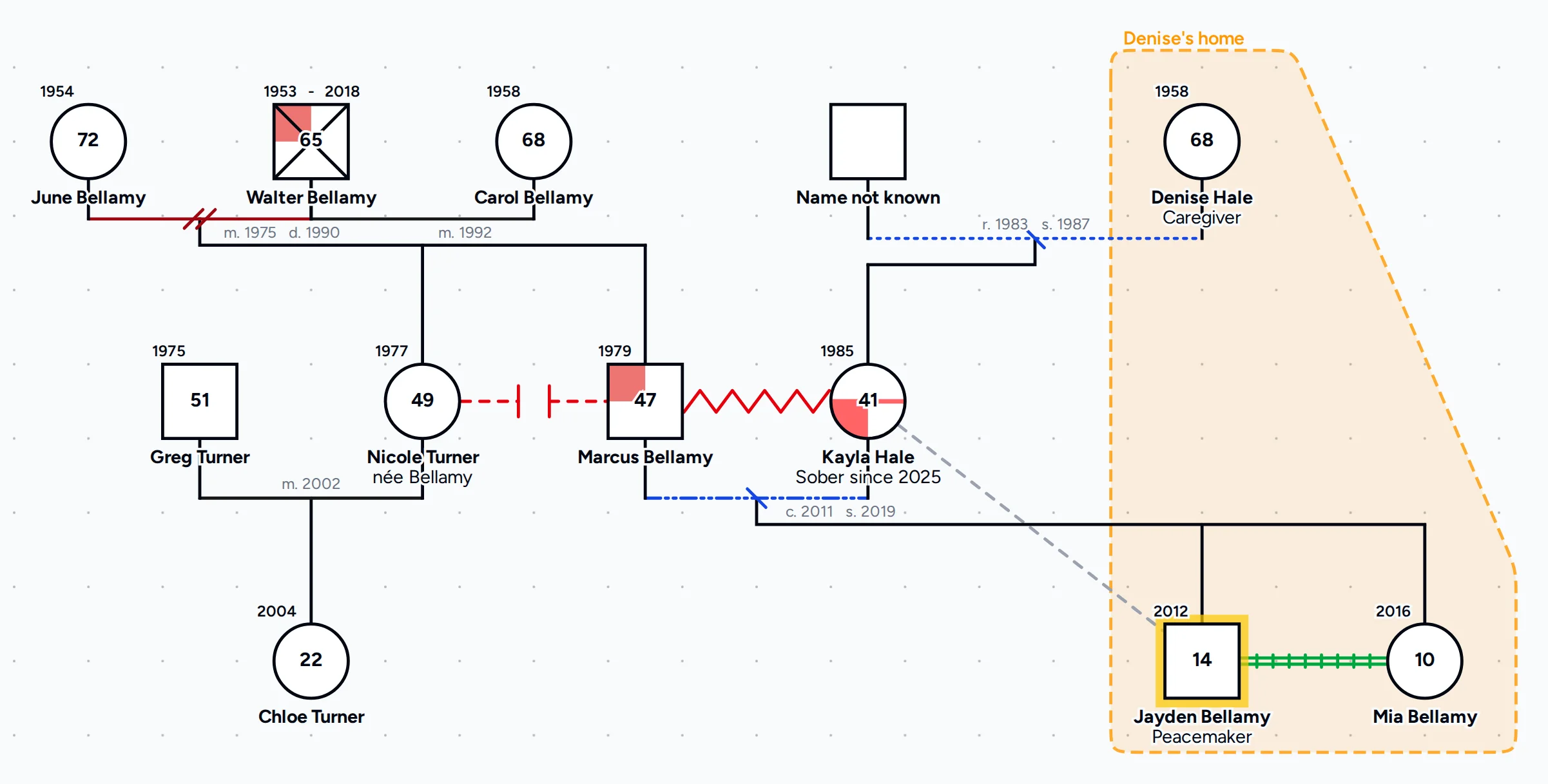
Marcus Bellamy and his older sister Nicole are drawn with a cutoff line.
Peacemaker
Jayden, the index person, has the note Peacemaker. His parents Marcus and Kayla are drawn with a hostile line, and Kayla and Jayden with a distant line.
What a genogram shows in social work
In social work, a genogram is a diagram of a client's family over at least three generations, drawn in standard genogram symbols, with lines for partnerships, separations and children, and other lines for how close or distant people are. Social workers draw genograms in child welfare, hospital discharge planning, schools and family casework to see who is in the family, who cares for whom and what repeats from one generation to the next.
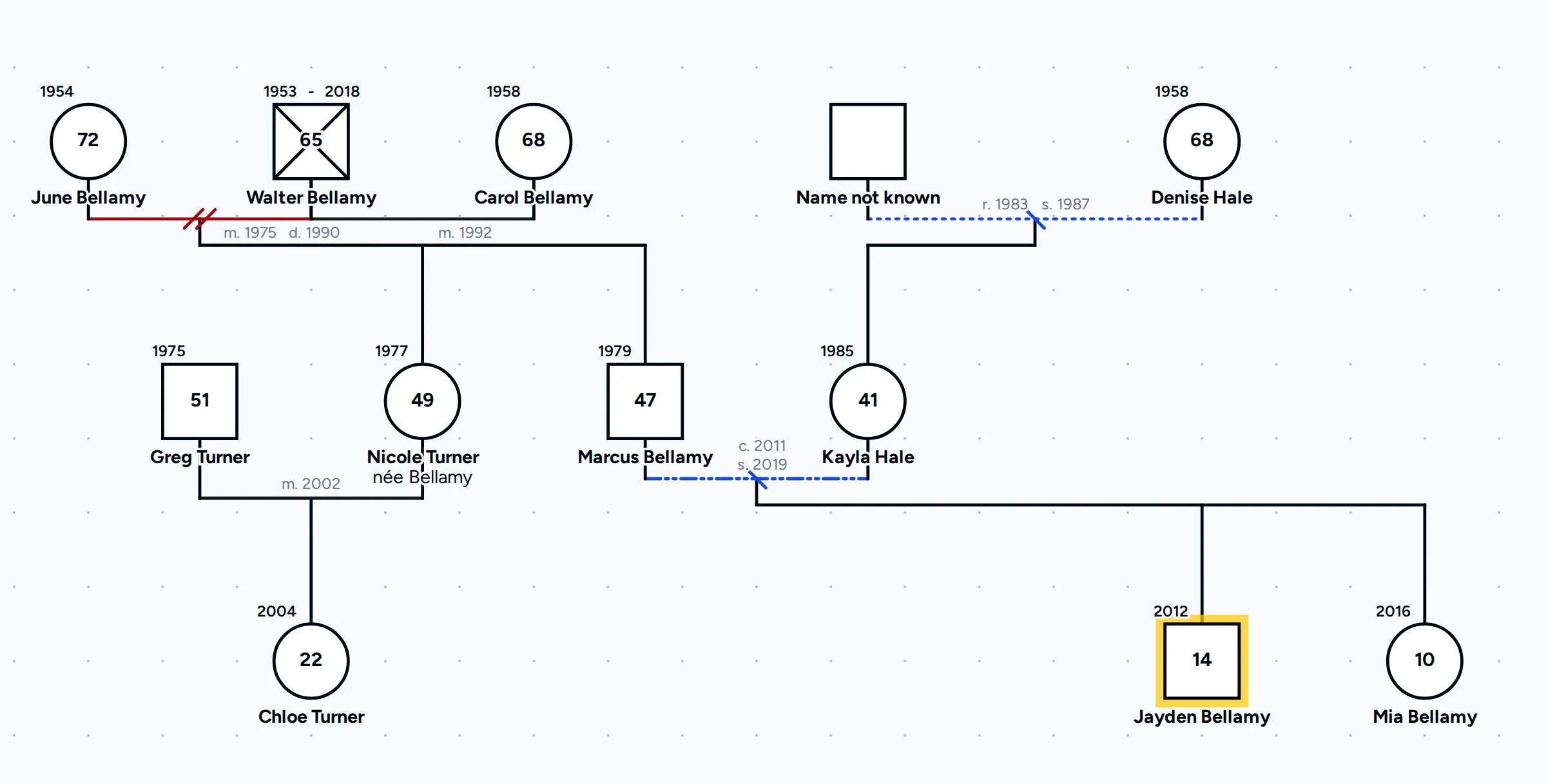
The Bellamy genogram is drawn for Jayden Bellamy, the index person. His parents Marcus Bellamy and Kayla Hale lived together from 2011 until they separated in 2019, and since 2024 Jayden and his sister Mia have lived with Kayla's mother, Denise Hale. Cardiovascular disease is recorded for his grandfather Walter, who died in 2018, and for his father Marcus. His mother Kayla has been in recovery from substance abuse since 2025.
The ecomap of the same household
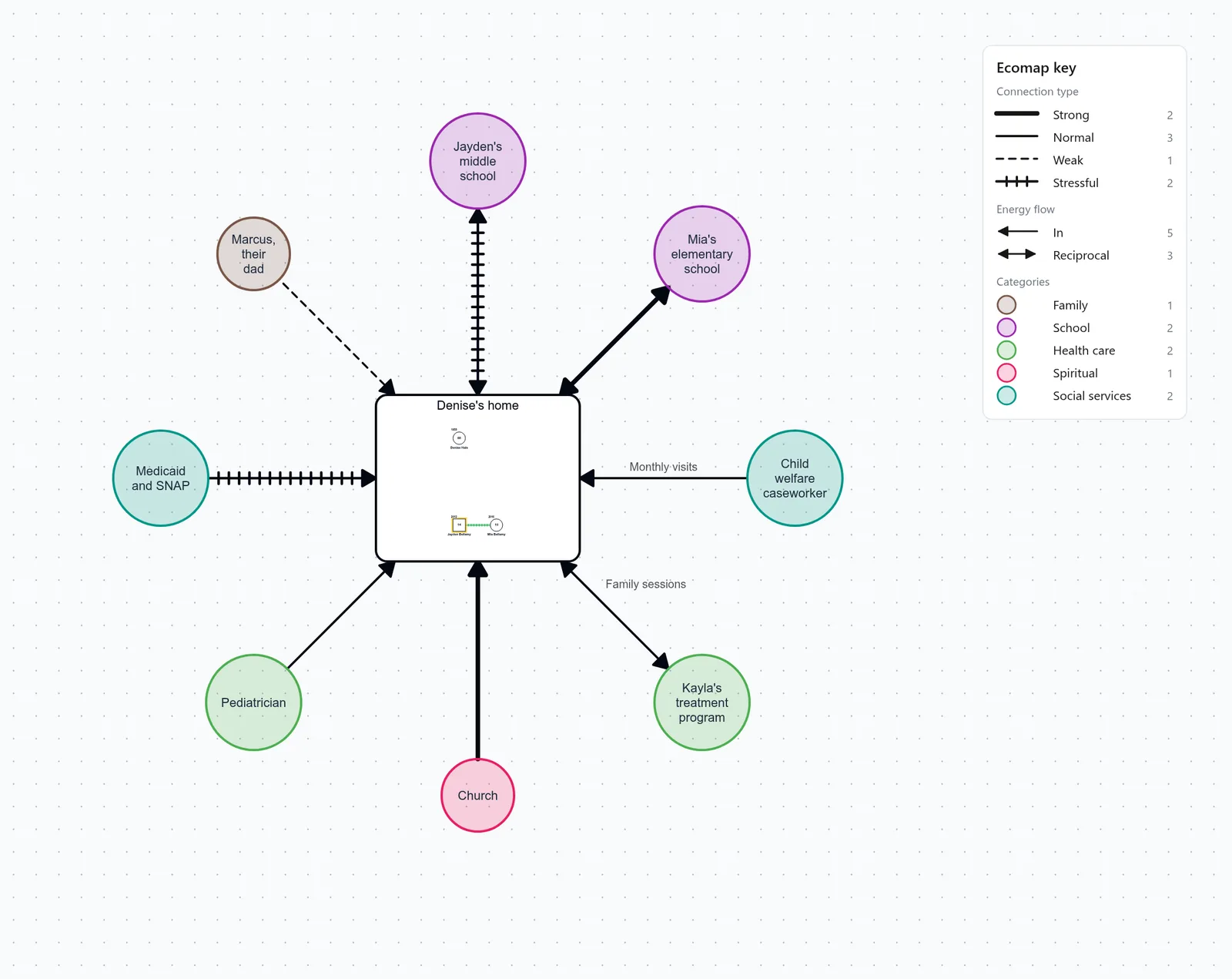
A genogram is drawn across generations of a family, and an ecomap is drawn for the household as it is now, with a circle for each system around it. The Bellamy ecomap has Denise's home at the center and eight systems around it, including the two schools and the child welfare caseworker. The lines to Jayden's middle school and to Medicaid and SNAP are stressful, the lines to Mia's elementary school and to church are strong, and the line to Marcus is weak.
Denise's home
The household is the center, with Denise, Jayden and Mia drawn inside it.
Stressful lines
The lines to Medicaid and SNAP and to Jayden's middle school are hatched for a stressful tie.
Kayla's treatment program
The household and Kayla's treatment program are joined by a normal line labeled Family sessions.
Weak line
Marcus, the children's father, is drawn with a dashed weak line.
With the Professional plan, an ecomap can be kept in the same file as its genogram, and a household at the center is drawn with its family inside, as Denise's home is here. In the free ecomap maker, an ecomap is drawn on its own. The two diagrams are compared on the genogram vs ecomap page.
What genogram assignments include
Social work programs set their own genogram assignments. The items below are from two published course outlines, the 2019 outline for SW 4X03 Social Work with Families at McMaster University and the Fall 2021 syllabus for SOWK 3533 Practice I at Midwestern State University, with each course's own words in quotation marks.
- Three or more generations, with both family lines. Students are asked to draw "a three generational genogram" that "shows how the two family lines come together with your parents" (Midwestern State), and a genogram of "three, or more" generations (McMaster).
- A key for every symbol. The instruction is "Clearly identify the meaning of all the symbols used in the genogram" (McMaster), with symbols "identified in a legend" (Midwestern State).
- Health, emotional and social history. The genogram "should portray health, emotional and social histories", including "births, stillbirth, deaths, partnerships" and "occupations" (McMaster).
- Very close, conflicted and tenuous relationships. "Be sure to identify very close, conflicted and tenuous relationships" (Midwestern State).
- Roles as short notes. Students add "notes to identify critical roles (e.g., family hero, scapegoat, peacemaker, rescuer, clown)", which "should be brief and included on the genogram" (Midwestern State).
- Triangles and coalitions. Students "identify critical triangles and coalitions" with "a highlighter or grouping (identified in your legend)" (Midwestern State).
- Cutoffs and what is not known. Students show "cut-offs, secrets" and are reminded that "you may not know the history of all members of previous generations" (McMaster).
- A written summary or analysis. Students write "a brief summary (APA format) discussing what you learned from the genogram" (Midwestern State) or discuss "the most important patterns" in a written analysis (McMaster).
Which of these items you need depends on your own assignment sheet.
For social work students and practitioners
You can open the free genogram maker in the browser with nothing to install and no account, and export a PNG or PDF with a small Genogram Pro badge.
The Professional plan is paid and has a 7-day trial. With it, your genograms and ecomaps are encrypted and saved to your account, exports have no badge, and a genogram can be drafted by the AI assistant from a typed description of the family. Students at participating schools can get the Professional plan at no cost for a year. Sign up with your school email.
How to draw a social work genogram
Follow these steps to build the Bellamy genogram in the free genogram maker, starting with Jayden and his parents.
Draw Jayden's family
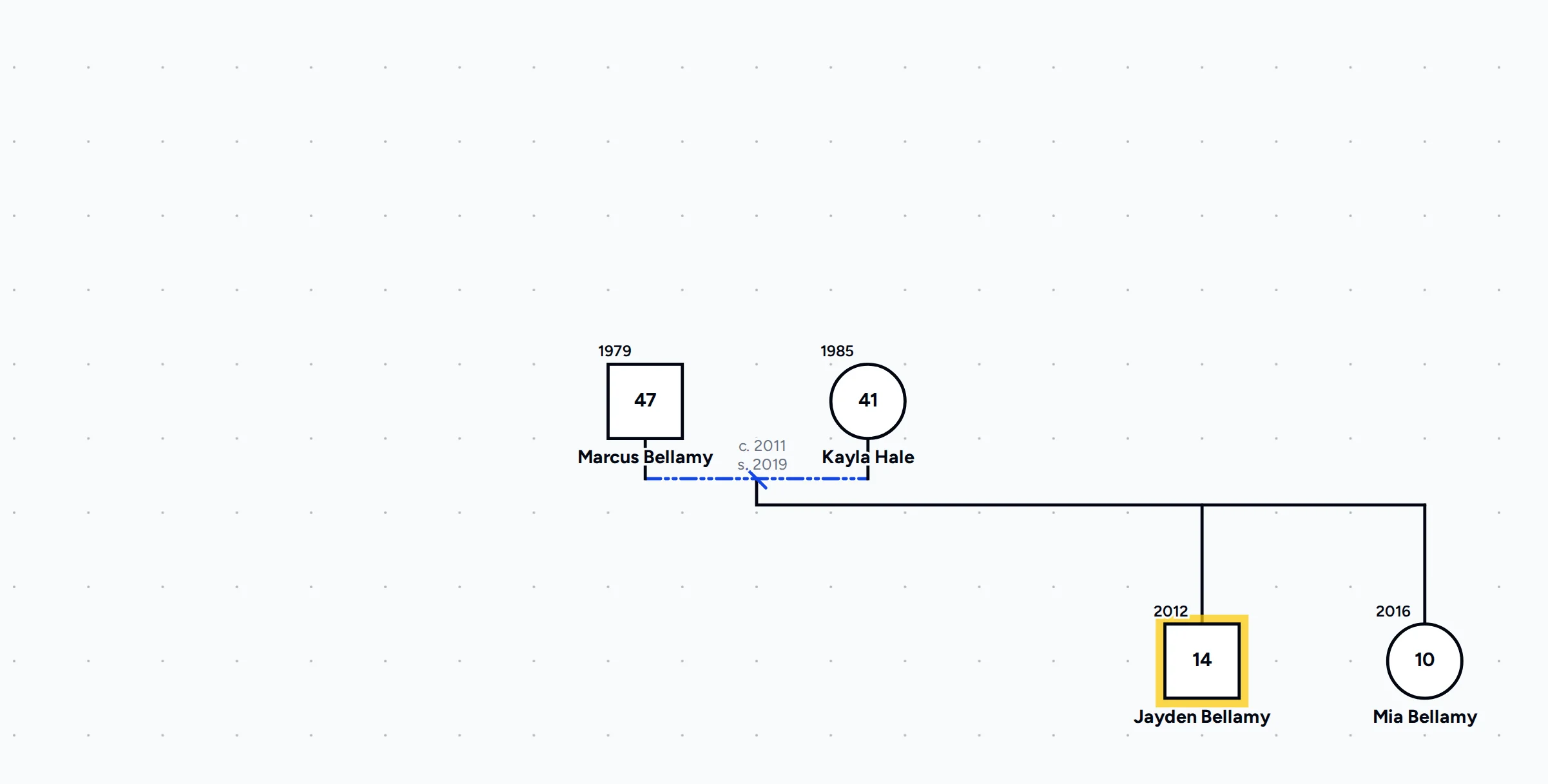
Add Jayden, born 2012, and click Toggle index person to give him a yellow outline. Add his parents Marcus Bellamy and Kayla Hale with a cohabitation line from 2011 that ends in a 2019 separation, then add his sister Mia, born 2016.
Add both parents' families
Add Marcus's parents Walter and June Bellamy, married in 1975 and divorced in 1990, and Walter's 1992 marriage to Carol. Then add Marcus's older sister Nicole with her husband Greg Turner and their daughter Chloe. Set Walter to Deceased with 2018 as his death year. On Kayla's side, add her mother Denise Hale and her father, with Name not known as his name and no birth year, on a casual relationship line from 1983 that ends in a 1987 separation.
Add the household, health history and notes
Select Denise, click Add to household and click Jayden, then add Mia to the same household and name it Denise's home. Add cardiovascular disease to Walter and Marcus and mark Kayla as in recovery from substance abuse. Then click Add property, name it Note, turn on Available on all people and Show in diagram, and type Caregiver for Denise, Sober since 2025 for Kayla and Peacemaker for Jayden.
Draw the relationship lines
Draw a cutoff line between Nicole and Marcus, a hostile line between Marcus and Kayla, a distant line between Kayla and Jayden and a very close line between Jayden and Mia, then export the genogram with the key.
Two common mistakes
Explain every line in a key
Without a key, a reader has to guess what the zigzag line between Marcus and Kayla means, and students in both courses above are asked to explain the meaning of every symbol.
Draw both parents' families
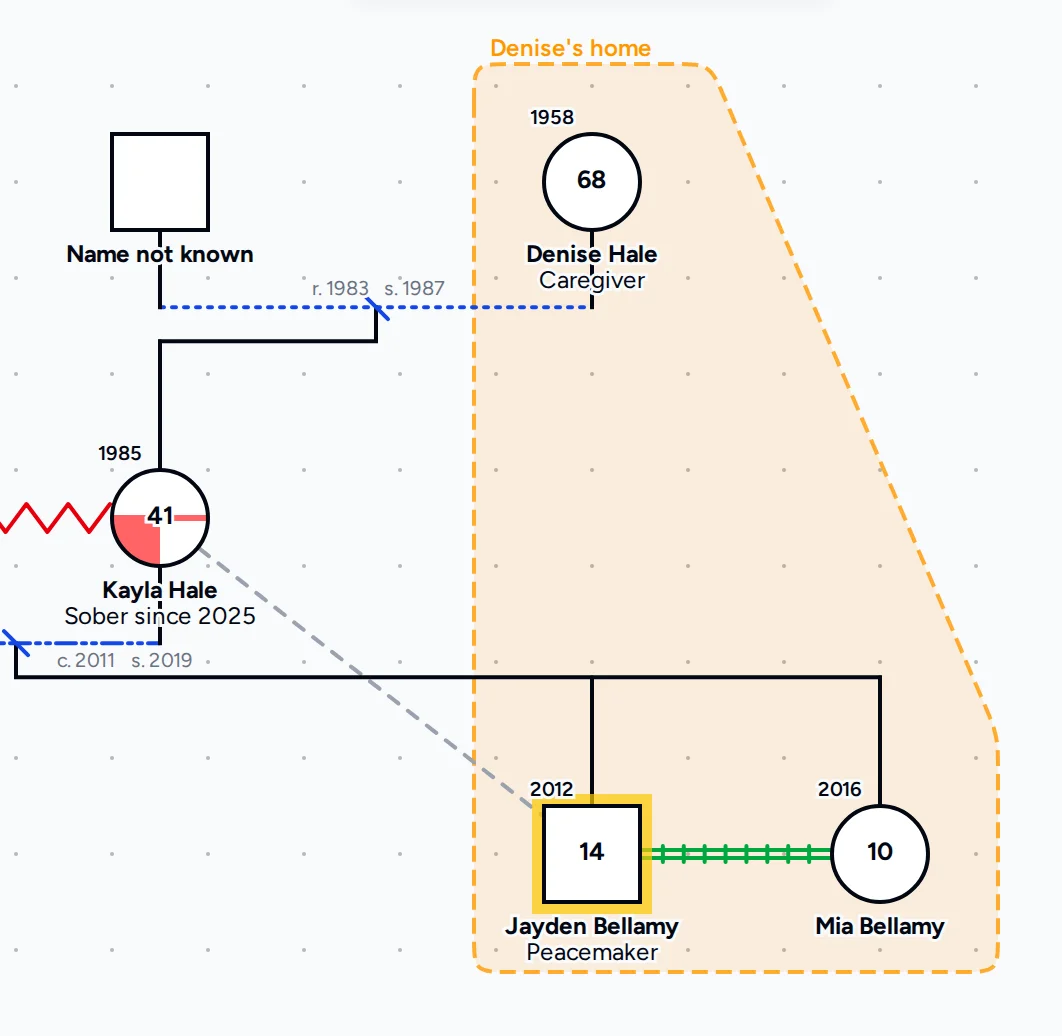
Draw both family lines so they meet at the parents, as students at Midwestern State are asked to do. In the common mistake, only Kayla's side is drawn, with her mother Denise and a father whose name is not known.
What you can add to a genogram for casework
Select a person, click Add to household and click each person who shares the home to draw an outline around them, such as Denise's home around Denise, Jayden and Mia. Each household has its own label and color.
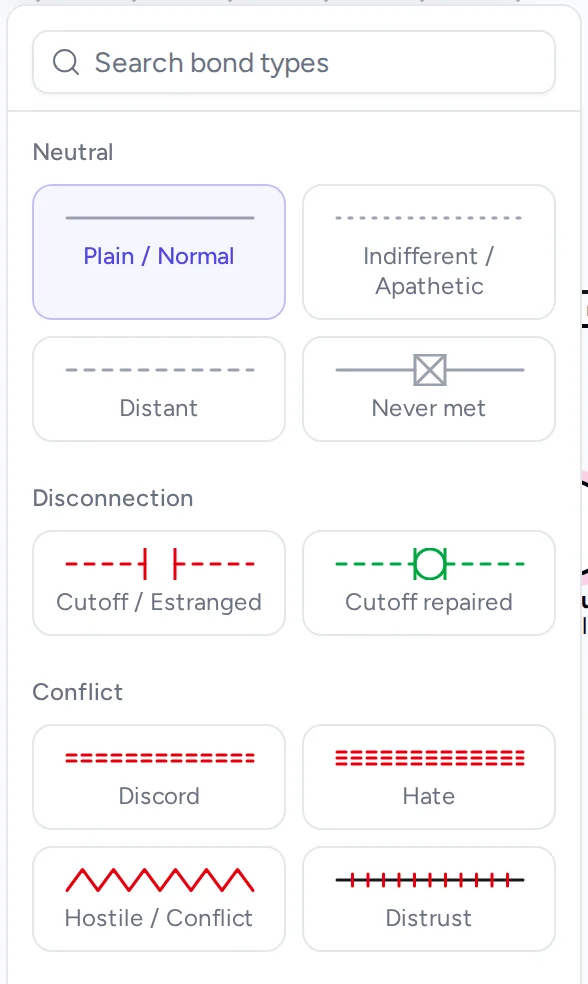
There are 39 bond line types in groups such as Neutral, Disconnection and Conflict, and you can search the list by name for a cutoff, a hostile line or a very close line.
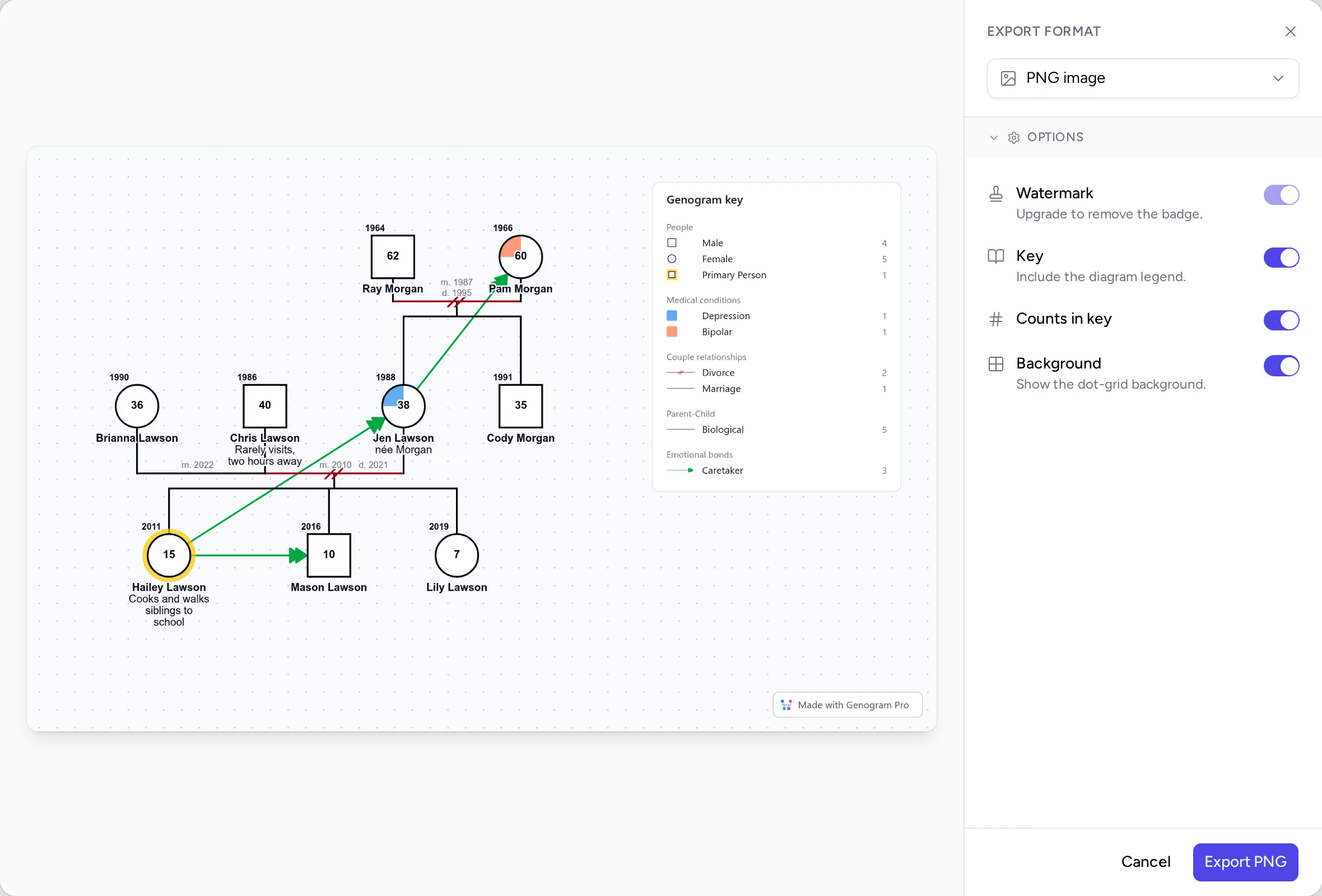
When you export a PNG or PDF, a key is added with only the symbols and lines on the genogram, so a reader can tell what a cutoff line or the recovery shading means.
Questions people ask
How do you do a genogram in social work?
Start with the index person and their brothers and sisters, add both parents' families back to the grandparents, then draw the household, the health history and the relationship lines, and add a key. On this page, the Bellamy genogram is built in that order in four steps, and the questions to ask the family about each generation are in the genogram questions guide.
Genogram questionsWhat is the difference between a genogram and an ecomap?
A genogram is drawn across at least three generations of a family, with a symbol for each person and lines for partnerships, children and relationships. An ecomap is drawn for one person or household as they live now, with a circle for each system around them, such as school, health care and social services.
Genogram vs ecomapWhat should a social work genogram include?
In the two course outlines on this page, students are asked for at least three generations with both family lines, a key for every symbol, and health, emotional and social history. They are also asked to show very close, conflicted and tenuous relationships, roles as short notes, and triangles and coalitions, and to write a summary or analysis. Which of these you need depends on your own assignment sheet.
Whose family can you use for a genogram assignment?
It depends on the course. In the McMaster outline, students may use "your own family, a family from your practice, or a friend's family", and for a family from practice "you must change all identifying information". In the Midwestern State syllabus, students are asked to draw their own family, from "your parents' parents" down to "yourself".
Is there a genogram template for social work?
Yes. You can open the Bellamy genogram as a template in the free genogram maker, and the genogram template page has blank 3 generation templates as PDF and Word files.
Genogram templatesIs Genogram Pro free for social work students?
The free genogram maker needs no account, and its PNG and PDF exports have a small Genogram Pro badge. The Professional plan is paid and has a 7-day trial, and students at participating schools can get it at no cost for a year. Sign up with your school email.
What symbols does a social work genogram use?
A social work genogram is drawn in the standard McGoldrick symbols, with a square for a male, a circle for a female, a horizontal line for a couple with one slash for a separation and two for a divorce, vertical lines down to children, and colored or patterned lines for relationships such as very close, distant, hostile and cutoff.
Genogram symbols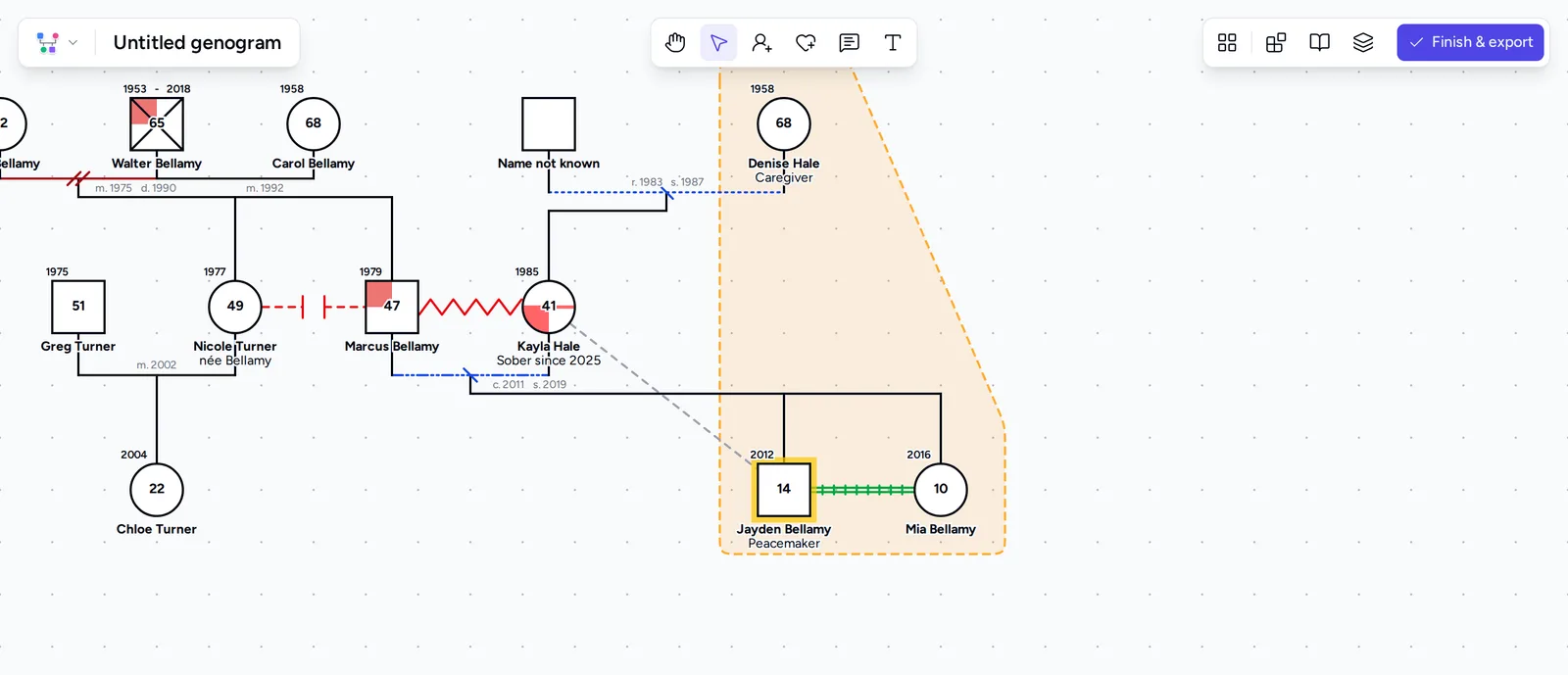
Start a social work genogram from the Bellamy family
Open it in the editor, swap in your own names and dates, and export it as a PNG or PDF.