
Ecomap examples
This page shows six ecomaps, for a family, a child in foster care, a teenager referred by her school counselor, an older adult home from the hospital, an adult in recovery from substance use and a family resettled as refugees.
Updated October 2026Notation follows Hartman, "Diagrammatic assessment of family relationships" (Social Casework, 1978)
Cite this diagram
Genogram Pro. (2026, October 21). Family ecomap [Diagram]. https://genogrampro.com/ecomap-examples
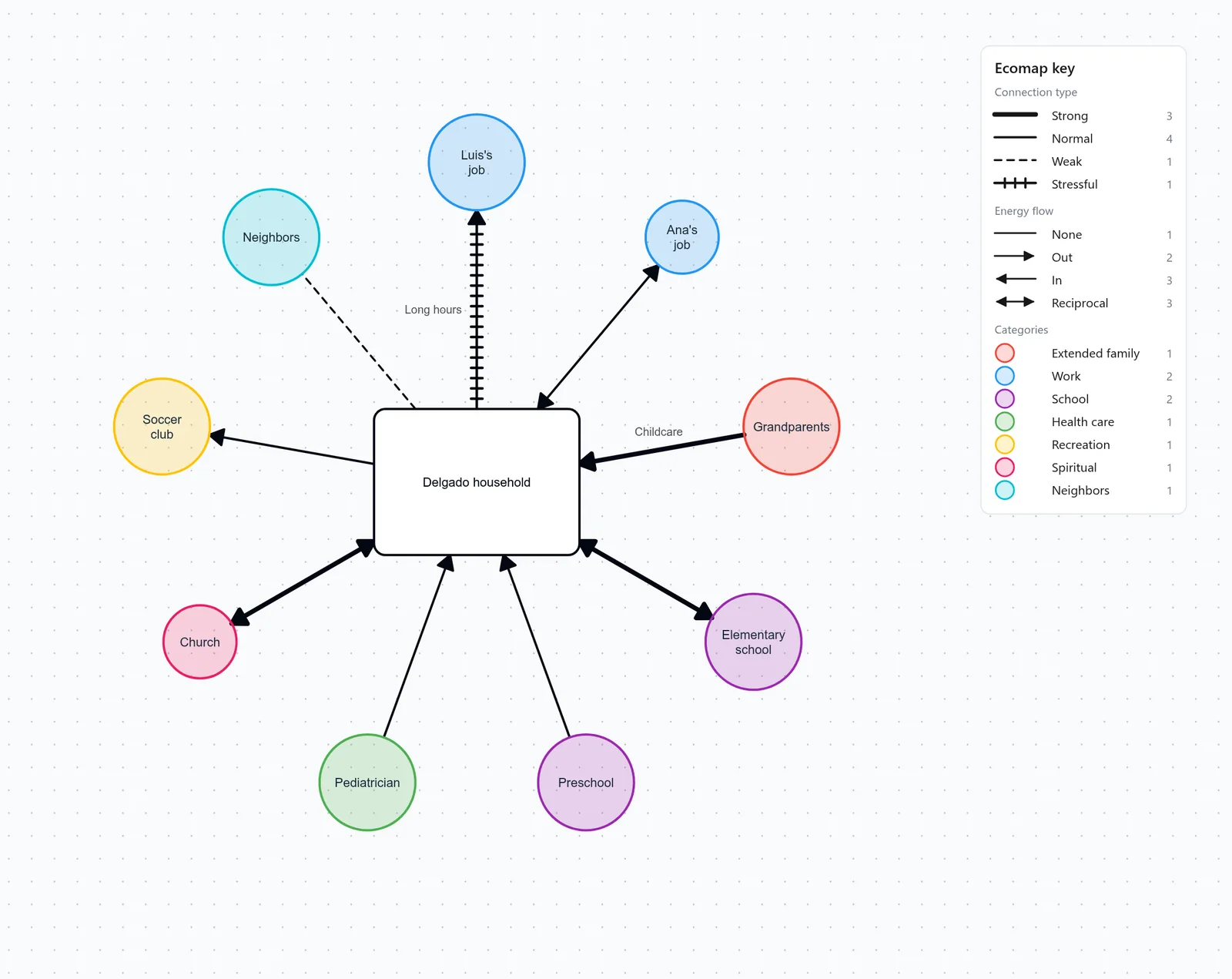
The household at the center
The whole family is the center, so every line is drawn from the household and not from one person.
Luis's job
A stressful line with the arrow pointing away from the family, because Luis works long hours and is rarely home.
Grandparents
A strong line with the arrow pointing in, because the grandparents look after Lucia while her parents work.
Neighbors
A dashed weak line with no arrow, because the family knows the neighbors only by sight.
Family ecomap
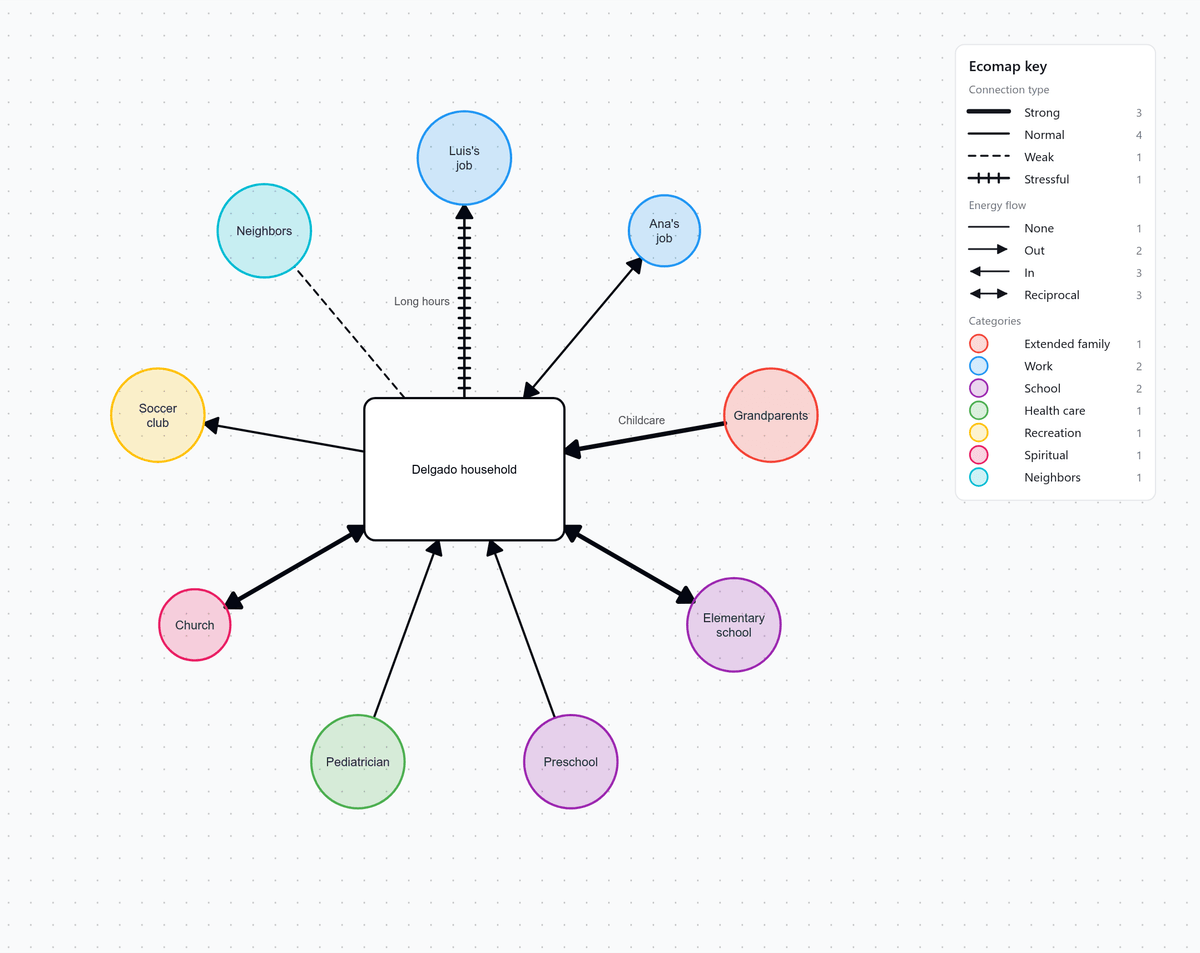
This family ecomap shows Luis and Ana Delgado and their children Sofia, 12, Mateo, 9, and Lucia, 4, with the nine systems around their household. The grandparents, the elementary school and the church are strong ties, and Luis's job is the one stressful tie.
| System | Line | Flow | Meaning |
|---|---|---|---|
| Luis's job | Stressful | Out | Luis works long hours. |
| Ana's job | Normal | Reciprocal | Ana works regular hours and earns a second income. |
| Grandparents | Strong | In | They look after Lucia four days a week. |
| Elementary school | Strong | Reciprocal | Sofia and Mateo are doing well, and both parents go to school events. |
| Preschool | Normal | In | Lucia goes three mornings a week. |
| Pediatrician | Normal | In | The children have regular checkups. |
| Church | Strong | Reciprocal | The family goes every Sunday, and Ana helps at the food pantry. |
| Soccer club | Normal | Out | Mateo plays, and the family spends weekends at games. |
| Neighbors | Weak | None | The family knows them only by sight. |
Ecomap for a child in foster care
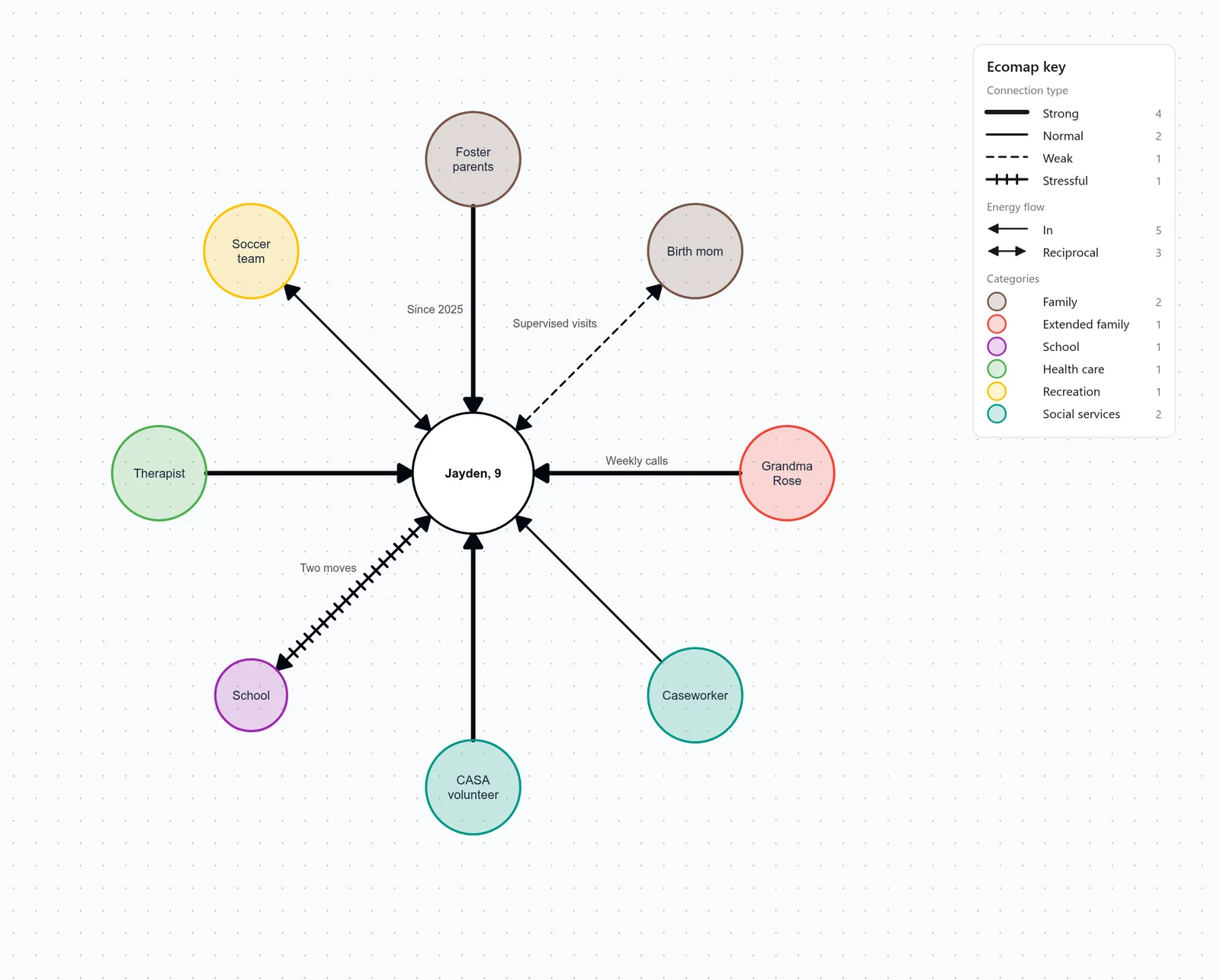
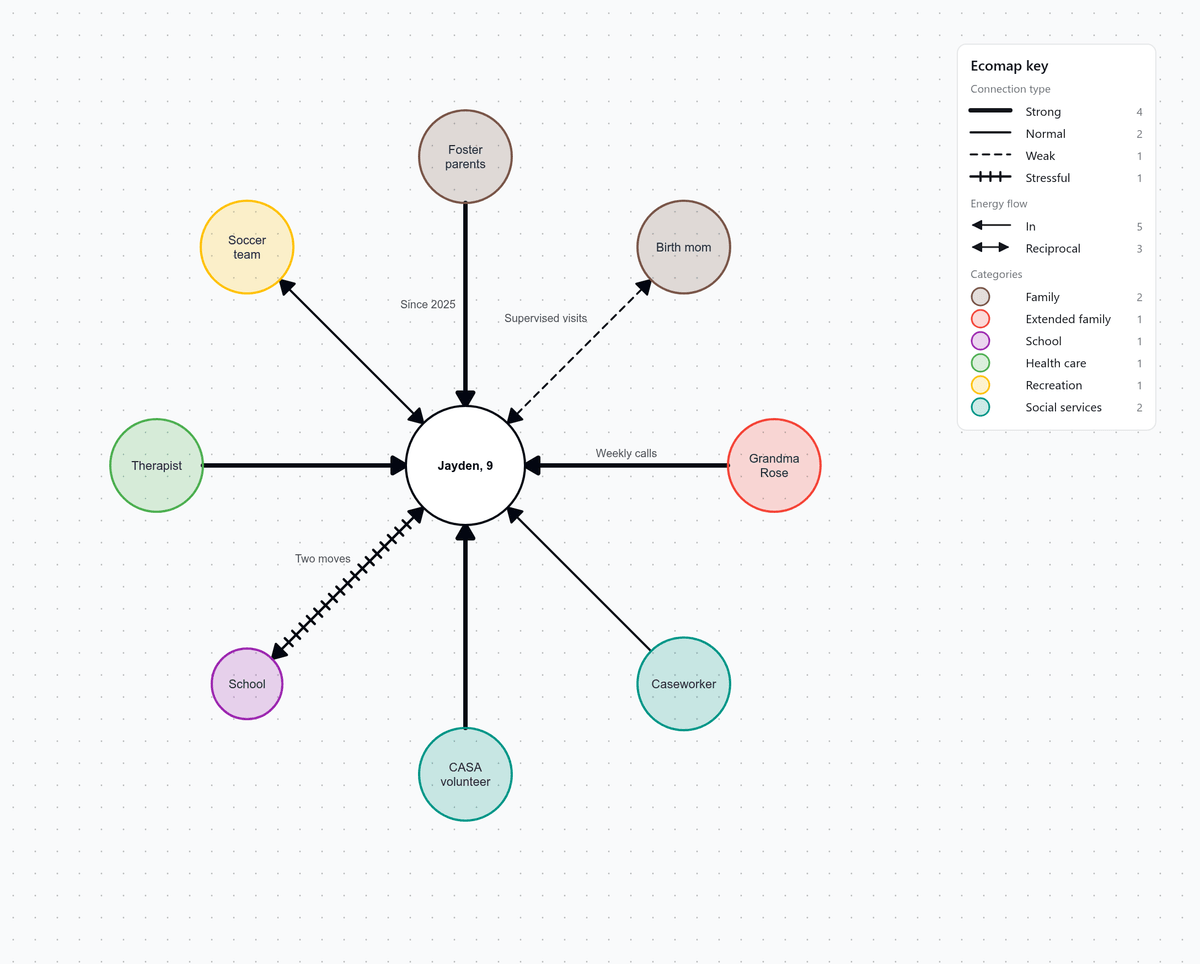
This ecomap shows Jayden, 9, who has lived with his foster parents since 2025 and sees his birth mom at supervised visits. He has strong ties to his foster parents, Grandma Rose, a CASA volunteer and his therapist, and a stressful one to school after two moves this year.
Birth mom
A weak line with arrows both ways, because contact with his birth mom is limited to supervised visits.
School
A stressful line with arrows both ways, because Jayden has changed schools twice this year.
CASA volunteer
A strong line with the arrow pointing in, because the court-appointed advocate is one of the steadiest adults in his life.
| System | Line | Flow | Meaning |
|---|---|---|---|
| Foster parents | Strong | In | Jayden has lived with them since 2025. |
| Birth mom | Weak | Reciprocal | They see each other at supervised visits twice a month. |
| Grandma Rose | Strong | In | She calls him every week. |
| Caseworker | Normal | In | She makes monthly home visits and reports to the court. |
| CASA volunteer | Strong | In | A court-appointed advocate visits him every week. |
| School | Stressful | Reciprocal | He has moved schools twice this year and is behind in reading. |
| Therapist | Strong | In | He has had weekly sessions since he entered care. |
| Soccer team | Normal | Reciprocal | He plays every Saturday. |
Cite this diagram
Genogram Pro. (2026, October 21). Ecomap for a child in foster care [Diagram]. https://genogrampro.com/ecomap-examples
Ecomap for a teenager referred by her school counselor
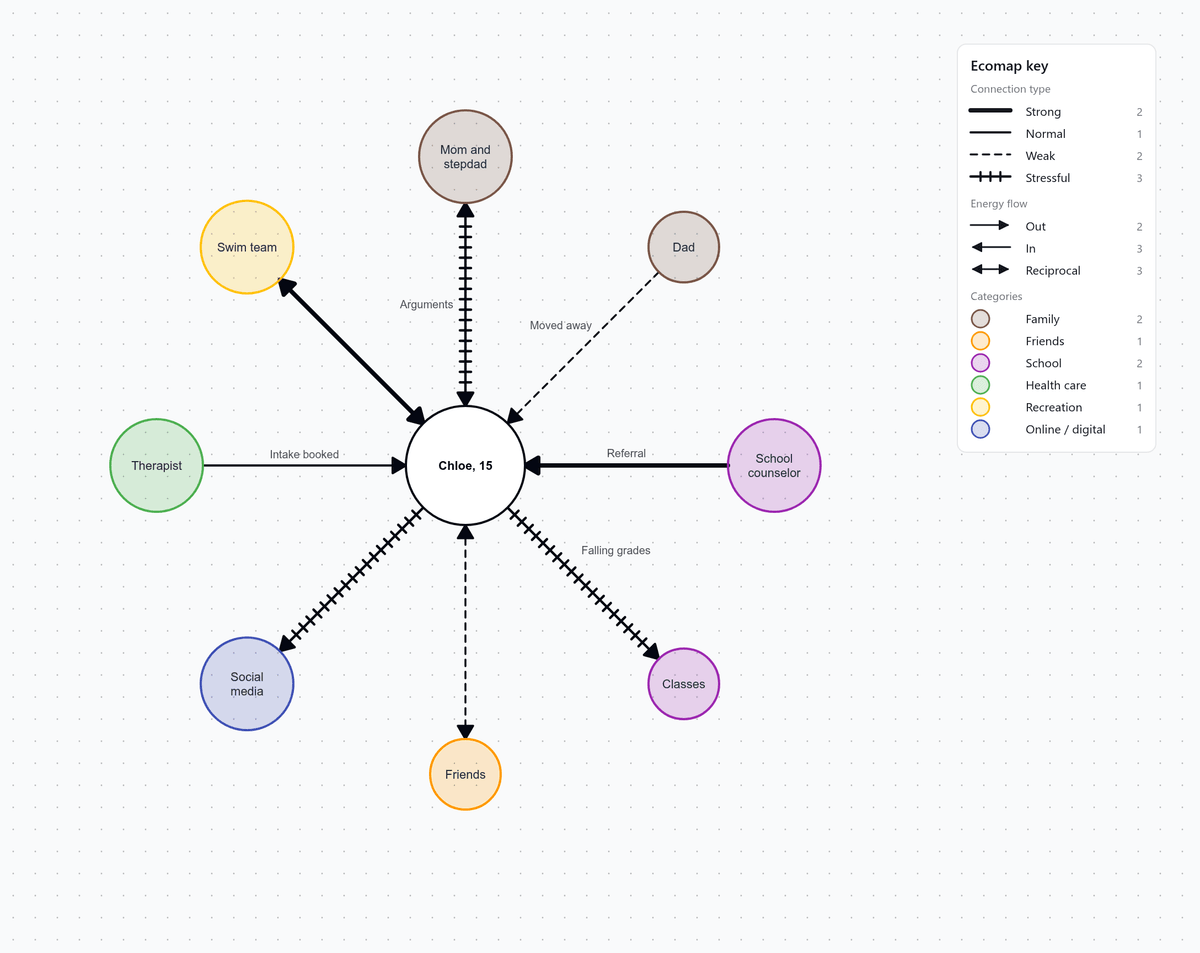
This ecomap shows Chloe, 15, after her school counselor referred her for therapy over falling grades and late nights online. The swim team and the counselor are her strong ties, and her mom and stepdad, her classes and social media are stressful.
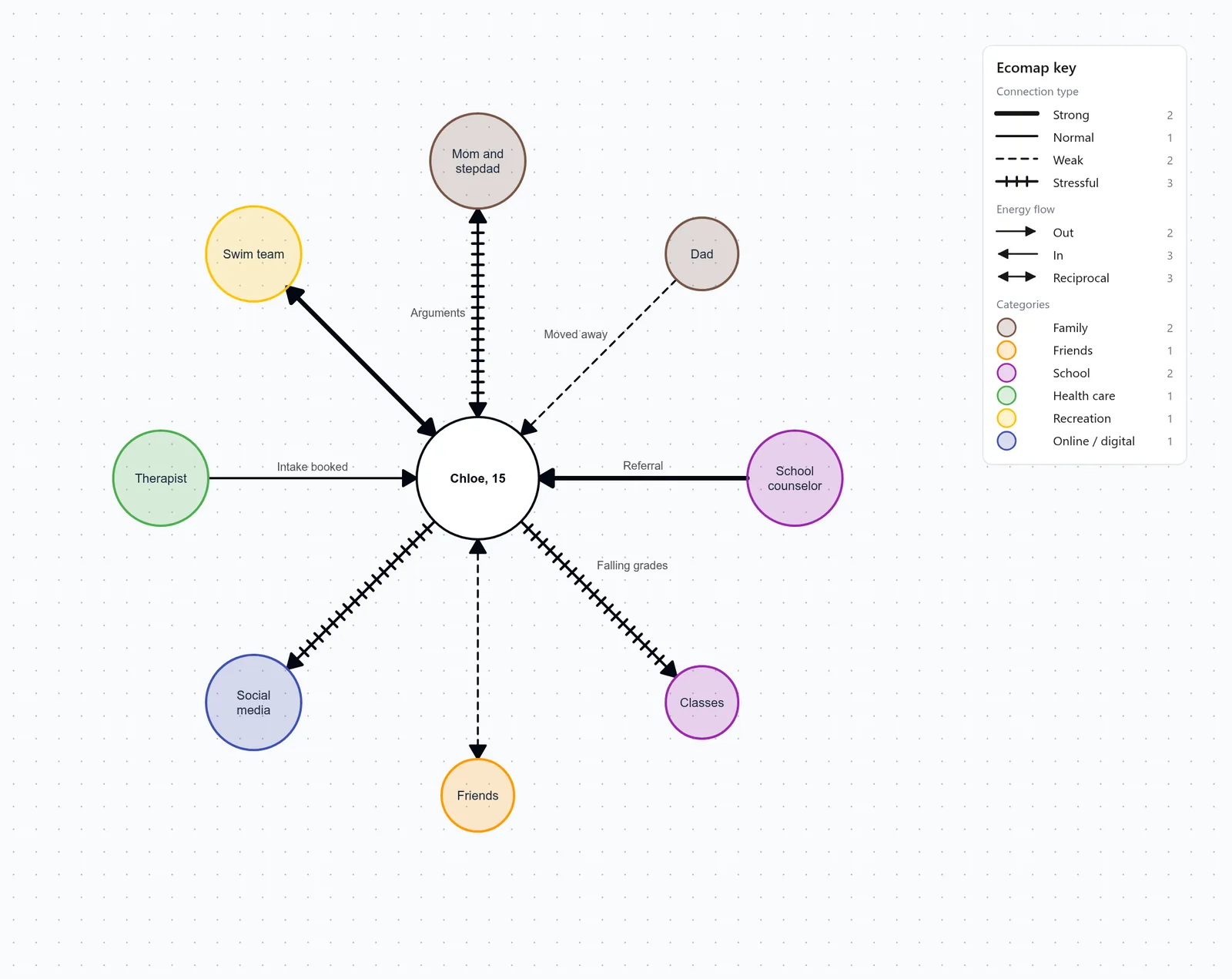
School counselor
A strong line with the arrow pointing in, because the counselor noticed that Chloe was struggling and made the referral.
Social media
A stressful line with the arrow pointing away, because Chloe puts hours into it every night.
Swim team
A strong line with arrows both ways, because practice is the one place where she still feels good.
| System | Line | Flow | Meaning |
|---|---|---|---|
| Mom and stepdad | Stressful | Reciprocal | They argue with Chloe every day about grades and curfew. |
| Dad | Weak | In | He moved to another state and calls now and then. |
| School counselor | Strong | In | She made the referral and checks in every week. |
| Classes | Stressful | Out | Her grades have dropped since spring. |
| Friends | Weak | Reciprocal | She has drifted away from her old friends. |
| Social media | Stressful | Out | She is online until late most nights. |
| Therapist | Normal | In | Her intake appointment is booked. |
| Swim team | Strong | Reciprocal | She practices four days a week and likes her coach. |
Cite this diagram
Genogram Pro. (2026, October 21). Ecomap for a teenager referred by her school counselor [Diagram]. https://genogrampro.com/ecomap-examples
Ecomap for an older adult after hospital discharge
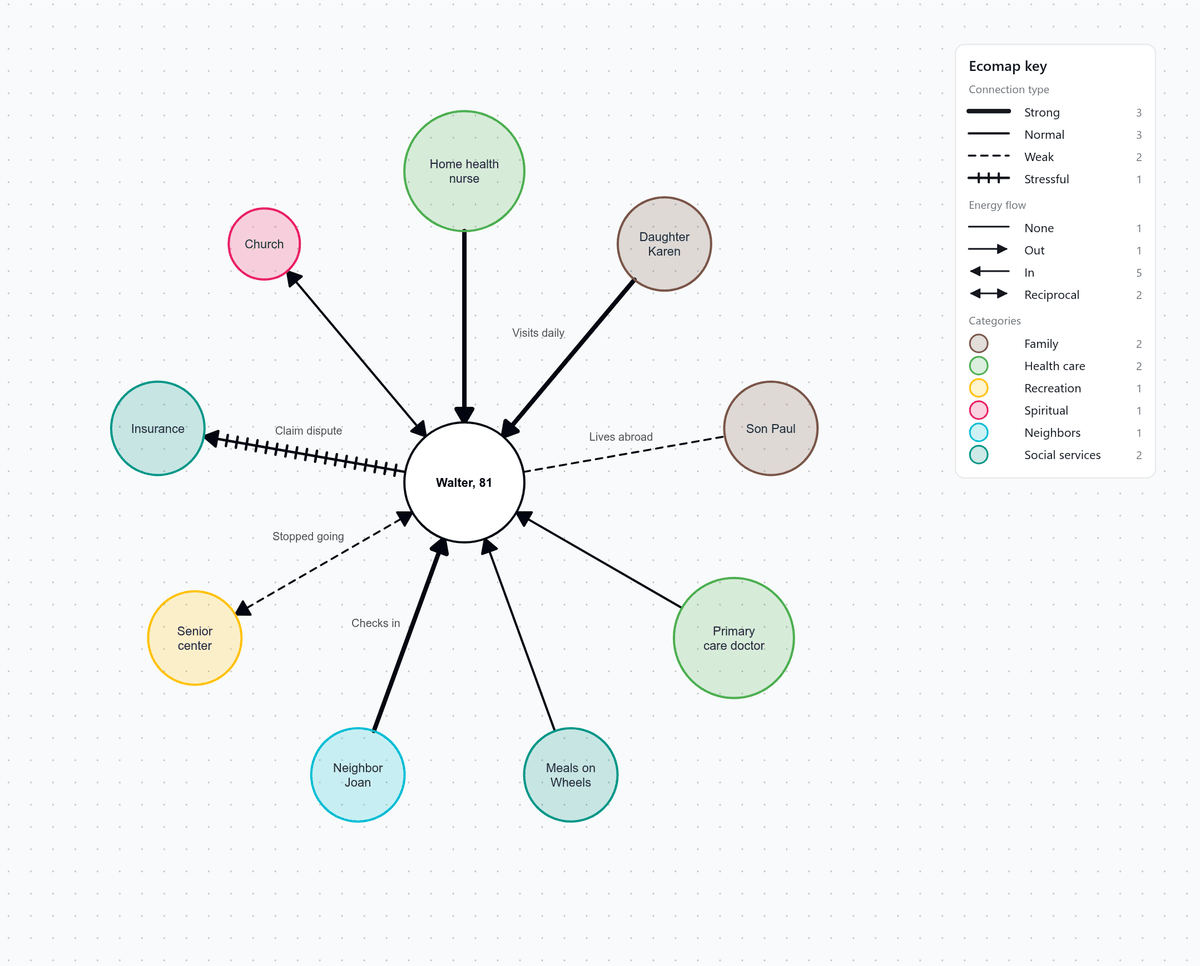
This ecomap shows Walter, 81, at home after a hospital stay for a fall, with most of his support from his daughter Karen, a home health nurse and his neighbor Joan. His son lives abroad and he has stopped going to the senior center, so both of those ties are weak, and his one stressful tie is to his insurance, over a disputed claim.
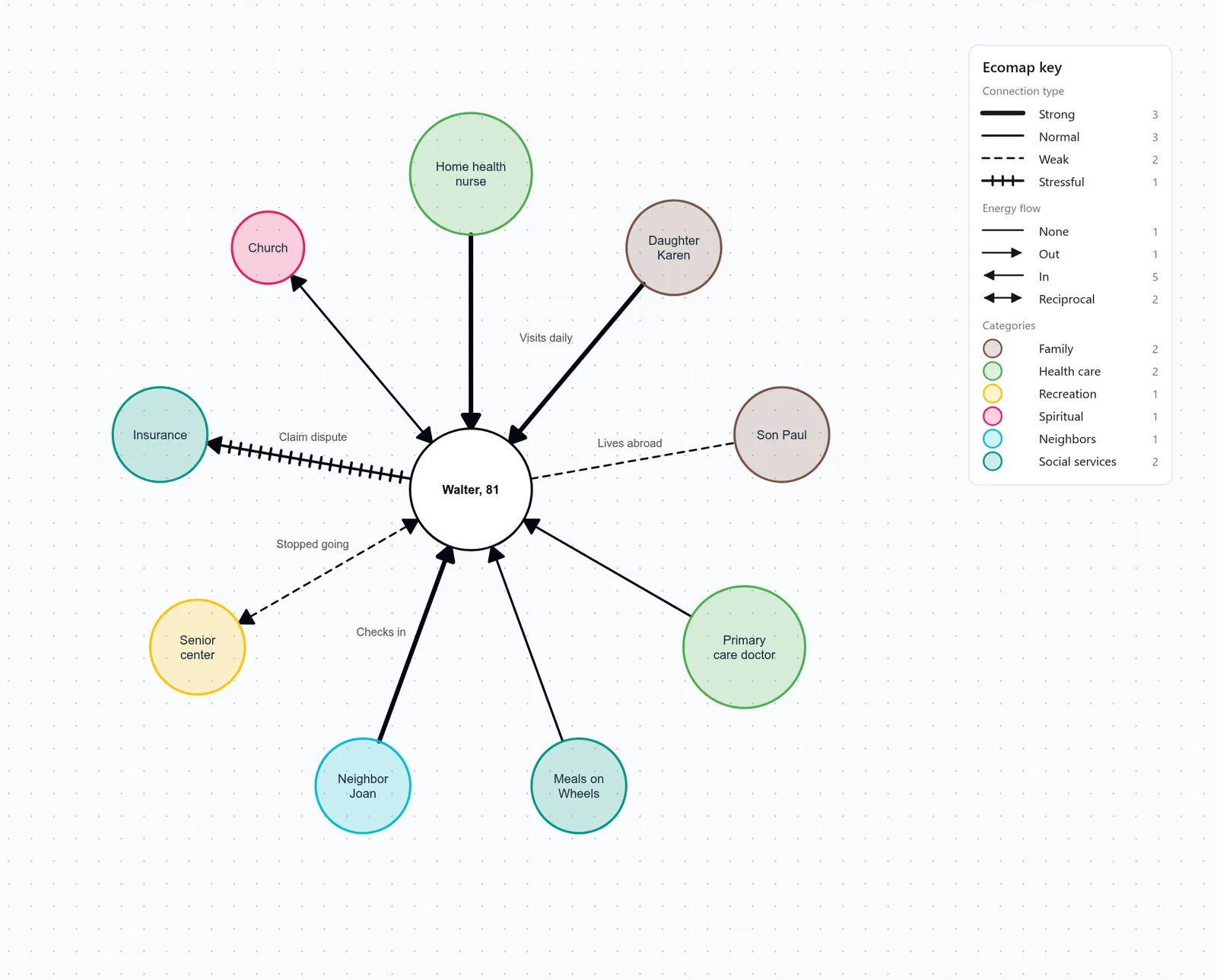
Daughter Karen
A strong line with the arrow pointing in, because Karen has visited every day since Walter came home.
Senior center
A weak line with arrows both ways, because Walter has not been back since his fall.
Insurance
A stressful line with the arrow pointing away, because Walter spends hours on the phone about a disputed claim.
| System | Line | Flow | Meaning |
|---|---|---|---|
| Home health nurse | Strong | In | She visits three times a week to check his wound and blood pressure. |
| Daughter Karen | Strong | In | She visits every day and manages his medications. |
| Son Paul | Weak | None | He lives abroad and rarely calls. |
| Primary care doctor | Normal | In | A follow-up visit is booked for next month. |
| Meals on Wheels | Normal | In | A hot lunch is delivered on weekdays. |
| Neighbor Joan | Strong | In | She checks in on him every morning. |
| Senior center | Weak | Reciprocal | He has not gone since his fall. |
| Insurance | Stressful | Out | A claim for his hospital stay is in dispute. |
| Church | Normal | Reciprocal | He watches the service online, and members visit him on Sundays. |
Cite this diagram
Genogram Pro. (2026, October 21). Ecomap for an older adult after hospital discharge [Diagram]. https://genogrampro.com/ecomap-examples
Ecomap for substance use recovery
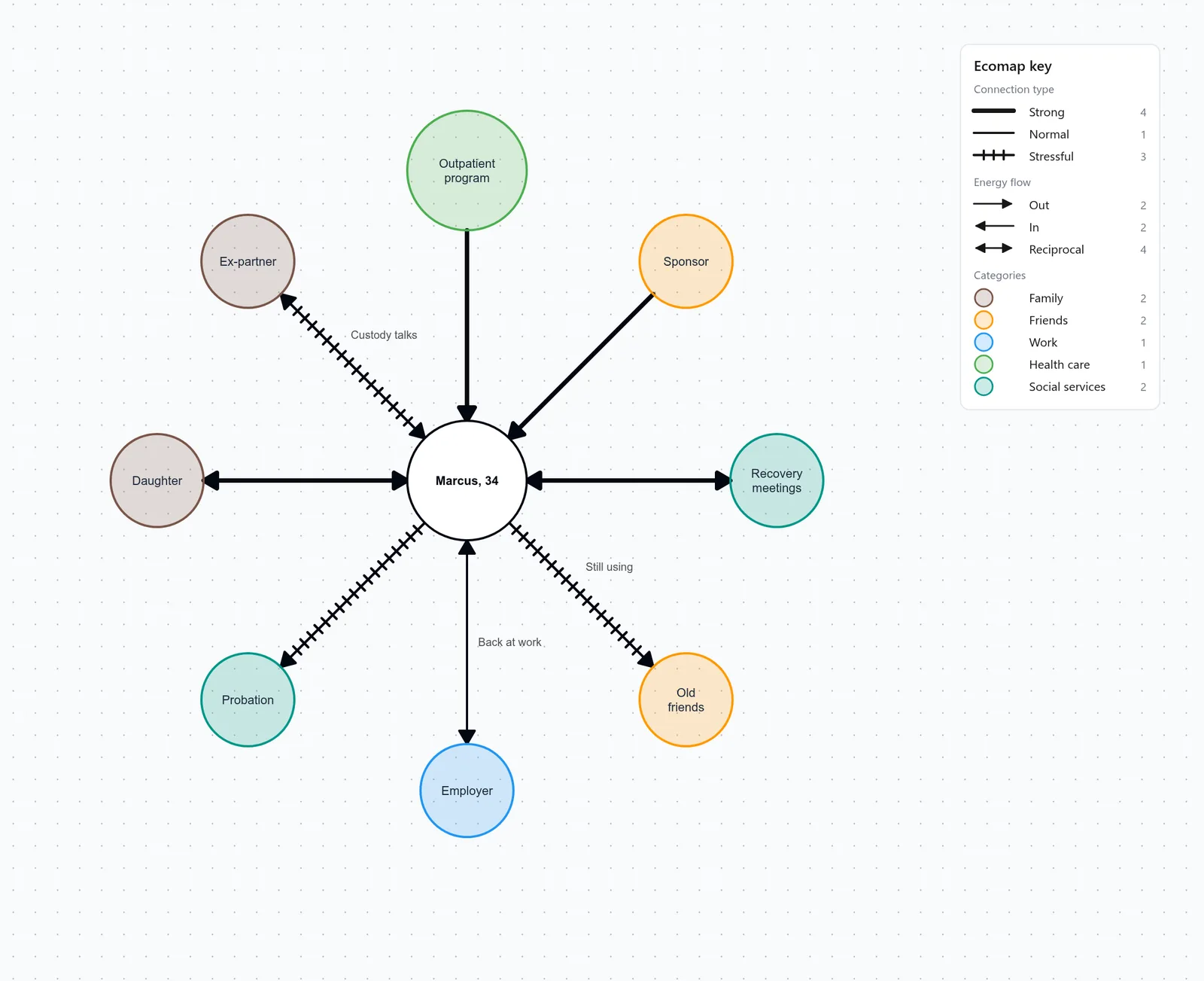
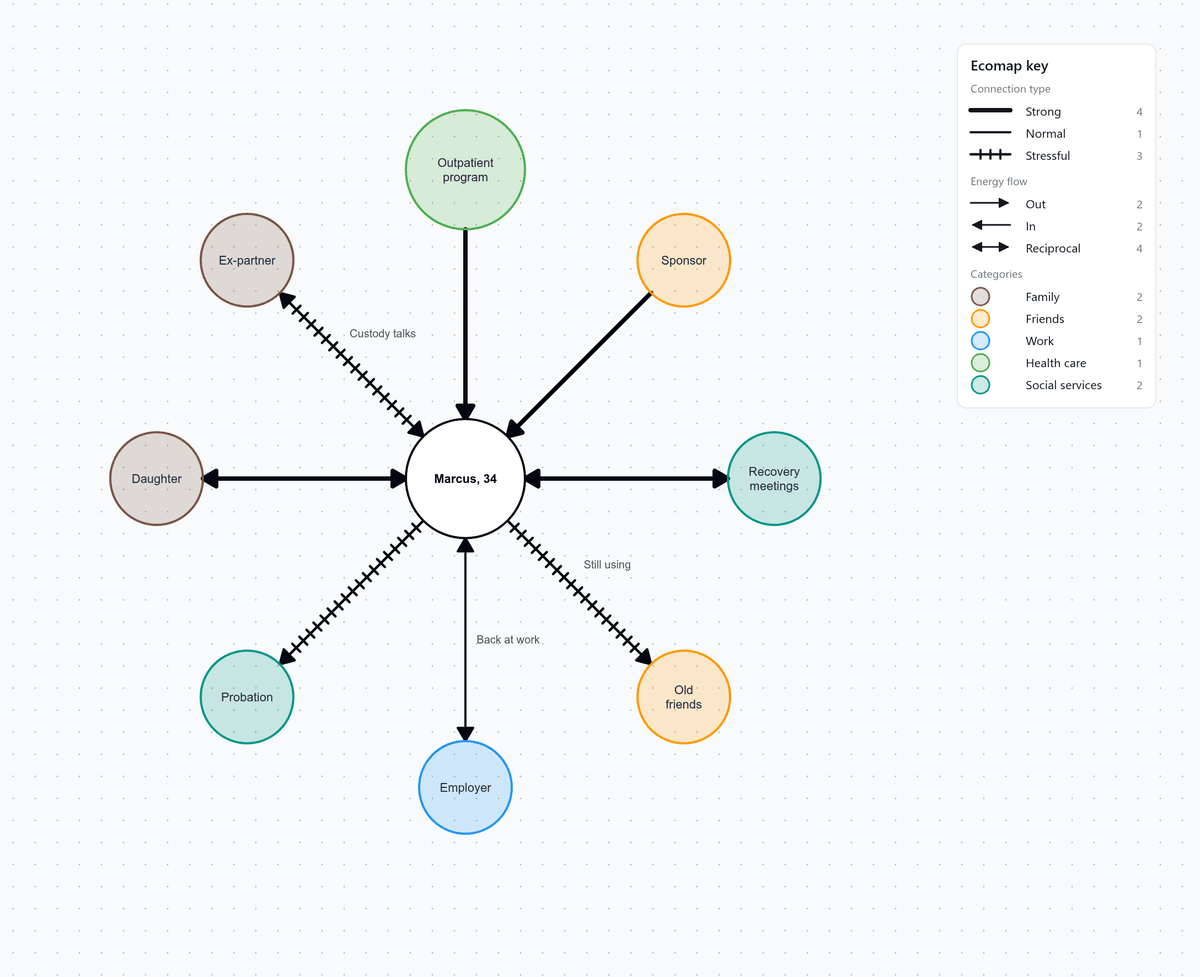
This ecomap shows Marcus, 34, eight months into recovery, with an outpatient program, a sponsor, recovery meetings and his daughter as his strong ties. The stressful ties are to old friends who still use, to probation and to his ex-partner, with whom he is negotiating custody.
Sponsor
A strong line with the arrow pointing in, because Marcus talks to his sponsor most days.
Old friends
A stressful line with the arrow pointing away, because Marcus has to work at keeping away from friends who still use.
Daughter
A strong line with arrows both ways, because Marcus and his daughter see each other every weekend again.
| System | Line | Flow | Meaning |
|---|---|---|---|
| Outpatient program | Strong | In | He has group and individual sessions three days a week. |
| Sponsor | Strong | In | They talk most days. |
| Recovery meetings | Strong | Reciprocal | He goes four times a week and now chairs one. |
| Old friends | Stressful | Out | They still use, so he keeps away from them. |
| Employer | Normal | Reciprocal | He is back at work after a leave. |
| Probation | Stressful | Out | He has monthly check-ins and drug tests. |
| Daughter | Strong | Reciprocal | Her weekend visits started again in June. |
| Ex-partner | Stressful | Reciprocal | Their custody talks are tense. |
Cite this diagram
Genogram Pro. (2026, October 21). Ecomap for substance use recovery [Diagram]. https://genogrampro.com/ecomap-examples
Ecomap for a refugee family
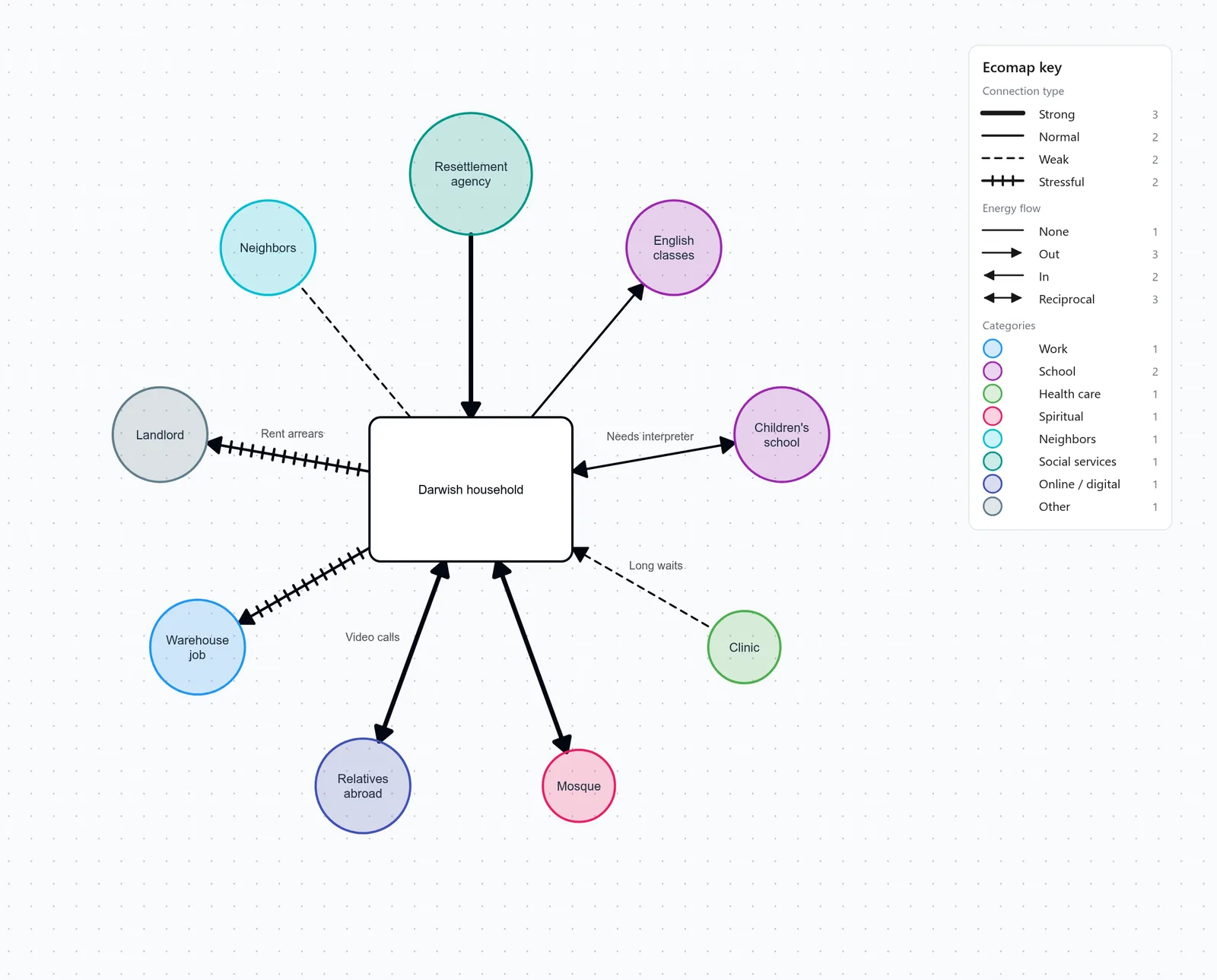
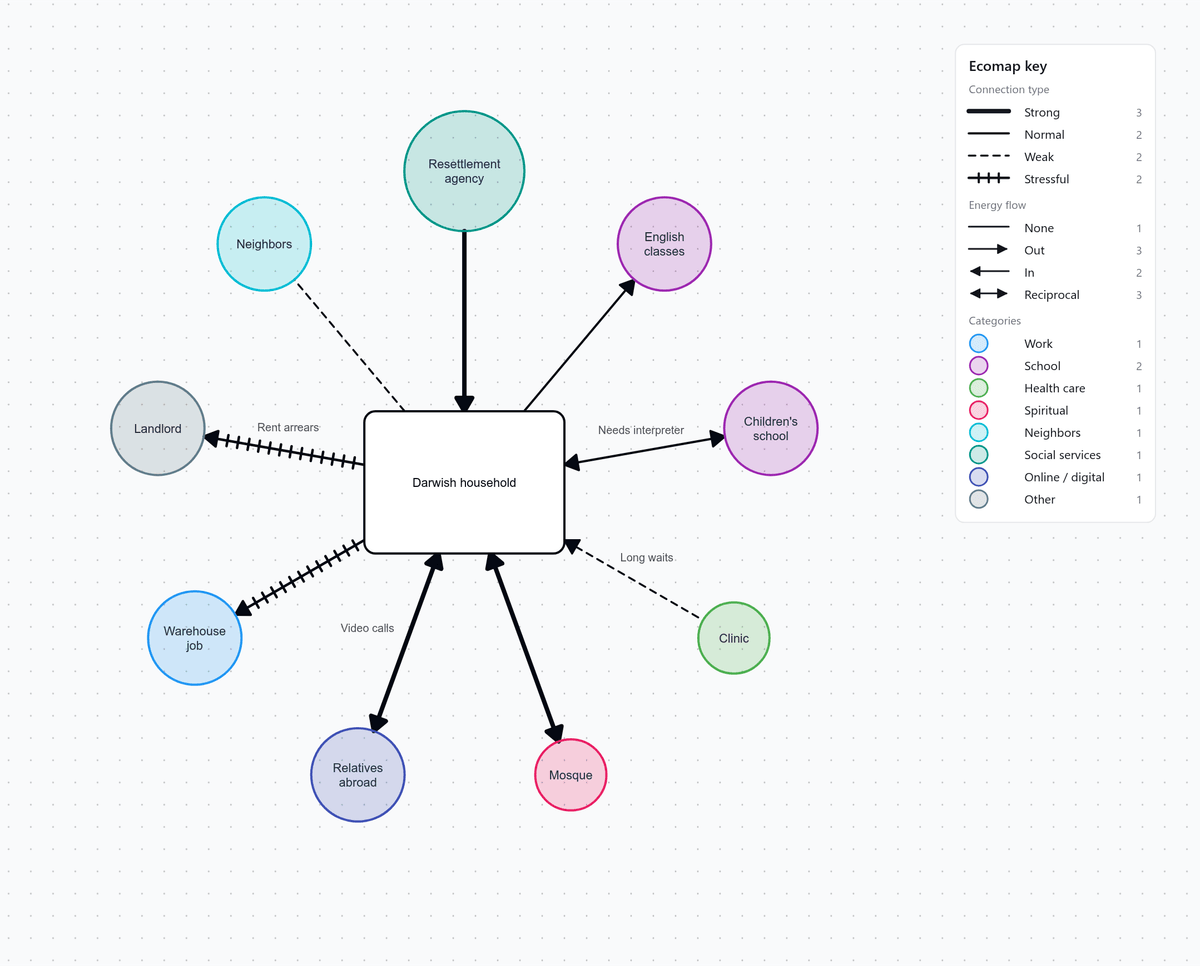
This ecomap shows the Darwish household in its first year after resettlement in 2025. The resettlement agency, the mosque and the relatives abroad are strong ties, and the warehouse job and the landlord, who is owed two months of rent, are stressful.
Resettlement agency
A strong line with the arrow pointing in, because the family relies on the agency for almost everything in its first year.
Relatives abroad
A strong line with arrows both ways, because the family keeps in touch through video calls.
Landlord
A stressful line with the arrow pointing away, because rent arrears are the most urgent problem the family has.
| System | Line | Flow | Meaning |
|---|---|---|---|
| Resettlement agency | Strong | In | A caseworker helps with housing, benefits and paperwork. |
| English classes | Normal | Out | Both parents go to evening classes. |
| Children's school | Normal | Reciprocal | The children are settling in, and the parents need an interpreter at meetings. |
| Clinic | Weak | In | The family waits weeks for appointments. |
| Mosque | Strong | Reciprocal | The family goes every Friday and has made friends there. |
| Relatives abroad | Strong | Reciprocal | They talk on video calls several times a week. |
| Warehouse job | Stressful | Out | The father works night shifts at a warehouse. |
| Landlord | Stressful | Out | The family is two months behind on rent. |
| Neighbors | Weak | None | The family has not met most of them yet. |
Cite this diagram
Genogram Pro. (2026, October 21). Ecomap for a refugee family [Diagram]. https://genogrampro.com/ecomap-examples
Read an ecomap line by line
Every line joins the center to one system and is drawn in Hartman's notation, with the line type for the quality of the tie and the arrows for the direction of energy.
Strong
A strong, supportive tie.
Normal
An ordinary tie.
Weak
A weak or occasional tie.
Stressful
A stressful or conflicted tie.
In
Support the center receives, with the arrow pointing to the center.
Out
Energy the center gives, with the arrow pointing to the system.
Reciprocal
Energy flowing both ways.
None
No arrow, for a tie with no clear direction.
A tie that is close and tense
A teenager who is close to her mom but argues with her every day has one tie with two qualities. A strong line beside a stressful one looks like two separate ties, so draw one line for the main quality and write the other in a short label, such as Still close.
Questions people ask
Can you provide an example of an ecomap?
Yes, the family ecomap at the top of this page shows the Delgado household with nine systems around it, including strong ties to the grandparents, the elementary school and the church, a stressful tie to Luis's job and a weak tie to the neighbors.
How do you create a family ecomap?
Put the household at the center, then add a circle for each system the family deals with as a whole, such as work, school, health care, church and extended family. Join each circle to the center with a strong, normal, weak or stressful line, and add arrows for the direction of energy, as in the Delgado ecomap.
How do you draw an ecomap for social work?
Put the client or household at the center and add the systems from your intake, such as family, school, health care, social services and work. Choose each line's type from what the client tells you, and add arrows for whether support comes in or energy goes out. Write details such as supervised visits or a claim dispute as short labels, and export the map with its key for the case file.
How to make an ecomapCan I use these examples for an assignment?
Yes, you can open any example in the free ecomap maker, change the names and systems to fit your case and export it as a PNG or PDF with a small Genogram Pro badge. To use an image as it is, copy its APA, MLA or Harvard citation from the panel next to the example.
What is an ecomap in social work?
An ecomap is a diagram that social workers draw of a client or family and the systems around them, such as school, health care and social services, with a line for how strong or stressful each tie is. Ann Hartman designed it for child welfare work in the 1970s.
What an ecomap isStart your ecomap from this example
Open it in the free ecomap maker, swap in your own people and systems, and export it as a PNG or PDF.