
Genogram questions
These genogram interview questions are grouped first for each generation of the family and then by topic, each paired with the symbol or line drawn from its answer. The same questions are on a two-page interview sheet to print for a class assignment or a first session with a client.
Updated October 2026Based on McGoldrick et al., Genograms: Assessment and Treatment (4th ed., 2020), and the genogram guides from Research in Practice, ISW Matters and the Leeds Safeguarding Children Partnership
Who lives in your home now?
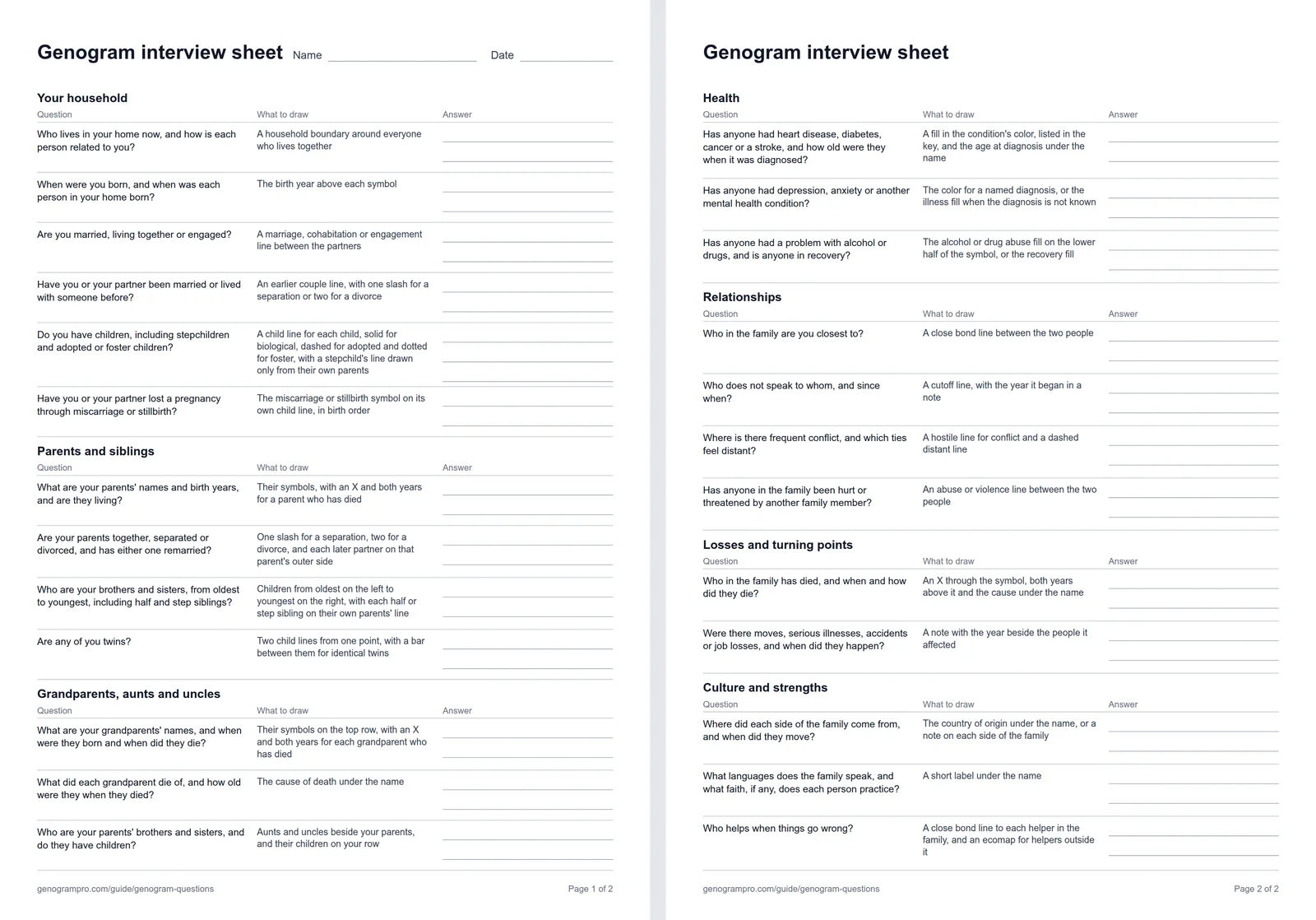
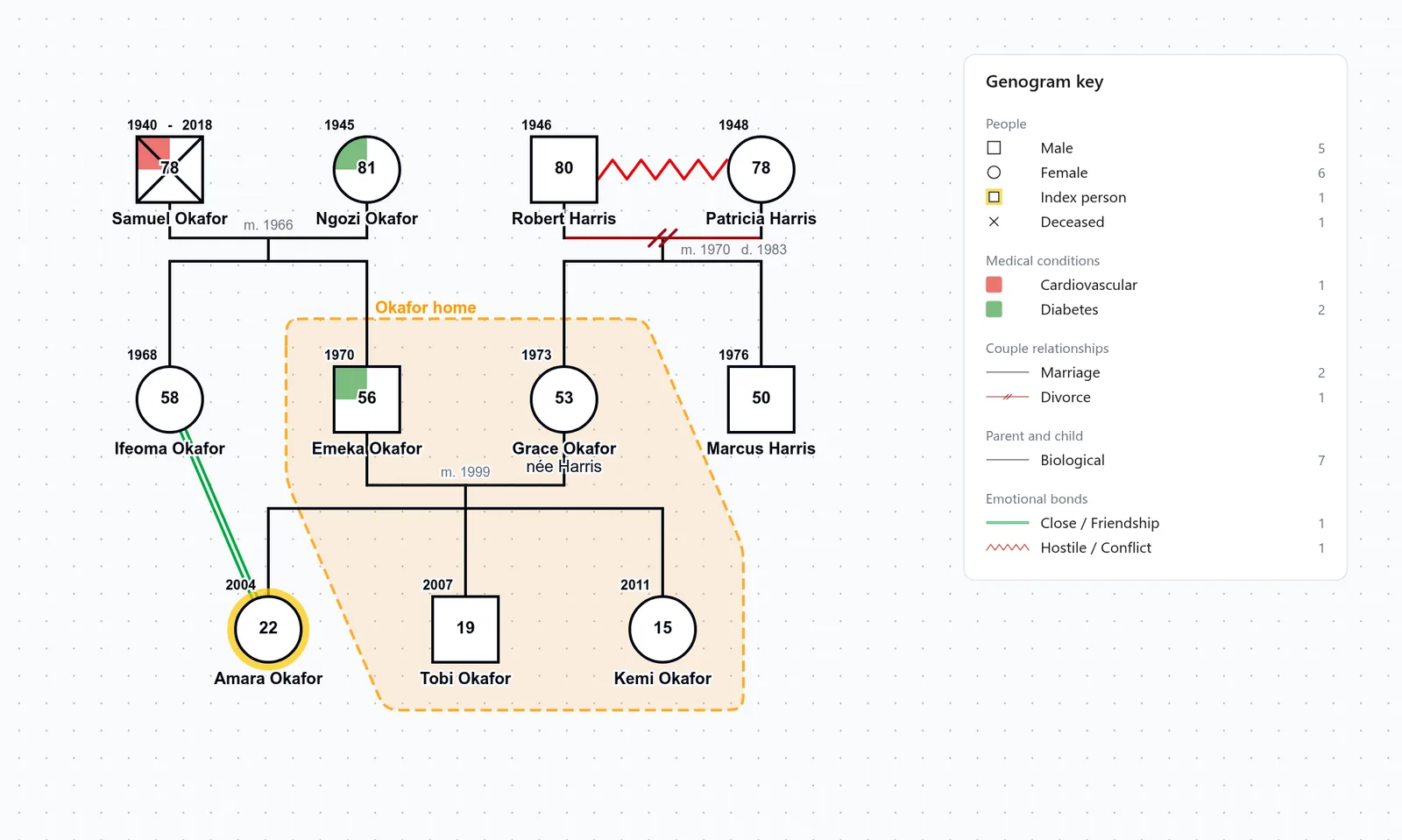
Amara's parents Emeka and Grace live with her brother Tobi and her sister Kemi, so those four are drawn inside the Okafor home boundary and Amara is drawn outside it.
Is anyone in the family no longer living?
Samuel died in 2018, so his square has an X and the years 1940 to 2018.
Have your parents or grandparents divorced?
Robert and Patricia married in 1970 and divorced in 1983, so their couple line has two slashes and both dates.
Has anyone had diabetes, heart disease or a stroke?
Ngozi and Emeka have diabetes and Samuel had cardiovascular disease, so each of their symbols has the condition's colored fill, listed in the key as Diabetes or Cardiovascular.
Who are you closest to in the family?
Amara named her aunt Ifeoma, and the two are joined by a green close bond line.
Questions for each generation
McGoldrick, Gerson and Petry start a genogram interview with the problem the family came with and the immediate household, then ask about each side of the extended family and back through the generations, in wider and wider circles. In a first session with a client, the household questions usually come out of talking about that problem, and in a class assignment they are the first questions.
If you draw each answer before you ask the next question, each new person can be added to a couple line or child line that is already drawn.
Your household
| Question | What to draw |
|---|---|
| Who lives in your home now, and how is each person related to you? | A household boundary around everyone who lives together |
| When were you born, and when was each person in your home born? | The birth year above each symbol |
| Are you married, living together or engaged? | A marriage, cohabitation or engagement line between the partners |
| Have you or your partner been married or lived with someone before? | An earlier couple line, with one slash for a separation or two for a divorce |
| Do you have children, including stepchildren and adopted or foster children? | A child line for each child, solid for biological, dashed for adopted and dotted for foster, with a stepchild's line drawn only from their own parents |
| Have you or your partner lost a pregnancy through miscarriage or stillbirth? | The miscarriage or stillbirth symbol on its own child line, in birth order |
Parents and siblings
| Question | What to draw |
|---|---|
| What are your parents' names and birth years, and are they living? | Their symbols, with an X and both years for a parent who has died |
| Are your parents together, separated or divorced, and has either one remarried? | One slash for a separation, two for a divorce, and each later partner on that parent's outer side |
| Who are your brothers and sisters, from oldest to youngest, including half and step siblings? | Children from oldest on the left to youngest on the right, with each half or step sibling on their own parents' line |
| Are any of you twins? | Two child lines from one point, with a bar between them for identical twins |
Grandparents, aunts and uncles
| Question | What to draw |
|---|---|
| What are your grandparents' names, and when were they born and when did they die? | Their symbols on the top row, with an X and both years for each grandparent who has died |
| What did each grandparent die of, and how old were they when they died? | The cause of death under the name |
| Who are your parents' brothers and sisters, and do they have children? | Aunts and uncles beside your parents, and their children on your row |
Questions by topic
Once the three generations are drawn, the answers to the topic questions are added to people already on the genogram, as a condition fill, an emotional bond line, a label under the name or a note with a date.
A client may give a painful answer to any of these questions, about abuse, suicide, addiction or a death. McGoldrick, Gerson and Petry write that a partner should never be asked about the other partner's possible abusive behavior while that partner is in the room, and the same warning about suspected violence is in the ISW Matters outline.
Health
| Question | What to draw |
|---|---|
| Has anyone had heart disease, diabetes, cancer or a stroke, and how old were they when it was diagnosed? | A fill in the condition's color, listed in the key, and the age at diagnosis under the name |
| Has anyone had depression, anxiety or another mental health condition? | The color for a named diagnosis, or the illness fill when the diagnosis is not known |
| Has anyone had a problem with alcohol or drugs, and is anyone in recovery? | The alcohol or drug abuse fill on the lower half of the symbol, or the recovery fill |
Condition fills, causes of death and hereditary risk are covered in more detail in the medical genogram guide.
Relationships
| Question | What to draw |
|---|---|
| Who in the family are you closest to? | A close bond line between the two people |
| Who does not speak to whom, and since when? | A cutoff line, with the year it began in a note |
| Where is there frequent conflict, and which ties feel distant? | A hostile line for conflict and a dashed distant line |
| Has anyone in the family been hurt or threatened by another family member? | An abuse or violence line between the two people |
The patterns a therapist reads in these lines are explained in the guide to genograms in family therapy.
Losses and turning points
| Question | What to draw |
|---|---|
| Who in the family has died, and when and how did they die? | An X through the symbol, both years above it and the cause under the name |
| Were there moves, serious illnesses, accidents or job losses, and when did they happen? | A note with the year beside the people it affected |
Culture and strengths
| Question | What to draw |
|---|---|
| Where did each side of the family come from, and when did they move? | The country of origin under the name, or a note on each side of the family |
| What languages does the family speak, and what faith, if any, does each person practice? | A short label under the name |
| Who helps when things go wrong? | A close bond line to each helper in the family, and an ecomap for helpers outside it |
For heritage, faith and migration on a genogram, see the cultural genogram guide.
Print the interview sheet
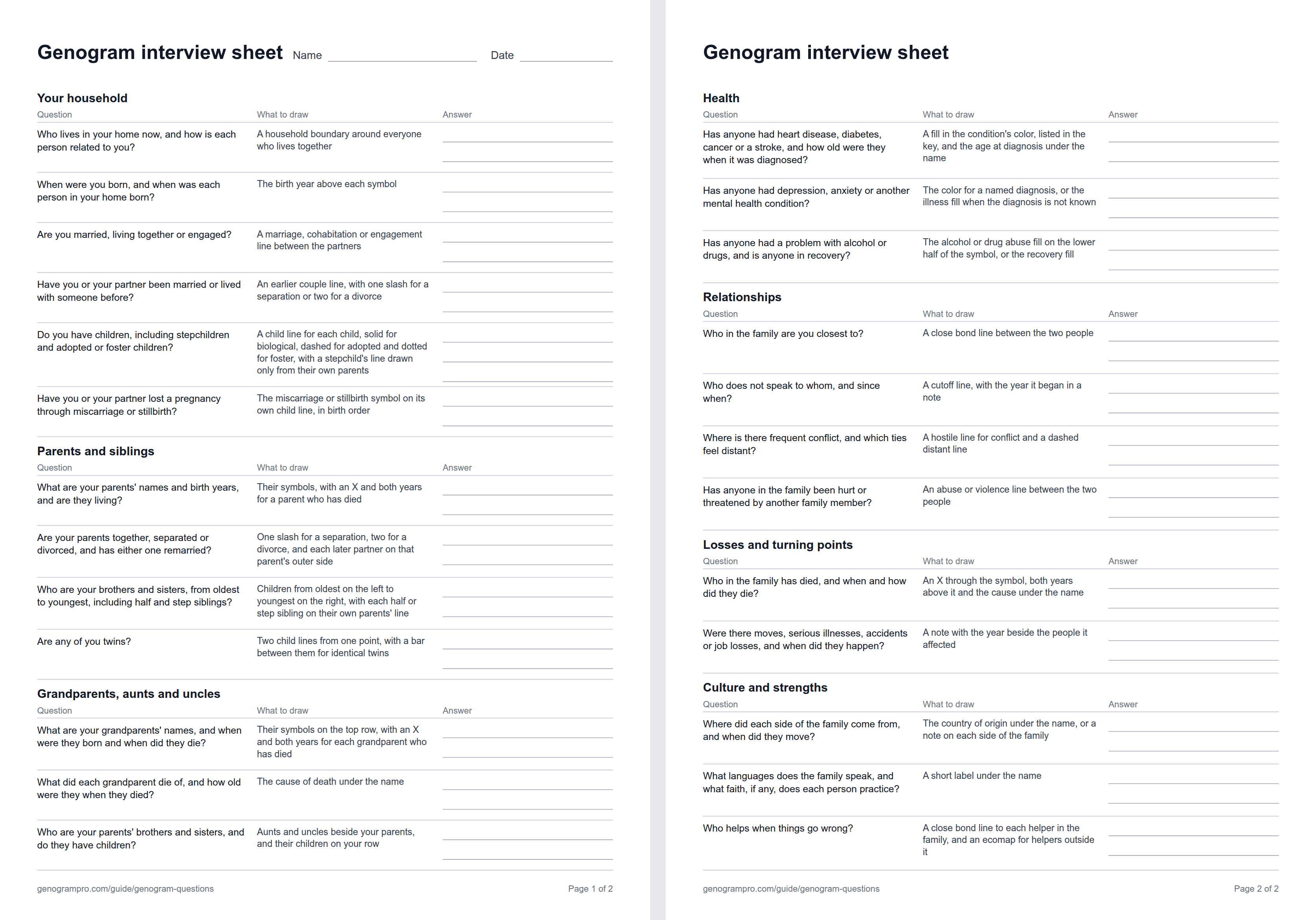
The interview sheet has the generation questions on the first page and the topic questions on the second, with an answer column beside each question. Each answer box in the PDF is a form field you can type into, and the Word file has the same tables, which you can fill in with Word or Google Docs.
Genogram interview sheet
Two pages, with an answer column
Questions people ask
What questions should you ask for a genogram?
Start with who lives in the home, then ask about parents and siblings, then grandparents, aunts and uncles, with each person's name, birth and death years, and any marriages, separations and divorces. Once those three generations are drawn, ask about health conditions, close and difficult relationships, deaths and moves, and where each side of the family came from.
How far back should a genogram go?
A genogram usually shows three generations, from the index person to their grandparents, and McGoldrick, Gerson and Petry aim for at least three or four. A fourth generation is worth adding when a health condition or a family pattern can be traced further back.
What should a genogram include?
A genogram includes everyone in at least three generations with their names and birth and death years, the couple lines and child lines that connect them, and a key. Health conditions, emotional bonds and household boundaries are added from the answers to the household and topic questions on this page.
Genogram keyHow many genogram questions should you ask in one session?
There is no set number. McGoldrick, Gerson and Petry write that the length of a genogram interview depends on its purpose, that the family's agenda for the appointment cannot be set aside to gather all the genogram information in the first session, and that the genogram questions can be picked up again in later sessions. According to the ISW Matters interview outline, the information may take more than one session to gather.
Can genogram questions be used with children?
Yes, with changes to how they are asked. The Leeds Safeguarding Children Partnership has a genogram tool for children aged 5 to 15 in which the child chooses where to start and who to include, because the child's own view of the family is what counts. Research in Practice describes a play genogram for work with a child, with buttons or toys to represent each person and the feelings associated with them.
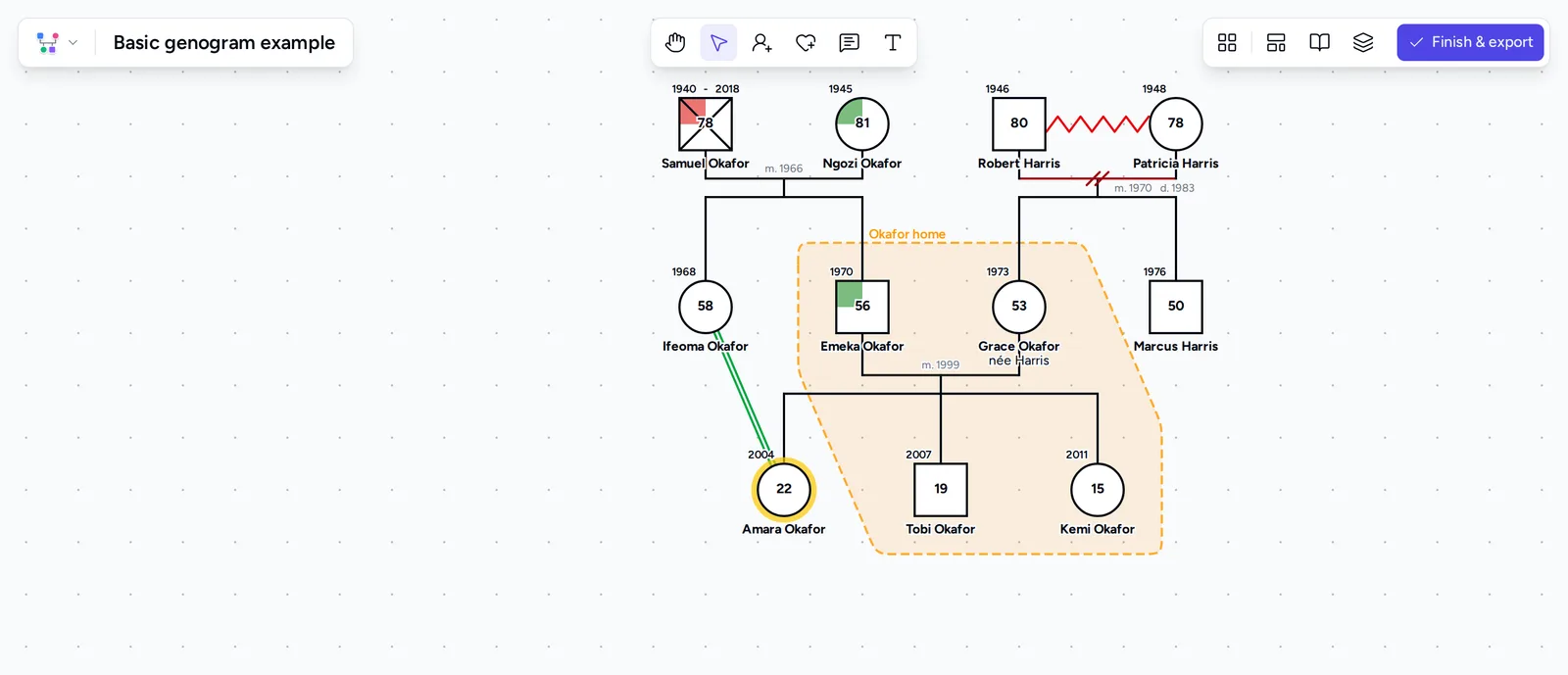
Draw the genogram from your answers
The free editor opens in your browser, with nothing to install and no account to create.