
Table of Contents
Genogram assessment template: how to start building from blank
Staring at a blank genogram canvas is the hardest part. Not because the tool is complicated, but because deciding what to capture first requires clinical judgment. A genogram assessment template provides structure for that first session so the essential information gets collected before the conversation ends.
Last updated March 2026 · Based on McGoldrick et al., Genograms: Assessment and Treatment (4th ed., 2020)
This example is designed to illustrate how to create and read genograms. It is not intended as clinical guidance.
This template shows the standard three-generation layout: grandparents at the top, parents in the middle, children at the bottom. Every generation has placeholders ready for names, dates, and relationship lines.
Use as TemplateThe three-generation minimum
Monica McGoldrick and Randy Gerson established the three-generation genogram as the clinical standard. Patterns that look individual in one generation reveal themselves as inherited when you can see three. A client's anxiety looks different once you learn that their parent and grandparent also carried it. A marriage in conflict gains context when the previous generation's marriages ended the same way.
Three generations is the minimum, not the ideal. Four generations can reveal long-cycle patterns, such as estrangements that repeat every other generation or medical conditions that skip one. But three generations is where the cost-benefit ratio is strongest: enough depth to see transmission patterns, and achievable in a single intake session. For a worked version, our 3 generation genogram example shows a completed family at this depth and opens as a ready-made template you can edit.
Questions to explore:
- What do clients know about their grandparents' relationships, and what do they not know?
- Are there patterns that appear in generations one and three but skip generation two?
- What strengths has the family drawn on during past crises?
Start from a blank canvas
Open the free editor and lay out three generations before your next intake session.
open the free editorWhere to start building
Clinical genograms are built outward from the presenting concern, not top-down from the oldest generation. Start with the identified patient, add their immediate household, then expand to parents, siblings, and grandparents. This sequence captures the most clinically relevant information first, which matters when session time is limited.
Students accustomed to family trees tend to start at the top and work down. This means the session may end before the client's current household dynamics are captured, the information most likely to be immediately useful.
Questions to explore:
- What information is most urgent for the presenting concern?
- Is the client more forthcoming about one side of the family than the other?
- Which relationships in this family are sources of stability?
What to collect in session
A genogram interview collects three types of information, and they overlap throughout the conversation rather than falling into rigid sequential phases. Structural data covers who is in the family: births, deaths, marriages, divorces. Functional data covers medical conditions, mental health diagnoses, occupations, and significant behaviors. Relational data covers who is close to whom, where conflict exists, and who has been cut off.
McGoldrick describes the interview as expanding outward in concentric circles from the presenting concern. Start with the immediate household: who lives together, what brought the client in, what is happening now. Then widen to the extended family: parents, siblings, grandparents, and their histories. Finally, fill in the chronology of major events. Within each circle, the conversation naturally moves from easier, factual questions ("Who are your parents? Do you have siblings?") to harder, more emotionally loaded ones ("How would you describe your parents' marriage? Which family member are you closest to?"). Structural, functional, and relational information surfaces at every stage; the interview does not wait until a "relational phase" to ask about relationships.
Questions to explore:
- Is the client willing to discuss relationships, or only facts?
- Is there a family member the client has not mentioned who should be on the genogram?
- Who in the family has coped well, and what made that possible?
The value of incomplete genograms
A genogram does not need to be finished to be useful. Incomplete genograms yield rich clinical data because the blank spaces tell a story. A client who can describe their mother's side in detail but knows nothing about their father's side is communicating something important, even if they do not realize it.
Gaps may reflect cutoffs, family secrets, adoption, estrangement, or trauma. A clinician who normalizes incompleteness ("It's fine that we don't have this information yet; we can add it over time") reduces client anxiety and models that the genogram is a living document, not a test to pass.
Questions to explore:
- What does the client not know about their family, and have they ever tried to find out?
- Are the gaps concentrated on one side of the family?
- Are there relationships that improved after a difficult period?
Using the AI assistant for initial input
For clients or students who find the blank canvas intimidating, natural language input bridges the gap between knowing your family and mapping it. Describing a family in plain sentences ("My mom and dad divorced when I was ten, my dad remarried, I have a half-sister") contains all the structural data needed for an initial genogram.
This approach works well for self-guided work, classroom exercises, and intake preparation. The client writes their family description before the session, and the clinician uses it to pre-populate the genogram. Session time then shifts from data collection to pattern exploration.
Questions to explore:
- Does the client's natural description emphasize certain family members over others?
- Does the written description match what the genogram reveals once visualized?
- Which family members does the client describe in positive terms, and what does that reveal about sources of support?
How to build this in Genogram Pro
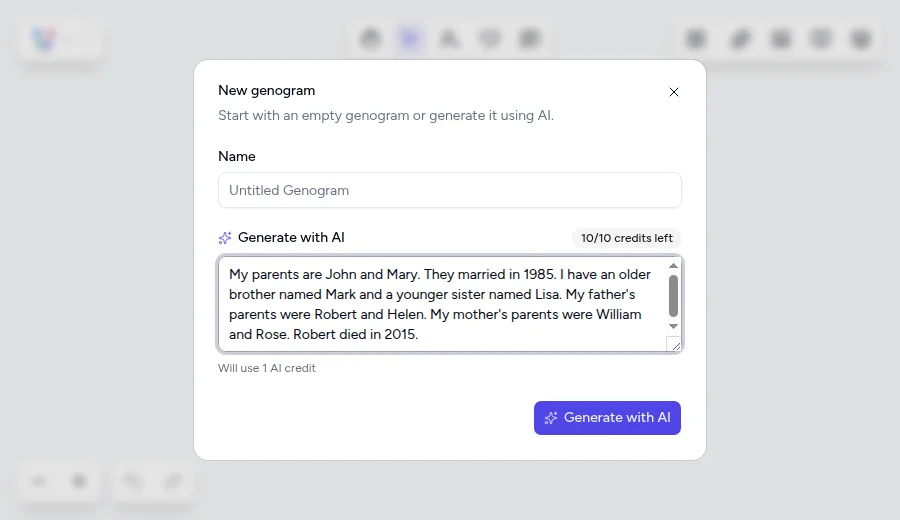
Open a new genogram and use the AI assistant
Click "New Genogram" and open the AI assistant in the editor. Type or paste a family description in plain language: "My parents are divorced. My mom remarried. I have two siblings and a half-brother." The assistant generates the initial structure.
Review the generated structure
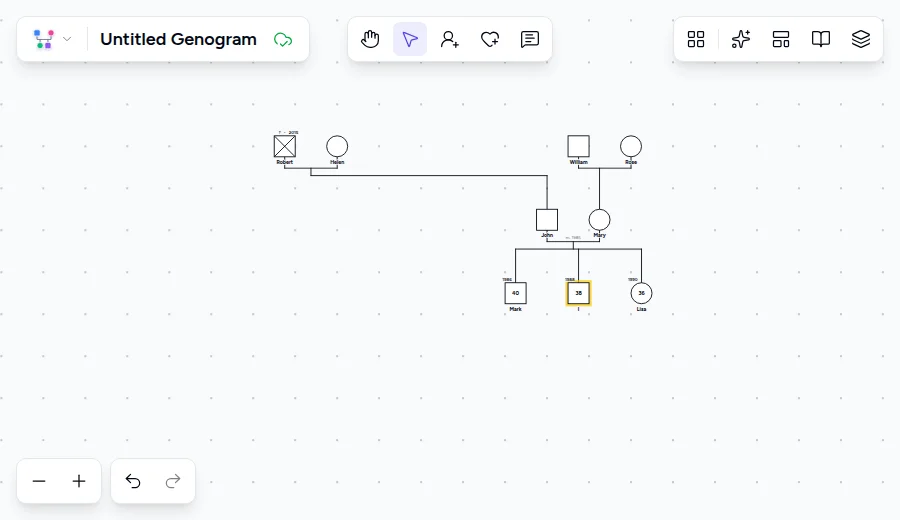
The AI creates person nodes and relationship lines based on the description. Check that all family members are present and correctly connected. Add missing members manually by clicking the canvas.
Add dates and demographic information
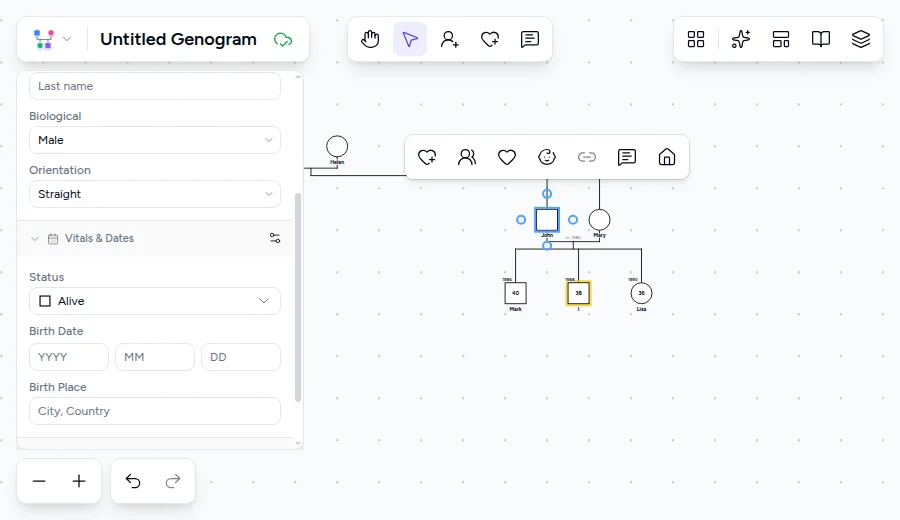
Click each person to open their detail panel. Enter birth and death dates on the person. Set marriage and divorce dates on the couple connection line.
Attach medical and behavioral conditions
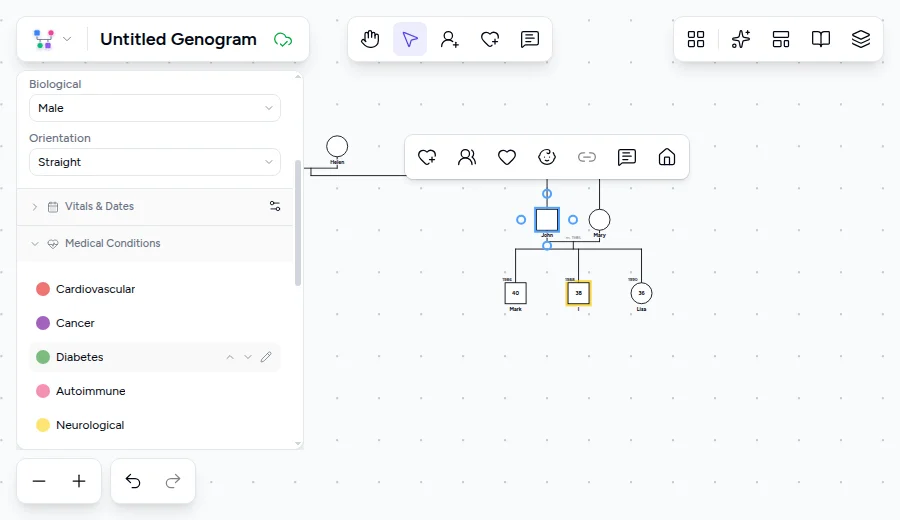
Select a person and open the Conditions panel. Add diagnoses, behaviors, or health conditions. These appear as color-coded fills on the person's symbol.
Draw emotional bond lines last
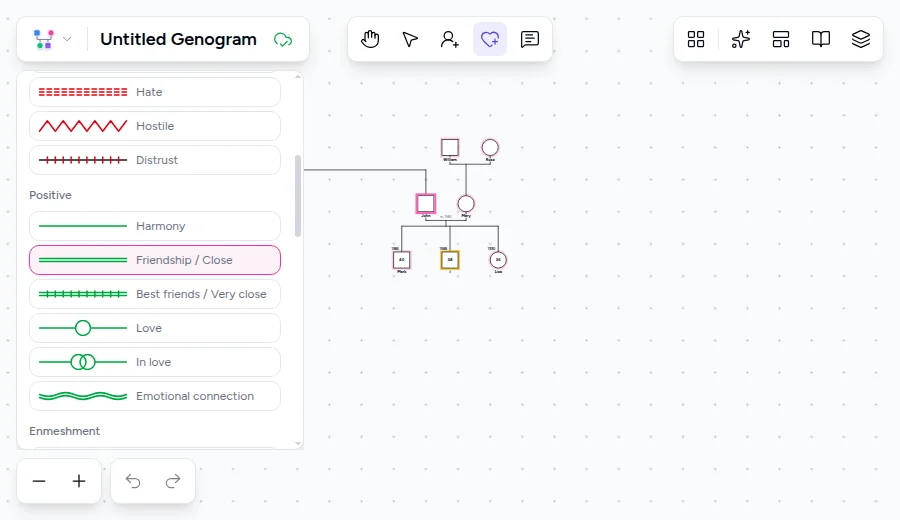
After structural and functional data are in place, select a person, click the Emotional Bond button in the selection toolbar, then click the target person. A bond type picker appears. These require the most clinical judgment and should reflect observed or reported dynamics, not assumptions.
Clinical context
The genogram as an assessment tool was formalized by McGoldrick and Gerson in Genograms: Assessment and Intervention (1985), now in its fourth edition. Their framework positions the genogram not as a one-time data-collection exercise but as an evolving clinical document that grows across sessions. The three-generation minimum reflects the Bowenian principle of multigenerational transmission: emotional patterns pass through families with predictable regularity.
Family therapists use genogram assessment templates to map relational dynamics. Social workers use them to assess family support structures. Nurses use them to track hereditary health risks. School counselors use them to understand a student's home environment. The template format, which provides the structure without the content, lets each discipline collect the information most relevant to its purpose.
A genogram generates hypotheses for further exploration, not conclusions. The patterns it shows are starting points for clinical questions, not diagnostic endpoints. One important caveat: a genogram is a clinical tool, not a factual record. It represents the family as understood by the person providing the information. Two siblings building genograms of the same family will produce different maps with different emotional bonds, different emphasis, and different gaps. This subjectivity is a feature. What the client sees and reports about their family is the clinical data.
Frequently Asked Questions
How long does it take to complete a genogram in a session?
What if my client does not know their family history?
Should I fill out the genogram in front of the client?
What is the difference between a genogram template and a genogram?
What is the most common mistake beginners make with genogram templates?
Ready to Create Your Own Genogram?
Build professional genograms online with standard notation, AI-powered generation, and end-to-end encryption.