
Table of Contents
Parentification genogram: mapping role reversal across generations
When a fourteen-year-old manages household chores, monitors her siblings' homework, and acts as her mother's emotional confidante, the family has inverted the generational hierarchy. Parentification is the process by which a child takes on parental responsibilities. It is a structural distortion that replicates across generations. Each generation's parentified child becomes the next generation's overwhelmed parent. A genogram traces this inversion, showing where the hierarchy broke and why it keeps breaking.
Last updated March 2026 · Based on McGoldrick et al., Genograms: Assessment and Treatment (4th ed., 2020)
This example is designed to illustrate how to create and read genograms. It is not intended as clinical guidance.
Find Maya at the bottom of the genogram. She is the focus person, age 14, highlighted with a yellow outline. A fused bond connects her to her mother Sarah. Notice Sarah's depression, Mark's absence, and grandmother Janet's addiction. Trace the pattern backward: Janet's addiction forced young Sarah to parent her brother Kevin. Now Sarah relies on Maya the same way.
Use as TemplatePatterns to look for
Emotional vs. instrumental parentification
The family therapy literature distinguishes two forms of parentification, and most genograms capture both. The emotional/instrumental distinction originates in the work of Boszormenyi-Nagy on relational ethics and was later formalized by Jurkovic's research on parentification. McGoldrick discusses caretaking patterns and role reversal in genogram assessment but does not use this specific framework. Instrumental parentification involves a child handling concrete household tasks: cooking, cleaning, paying bills, managing younger siblings' schedules. Emotional parentification involves a child becoming a parent's emotional support system, listening to adult problems, mediating conflicts, and managing a parent's mood.
Emotional parentification is generally considered more damaging because it distorts the child's emotional development. A child who cooks dinner performs a task. A child who regulates a parent's depression performs a function that exceeds their developmental capacity. On a genogram, both forms show through annotations and bond types. Fused bonds between parent and child, combined with notes about the child's responsibilities, tell the story that relationship lines alone cannot. Emotional bond lines are approximations. McGoldrick notes they are "the least reliable lines on a genogram" because they oversimplify complex dynamics. Annotations and clinical notes add the nuance that line types alone cannot capture.
Questions to explore:
- What specific tasks does the child perform that would normally belong to a parent?
- What role does the child play in the parent's emotional life?
- How does the parent describe the child's needs, apart from the child's helpfulness to the family?
- What protective factors exist in this family that could support a healthier distribution of responsibilities?
Map a role reversal yourself
Open the free editor to draw the fused parent-child bond and trace the inverted hierarchy.
build a genogram freeTrigger events and system collapse
Parentification does not happen randomly. It follows events that overwhelm the parental generation's capacity to function: addiction, mental illness, divorce, death, incarceration, immigration, or economic crisis. When the adults in the system cannot hold the parental role, the system redistributes that role to whoever is available. That is often the oldest or most capable child.
On a genogram, look for the trigger event in the generation above the parentified child. There is usually an identifiable crisis that preceded the role reversal. Mapping the trigger event clarifies that the parentified child is not "mature for their age" or "a natural helper." They are a child drafted into a role because the system had no other option.
Questions to explore:
- What event or condition in the parental generation preceded the child's assumption of adult responsibilities?
- Was the role reversal sudden (crisis event) or gradual (chronic parental impairment)?
- Are there adults in the extended family who could have stepped in but did not?
- Which extended family members or community resources could be mobilized to relieve the child's burden now?
The parentified child as adult identified patient
One of the most useful clinical applications of a parentification genogram is reframing the adult client's presenting problem. Many adults who were parentified as children present in therapy with anxiety, depression, relational difficulties, perfectionism, or burnout. They do not connect these symptoms to their childhood role. They describe themselves as "responsible" or "the one who held the family together" with a mix of pride and exhaustion.
The genogram provides the reframe. When the clinician maps the childhood household, the absent or impaired parent, the fused bond with the overburdened parent, and the siblings the child managed, the adult client begins to see their chronic overresponsibility differently. It is not a personality trait. It is a survival adaptation from a system that asked them to be an adult before they were ready. The genogram externalizes the role, making it a structural fact rather than an identity.
Questions to explore:
- Does the adult client describe their childhood self as "the responsible one" or "the one who took care of everyone"?
- How does the client respond when others offer help or take on responsibilities?
- Can the client connect their current symptoms (anxiety, burnout, overresponsibility) to their childhood role?
- What strengths or competencies did the client develop through their childhood role that now serve them well in healthier contexts?
Cross-generational replication
Parentification replicates across generations with striking consistency. The parentified child grows up, becomes a parent, and, overwhelmed by their own unresolved burden, leans on their child in the same way they were leaned on. The replication is not intentional. The parentified adult has no model for what healthy parenting looks like, because they never experienced it. They know how to caretake, manage, and suppress their own needs. They do not know how to set limits, ask for help, or let their child simply be a child.
On a genogram, cross-generational replication appears as parallel structures: a parentified child in one generation connected by a fused bond to an impaired parent, and the same structure repeated in the next generation. The trigger events may differ (addiction in one generation, depression in the next), but the structural result is identical: a child in the parental role.
Questions to explore:
- Was the current parent themselves parentified as a child?
- What similarities exist between the current child's role and the parent's childhood role?
- What would need to change in the system to prevent the pattern from continuing to the next generation?
- Has any family member successfully broken this pattern, and what enabled them to do so?
How to build this in Genogram Pro
Map the current nuclear family
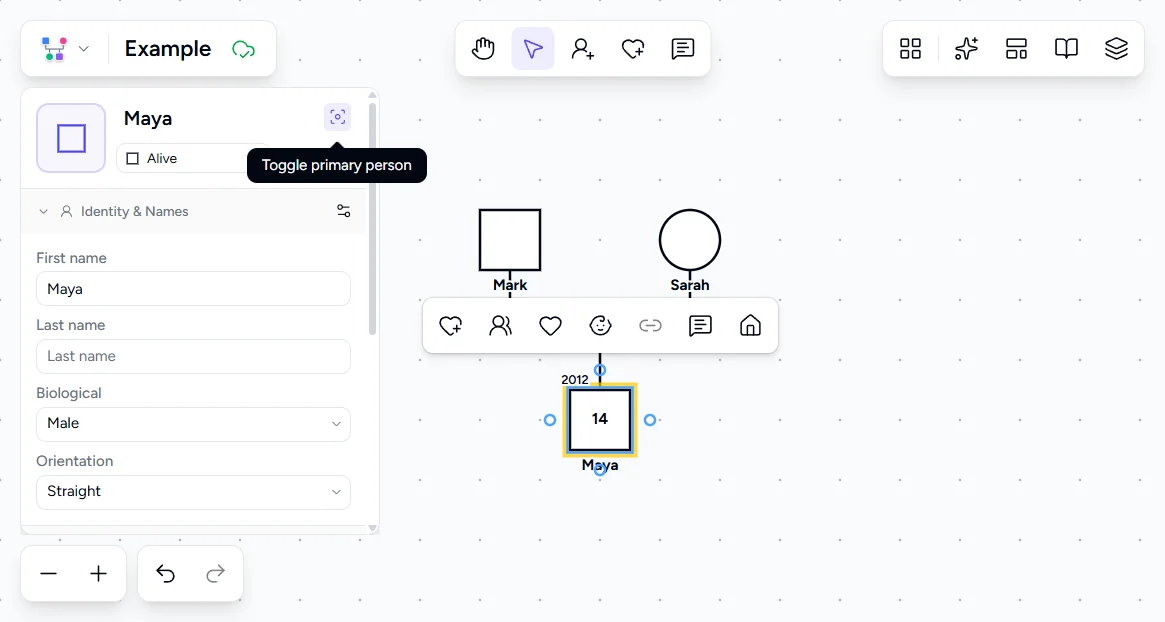
Add Sarah and Mark as the couple, with Maya (age 14) as their daughter. Add siblings if present. Set Maya as the focus person. She will have a yellow outline around her symbol.
Add the extended family and trigger events
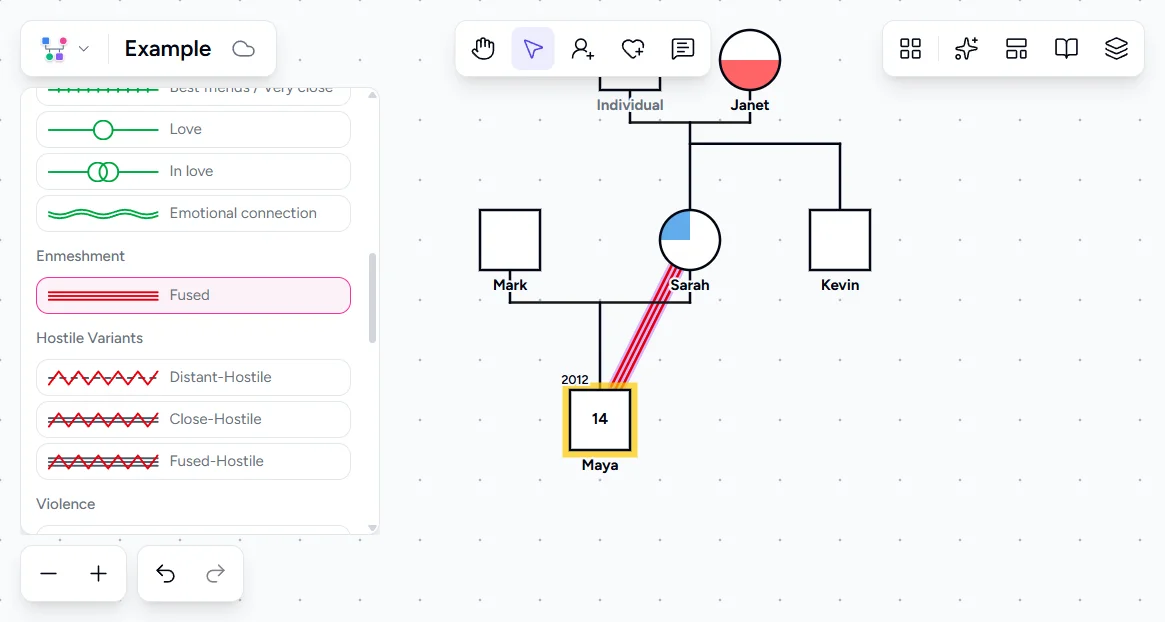
Add grandmother Janet in the generation above Sarah. Add uncle Kevin as Sarah's sibling. In Janet's detail panel, add an addiction condition. In Sarah's, add a depression condition. Attach a note to Mark: "Emotionally absent."

Draw the fused bond between Maya and Sarah
Select Maya, click the Emotional Bond button in the selection toolbar, then click Sarah. Choose the fused bond type (triple line) from the bond type picker. This bond is the genogram's visual center. It represents the inverted hierarchy, not a healthy close relationship.
Mark Mark's absence
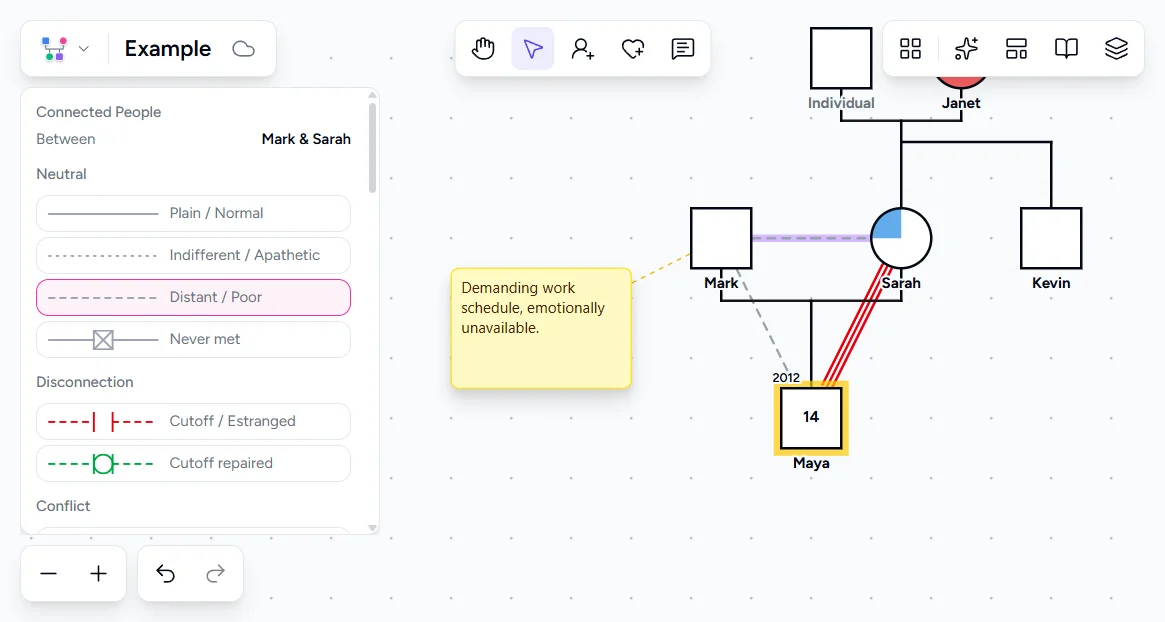
Select Mark, click the Emotional Bond button in the selection toolbar, then click Sarah. Choose the distant bond type. Repeat from Mark to Maya. Attach a note to Mark with context: "Demanding work schedule, emotionally unavailable." These distant lines to both Sarah and Maya show the structural gap that Maya fills.
Annotate parentification across generations
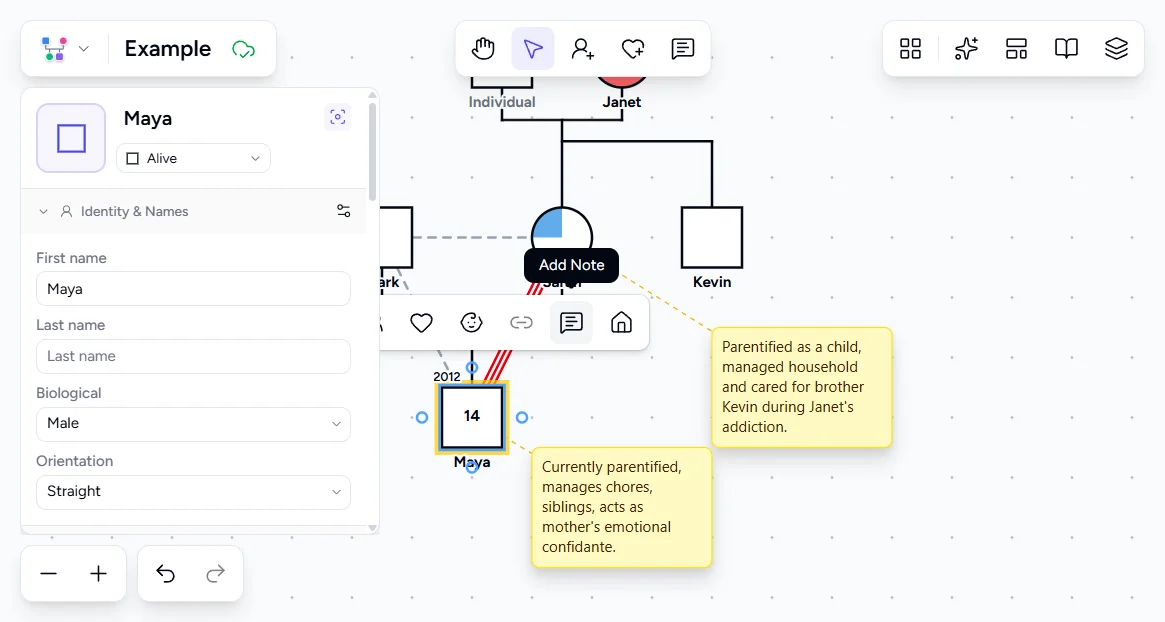
Select Sarah and click the Note button in the selection toolbar to add an annotation: "Parentified as a child, managed household and cared for brother Kevin during Janet's addiction." Do the same for Maya: "Currently parentified, manages chores, siblings, acts as mother's emotional confidante."
Clinical context
Parentification was first described within structural family therapy, where it represents a violation of the generational hierarchy: a child occupying a parental subsystem that does not belong to them. Minuchin's structural model emphasizes that healthy family functioning depends on clear generational boundaries. Parents parent; children are children. When these boundaries collapse, the system may appear functional on the surface (someone is managing the household), but the developmental cost to the child is real.
Research distinguishes between destructive and adaptive parentification. Brief, age-appropriate responsibility during a time-limited crisis (a parent's surgery, for example) can build competence. Chronic emotional parentification, ongoing, unacknowledged, and exceeding the child's developmental capacity, is associated with anxiety, depression, relational difficulties, and identity disturbance in adulthood. The genogram helps clinicians differentiate between these by mapping duration, intensity, and whether the system acknowledged the child's sacrifice.
Cultural context matters here. In many families and cultural traditions, older children are expected to help care for younger siblings and contribute to household functioning. This is not inherently parentification. The clinical distinction lies in whether the child supplements parental functioning (adaptive) or replaces it (destructive), whether the child's own developmental needs are met, and whether the responsibility is acknowledged and bounded rather than invisible and limitless.
A genogram generates hypotheses, not conclusions. Seeing a parentification pattern across generations suggests a tendency, not a certainty. McGoldrick stresses that genograms "cannot be used in a cookbook fashion to make clinical predictions." Clinicians should also assess for resilience and strengths alongside dysfunction. Which family members have broken the pattern? What resources has the family drawn on?
Frequently Asked Questions
What is parentification on a genogram?
What is the difference between emotional and instrumental parentification?
Does parentification always repeat across generations?
How do you distinguish parentification from cultural expectations about family contribution?
Ready to Create Your Own Genogram?
Build professional genograms online with standard notation, AI-powered generation, and end-to-end encryption.