
Table of Contents
Bowen family therapy genogram example: mapping multigenerational patterns
Anxiety does not always start with the person in the room. It can travel through cutoffs that bury conflict, triangles that redistribute tension, and emotional patterns that intensify each generation. A Bowenian genogram traces these transmission lines and makes a family's reactive cycles visible and workable.
Last updated March 2026 · Based on McGoldrick et al., Genograms: Assessment and Treatment (4th ed., 2020)
This example is designed to illustrate how to create and read genograms. It is not intended as clinical guidance.
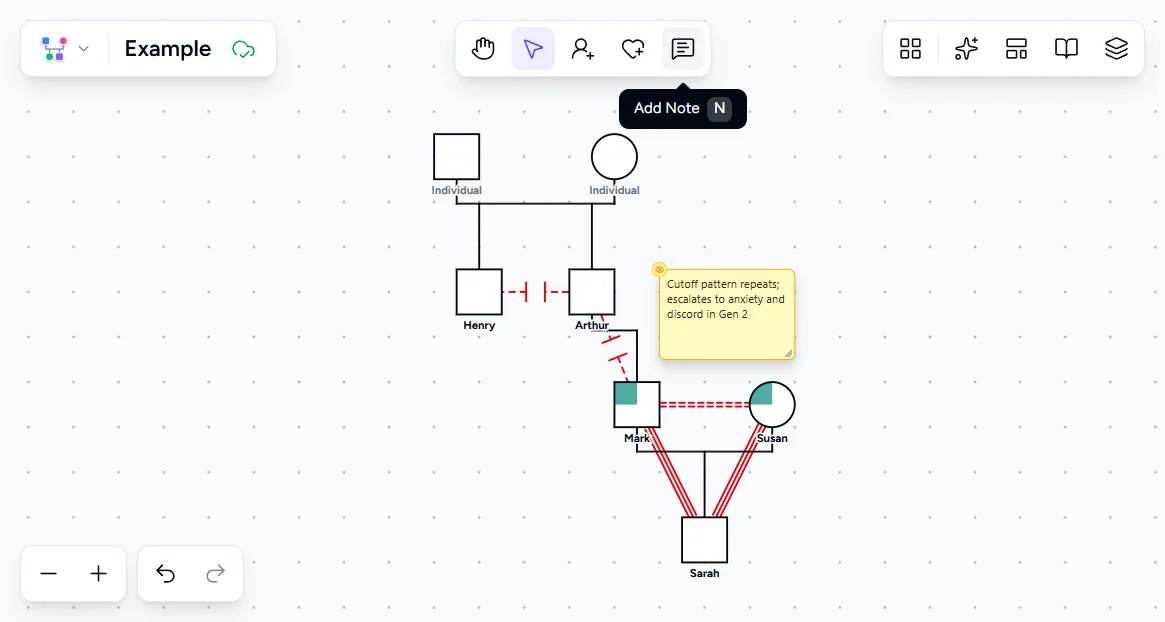
Two cutoff lines (Arthur to Henry, and Mark to Arthur) and anxiety clustering in the couple at the center. Follow the triangle connecting Mark, Susan, and their daughter Sarah.
Use as TemplatePatterns to look for
Multigenerational transmission process
Murray Bowen observed that families transmit levels of emotional differentiation (the capacity to think clearly under relational stress) from one generation to the next. When differentiation is low, successive generations may show more emotional reactivity. This is the multigenerational transmission process: not a single dramatic event, but an accumulation of patterns across time.
Transmission does not always intensify linearly. McGoldrick notes that "an alcoholic father may have children who become teetotalers, but whose children may again become drinkers." Patterns can skip generations, reverse, or shift form. What persists is the underlying level of differentiation, even when the surface behaviors look different.
On a genogram, look for the same symptom or relational pattern appearing in multiple generations, whether intensifying, skipping, or changing form. A grandparent's occasional tension may become a parent's chronic anxiety, which may become a child's symptomatic behavior, or it may skip a generation and reappear in a different guise. The pattern is not a moral failing. It is a system doing what systems do: repeating what was never resolved. To trace a transmission pattern in a family you are working with, open the free genogram maker and lay out the generations side by side.
Questions to explore:
- What emotional patterns appear in at least two generations of this family?
- Has the intensity of those patterns increased or decreased over time?
- Which generation first showed the symptom that the focus person now presents with?
- Who has broken a destructive pattern in this family, and how?
Emotional cutoff
Emotional cutoff describes how people manage unresolved emotional attachment to their families by reducing or eliminating contact instead of working through it. The cutoff can be physical (moving across the country, refusing phone calls) or emotional (staying in the same room but shutting down internally). On a genogram, a segmented line (broken into pieces with gaps, drawn in red) represents a cutoff.
Cutoff feels like a solution. It stops the immediate pain of a conflicted relationship. But Bowen found that cutoff buries tension rather than resolving it. The person who cuts off from a parent often recreates the same intensity in their next significant relationship, whether with a spouse, a child, or a workplace. The unresolved attachment does not disappear. It migrates.
Questions to explore:
- When did the cutoff begin, and what triggered it?
- What relationships intensified after the cutoff occurred?
- Has anyone in the family attempted to repair a cutoff, and what happened?
- What coping strategies has the family used to manage the loss of that relationship?
Triangulation
A triangle is the smallest stable relationship unit. When tension between two people exceeds their ability to manage it, they pull in a third person (a child, an in-law, a therapist) to stabilize the system. This is triangulation. It reduces anxiety in the original pair but overloads the third person, who now carries tension that was never theirs.
Bowen considered the triangle the building block of all emotional systems. In calm periods, two people occupy the comfortable "inside" position and one is on the outside. When stress rises, the outside position becomes uncomfortable, and people cycle through positions. In families with low differentiation, triangles become rigid: the same person gets pulled into the stabilizing role again and again.
On a genogram, triangulation shows up as a child positioned between two parents in conflict, with fused relationship lines connecting them. The child may present as the "problem" (acting out, developing symptoms, performing perfectly), but the real issue is unmanaged tension in the couple above.
Questions to explore:
- Who gets pulled in when this couple argues?
- What role does the triangulated person play: mediator, distraction, or symptom-bearer?
- What happens to the couple's relationship when the third person is unavailable?
- Which relationships in this family provide stability for the triangulated person?
Anxiety as a system symptom
Individual diagnostic frameworks locate anxiety inside a person: their neurobiology, their cognition, their history. Bowen's framework adds a layer. Anxiety is also a property of the system. When a family operates with low differentiation and high emotional reactivity, anxiety circulates like voltage through a circuit. It lands on whichever member is least able to deflect it.
On a genogram, look for anxiety (or depression, or somatic symptoms) clustering in multiple family members at once, especially those connected by fused or conflictual bonds. When two spouses both carry the same diagnosis, it often signals system-level reactivity rather than coincidence. The question shifts from "Why is this person anxious?" to "Where is the anxiety in this system, and how does it move?"
Questions to explore:
- How many family members carry anxiety or mood-related conditions?
- Do symptoms in one member fluctuate with relational events (cutoffs, conflicts, transitions)?
- If the focus person's anxiety resolved tomorrow, what would change in the family system?
- What strengths does the focus person draw on when anxiety is at its lowest?
How to build this in Genogram Pro
Build a Bowenian genogram yourself
Open a blank canvas to map cutoffs, triangles, and the multigenerational pattern step by step.
make a genogram for freeEstablish the generational structure
Add Arthur and his brother Henry in the top generation. Then add Mark and Susan as the couple in the middle generation, and Sarah as their daughter in the third generation. Place each person in the correct generational row.

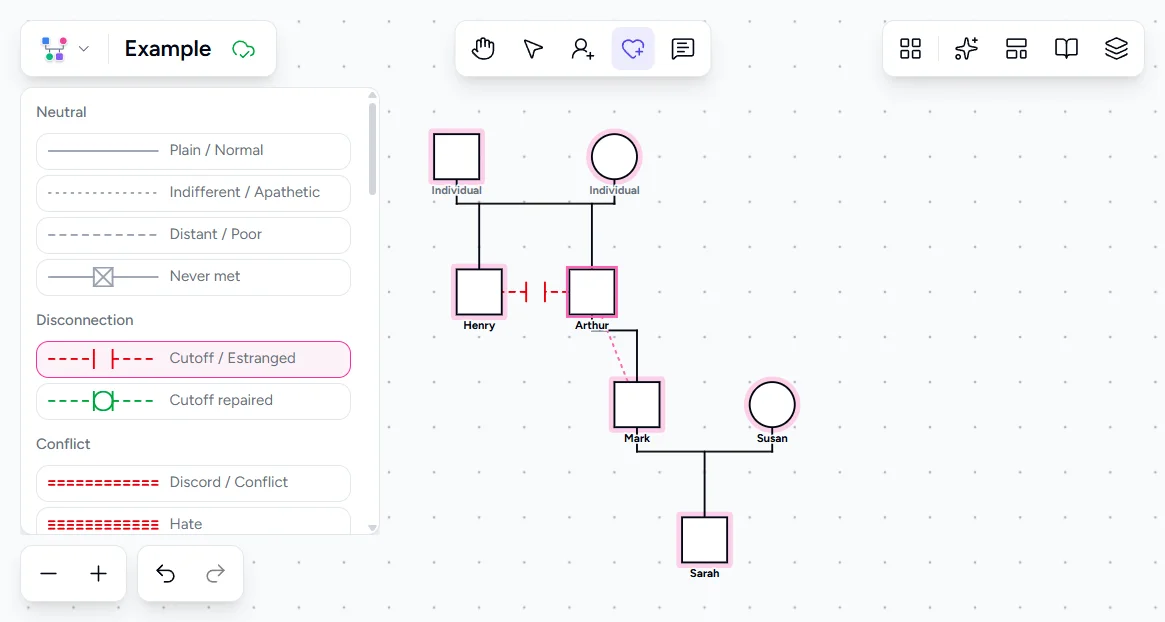
Apply emotional cutoff lines
Select Arthur, click Emotional Bond in the selection toolbar above him, then click Henry. In the bond type picker, choose cutoff. Repeat between Mark and Arthur. These two cutoffs are the backbone of the genogram's clinical story.
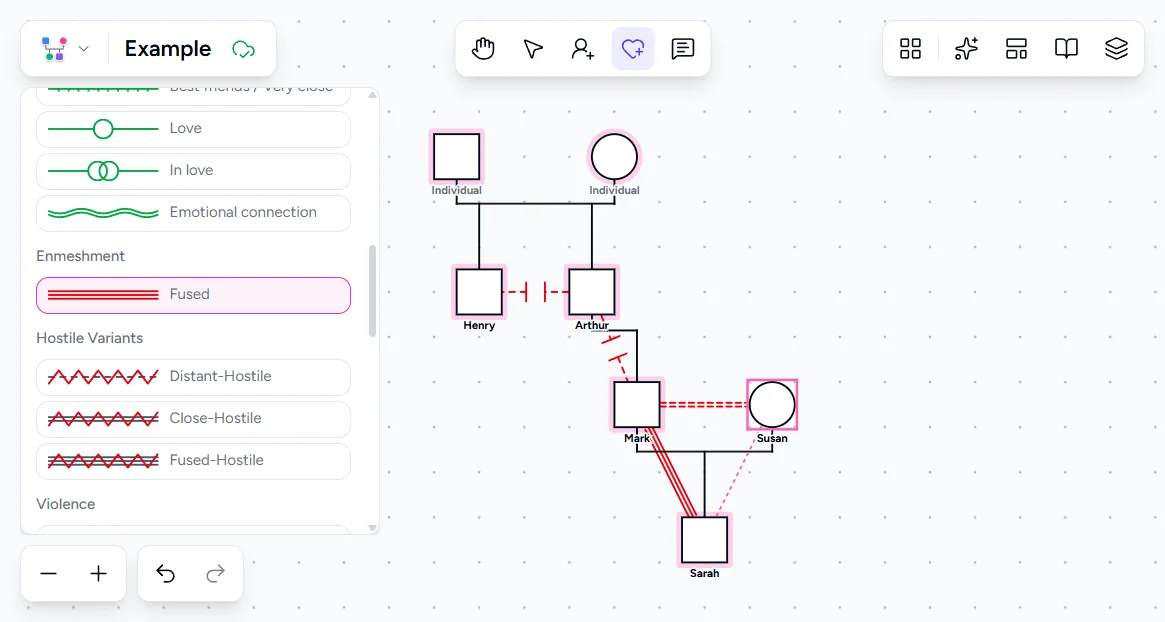
Add discord and triangulation
Select Mark, click Emotional Bond in the selection toolbar, then click Susan. Choose discord. Then select Mark, click Emotional Bond, and click Sarah to add a fused bond. Repeat from Susan to Sarah. These bonds show how Sarah is pulled into their conflict.
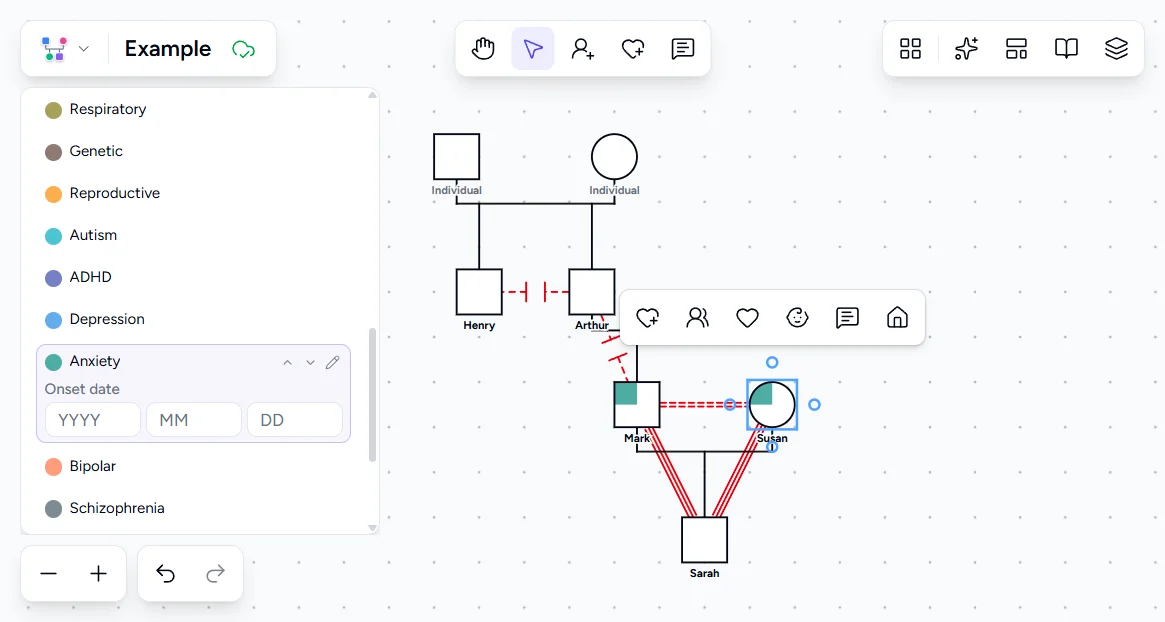
Assign conditions
Select Mark and add "Anxiety" from the condition presets. Do the same for Susan. This makes the shared symptom pattern across the couple visible.
Annotate the multigenerational pattern
Click the canvas to place a freeform note linking the two cutoffs across generations. A brief annotation like "Cutoff pattern repeats; escalates to anxiety and discord in Gen 2" helps any reader see the transmission process.
Clinical context
This genogram draws from Murray Bowen's family systems theory, developed at the National Institute of Mental Health and Georgetown University starting in the 1950s. Bowen identified eight interlocking concepts (differentiation of self, triangles, nuclear family emotional process, family projection process, multigenerational transmission process, emotional cutoff, sibling position, and societal emotional process). This example foregrounds four of them: differentiation of self, triangles, multigenerational transmission process, and emotional cutoff. Two others appear implicitly. The nuclear family emotional process is visible in how Mark and Susan's couple system absorbs and circulates anxiety. The family projection process is visible in how that couple-level tension gets directed toward Sarah, producing her symptoms.
Bowenian genograms are used in individual therapy (to help a client see their family as a system), couple therapy (to trace how each partner's family of origin contributes to current dysfunction), and supervision (to help trainees recognize when they are being triangulated into a family system). McGoldrick, Gerson, and Petry's Genograms: Assessment and Treatment remains the standard reference.
One caveat: Bowen's framework was developed in a mid-20th-century Anglo-American clinical context. Concepts like emotional cutoff and differentiation look different across cultures where interdependence is normative. Close involvement between generations is not inherently enmeshment, and physical distance is not inherently differentiation. McGoldrick writes that "all genograms should be cultural genograms," tracking ethnic background, migration history, language, acculturation, and experiences of oppression alongside family structure. Clinicians should apply these concepts with cultural humility, using the genogram for inquiry rather than diagnosis.
Emotional bond lines are approximations. McGoldrick notes they are "the least reliable lines on a genogram because they are inevitably oversimplified." Two clinicians may draw different bonds between the same pair. Bond lines should be treated as starting points for conversation, not as established facts about a relationship.
McGoldrick emphasizes that every genogram assessment should include strengths and resilience alongside problems. A genogram that maps only dysfunction tells half the story. In a Bowenian genogram, identifying who in the family has differentiated successfully, maintained healthy bonds, or broken a reactive cycle is as clinically valuable as mapping the problems.
Frequently Asked Questions
What is a Bowen family therapy genogram?
How does emotional cutoff appear on a genogram?
Can anxiety in a couple indicate a system-level problem?
Is Bowen's approach applicable to non-Western families?
Ready to Create Your Own Genogram?
Build professional genograms online with standard notation, AI-powered generation, and end-to-end encryption.