
Table of Contents
Triangulation genogram: understanding triangles in family systems theory
Conflict between two people is unstable. Under enough pressure, a dyad will recruit a third person, a child, an in-law, a friend, to absorb, redirect, or stabilize the tension. This is triangulation. Murray Bowen considered it the most basic process in family emotional systems. A triangulation genogram maps these three-person structures. It shows who carries the tension, who benefits from the redirection, and how overlapping triangles can lock an entire family into rigid patterns.
Last updated March 2026 · Based on McGoldrick et al., Genograms: Assessment and Treatment (4th ed., 2020)
This example is designed to illustrate how to create and read genograms. It is not intended as clinical guidance.
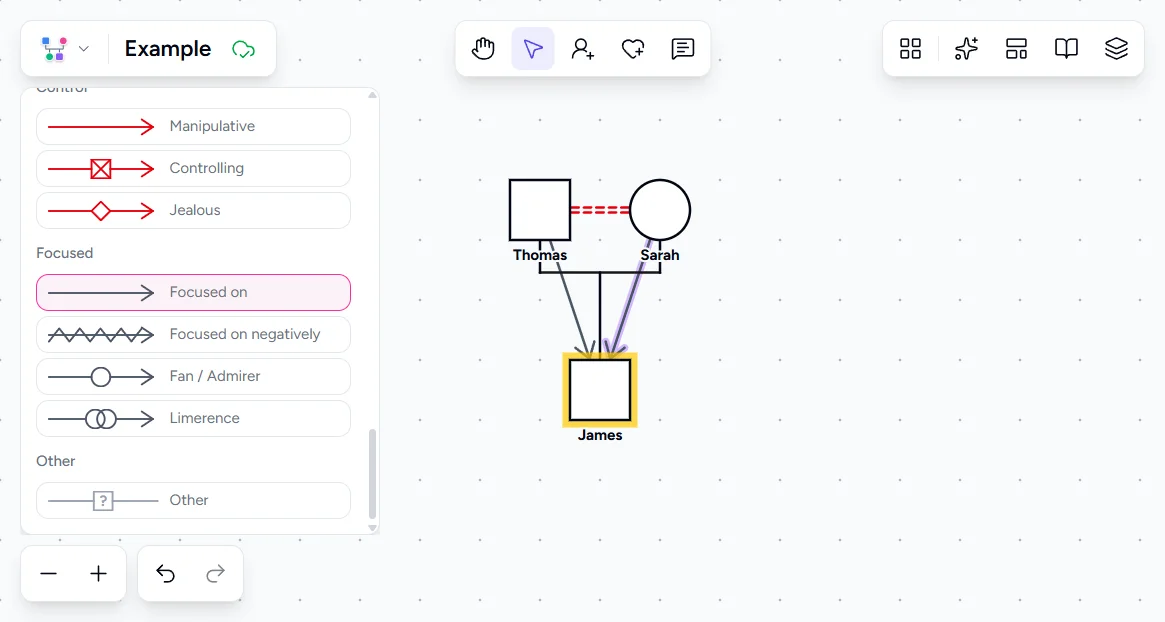
Identify the primary triangle: Thomas and Sarah Thompson (discord line) with their son James (focus person, mediator) between them. Then notice the cross-generational coalition: Sarah Thompson fused with Susan Miller, creating a second triangle that crosses the generational boundary.
Use as TemplatePatterns to look for
Triangle structure identification
A triangle is the smallest stable emotional unit. Bowen observed that a two-person relationship is inherently unstable under stress: the tension between two people exceeds their capacity to contain it, and they pull in a third party. This third person does not resolve the conflict. They absorb or redirect it, lowering anxiety in the original pair at their own expense.
On a genogram, a triangle appears as three people connected by relationship lines with an imbalanced distribution of tension. The classic configuration: two people with a discord or conflict line between them, both connected to a third person by focused-on, fused, or close bonds. The conflict line shows where the tension originates. The bonds to the third person show where it goes. To map a triangle from your own caseload, you can build a genogram free online.
Map a triangle yourself
Open the free editor to place the couple, add the third person, and draw the bonds that form the triangle.
free genogram makerIdentifying triangles requires looking beyond individual relationship lines to the pattern they form together. A single discord line between a couple is a relational fact. That same discord line combined with focused-on bonds converging on a child is a triangle, a structural pattern with its own rules and consequences. Keep in mind that emotional bond lines are approximations. McGoldrick notes they are "the least reliable lines on a genogram" because they oversimplify complex dynamics. Use annotations to add context that line types alone cannot convey.
Questions to explore:
- Which three people form the triangle, and what relationship lines connect them?
- Who occupies the "inside" position (absorbing tension) versus the "outside" position?
- Does the triangle's configuration shift under different stress conditions?
- Which relationships in the family function as stabilizing forces outside the triangle pattern?
Detouring triangles
Detouring is a form of triangulation in which a couple redirects their conflict through a child rather than addressing it directly. Instead of fighting with each other, the parents focus jointly on the child, either as a shared problem (the child acts out, fails at school, develops symptoms) or as a shared project (the child must be protected, managed, or rescued). The couple's relationship appears stable because they have a shared focus, but the stability is purchased at the child's expense.
On a genogram, a detouring triangle looks like convergence: two focused-on bonds from both parents pointing at the same child, with a discord or distant line between the parents. The child may present as the identified patient, the family member with symptoms, but the genogram shows that the child's symptoms function to keep the parents connected through shared concern rather than confronting their unresolved conflict.
The detouring pattern is hard to see from inside the system because the family does not recognize it. The parents genuinely believe the problem is the child. They seek therapy for the child's behavior, grades, or anxiety. The genogram redirects the clinical gaze: the symptom is in the child, but the tension is in the couple.
Questions to explore:
- Do both parents agree that the child is "the problem," while avoiding discussion of their own relationship?
- What happens to the couple's conflict level when the child is unavailable (at camp, with a friend, in a session alone)?
- Does the child's symptom intensity track with the couple's conflict intensity?
- What has the child managed to sustain (friendships, interests, school performance) despite the triangulated position?
Cross-generational coalitions
A cross-generational coalition occurs when one parent allies with someone outside the couple, usually their own parent, a sibling, or a friend, against the other parent. This coalition violates the generational hierarchy: instead of the couple functioning as a unified parental subsystem, one parent has recruited an ally from another generation or family. The allied pair shares a fused bond, and the excluded parent faces opposition from both.
Minuchin identified cross-generational coalitions as a structural violation in dysfunctional families. The coalition undermines the couple subsystem, triangulates the outside ally, and leaves the excluded parent feeling powerless, angry, or withdrawn. That reaction escalates the conflict that created the coalition in the first place.
On a genogram, a cross-generational coalition appears as a fused bond between one partner and a person outside the nuclear family, combined with discord between the couple. The fused bond and the discord line work together: the stronger the coalition grows, the more the excluded partner withdraws or escalates, which further strengthens the coalition.
Questions to explore:
- Does one partner have an ally outside the couple who is regularly involved in marital issues?
- Does the outside ally take sides, offer validation to one partner, or communicate displeasure to the other?
- Has the excluded partner ever confronted the coalition, and what was the result?
- Are there extended family members who have maintained balanced relationships with both partners?
Multiple overlapping triangles
Families rarely contain a single triangle. Most families operate within a network of overlapping triangles that interlock and reinforce each other. When one triangle is stressed, the tension may shift to an adjacent triangle. When one triangle is disrupted (through therapy, cutoff, or a life event), the system may activate another triangle to compensate.
On a genogram, overlapping triangles appear when the same person participates in more than one three-person pattern. A child who mediates between parents (Triangle 1) may also be pulled between a parent and a grandparent (Triangle 2). A parent who has a cross-generational coalition with their mother may also detour conflict through a child. Mapping these overlapping structures shows the full complexity of the family's emotional architecture.
Understanding overlapping triangles matters for treatment planning. Intervening in one triangle without recognizing its connections to others may shift the tension rather than resolve it. The child de-triangulated from the parental conflict may find that the system redirects tension to another family member, or that the cross-generational coalition intensifies to compensate.
Questions to explore:
- How many distinct triangles can you identify on this genogram?
- Which family members participate in more than one triangle?
- If you resolved the primary triangle, which other triangles would be affected?
- Are there any family relationships that have remained flexible and non-triangulated, and what can those relationships teach about healthier patterns?
How to build this in Genogram Pro
Build the couple and child structure
Add Thomas Thompson and Sarah Thompson as a married couple. Add James as their son and set him as the focus person. He will display a yellow outline. Position the couple at the top and James below.

Draw the discord line
Select Thomas, click the Emotional Bond button in the selection toolbar, then click Sarah. Choose the discord bond type (double dashed line) from the picker. This is the origin of all tension in the system, the line that drives the triangulation.

Add focused-on bonds to James
Select Thomas, click the Emotional Bond button in the selection toolbar, then click James. Choose the focused-on bond type. Repeat from Sarah to James. These converging lines, combined with the discord above, form the visual triangle. The convergence on James shows his mediator role.
Add the cross-generational coalition
Add Susan Miller to the genogram. Select Sarah Thompson, click the Emotional Bond button in the selection toolbar, then click Susan Miller. Choose the fused bond type (triple line). This coalition line, combined with the Thomas-Sarah discord, creates the second triangle.

Annotate triangle roles
Select each person and click the Note button in the selection toolbar to label their role in the triangulation pattern. James: "Mediator, absorbs parental conflict." Susan Miller: "Coalition partner, allies with Sarah against Thomas." Thomas: "Excluded, faces opposition from coalition."

Clinical context
Triangulation is one of Bowen's eight interlocking concepts and is foundational to family systems theory. Bowen described the triangle as the "molecule" of emotional systems, the basic building block from which all larger relational structures are assembled. His central insight was that triangles are not pathological in themselves; they are universal. Every family has them. The clinical question is whether the triangles are flexible (people move in and out of positions as stress fluctuates) or rigid (the same person is permanently locked in the tension-absorbing position).
In clinical practice, triangulation genograms are used in couple therapy (to show how the couple detours conflict), family therapy (to de-triangulate children who carry parental tension), and supervision (to help therapists recognize when they have been triangulated into the system, a common occupational hazard). Minuchin's structural framework adds the concept of cross-generational coalitions, which violate the boundary between the couple subsystem and the extended family.
McGoldrick, Gerson, and Petry emphasize that effective genogram assessment includes triangle mapping. They recommend asking: "When these two people fight, who gets pulled in?" This single question can uncover the system's primary triangle. Clinicians should note that triangulation patterns look different across cultures. In some families, the involvement of extended family in couple conflicts is normative and expected, not inherently dysfunctional. The genogram should generate inquiry, not automatic pathologizing.
A genogram generates hypotheses, not conclusions. Identifying a triangulation pattern suggests a relational tendency, not a fixed diagnosis. McGoldrick stresses that genograms "cannot be used in a cookbook fashion to make clinical predictions." Clinicians should also look for resilience: Which relationships serve as stabilizing forces? Has the family developed any healthy strategies for managing conflict directly?
Frequently Asked Questions
What is triangulation in family systems theory?
How do you identify a triangle on a genogram?
What is a cross-generational coalition?
How does a therapist "de-triangulate" a family member?
Ready to Create Your Own Genogram?
Build professional genograms online with standard notation, AI-powered generation, and end-to-end encryption.