
Table of Contents
Enmeshment vs. healthy boundaries genogram: visualizing fused and differentiated family bonds
Some families are so tightly woven that members cannot tell where one person's emotions end and another's begin. Other families maintain closeness without sacrificing individual autonomy. The difference between enmeshment and healthy connection is hard to spot in conversation, but it becomes clear on a genogram, where triple lines of fusion stand next to balanced close bonds.
Last updated March 2026 · Based on McGoldrick et al., Genograms: Assessment and Treatment (4th ed., 2020)
This example is designed to illustrate how to create and read genograms. It is not intended as clinical guidance.
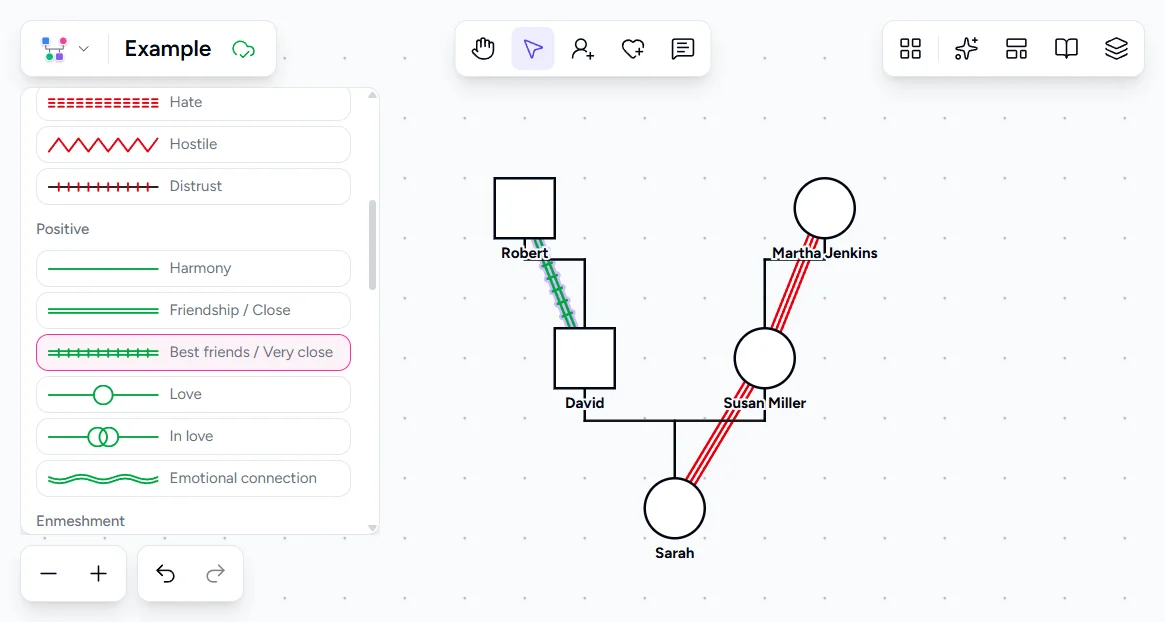
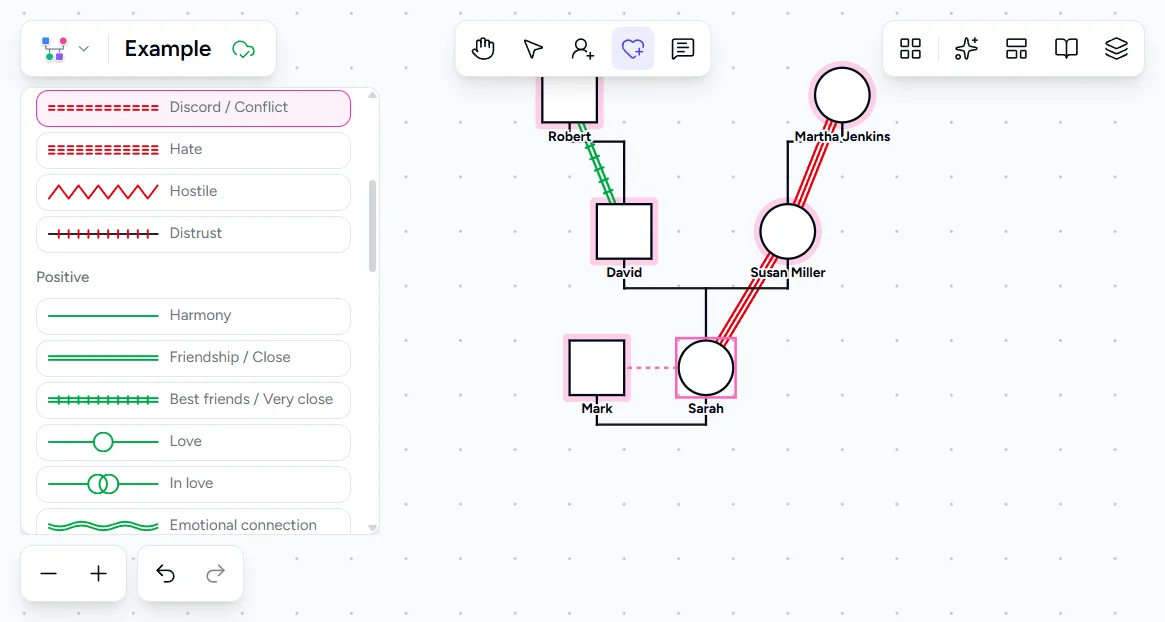
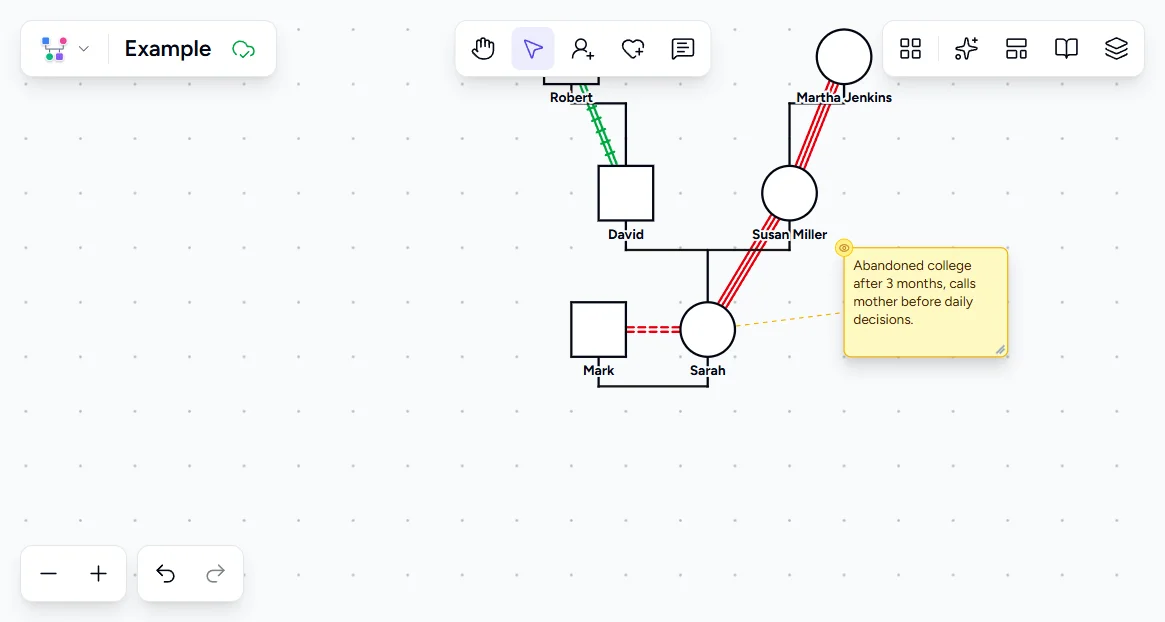
Compare the maternal line (Martha Jenkins to Susan Miller to Sarah, connected by fused-bond lines) with the paternal line (Robert to David, a close bond). Notice the discord line between Sarah and Mark.
Use as TemplatePatterns to look for
Fused bonds across generations
Enmeshment, what Salvador Minuchin called the product of "diffuse boundaries," is not a single relationship problem. It is a multigenerational pattern. When a mother and daughter share a fused bond, the daughter often replicates that same intensity with her own child. Each generation inherits not just closeness but the inability to maintain a separate self within closeness.
Enmeshment as a concept comes from Minuchin's structural family therapy, which focuses on present-moment boundaries. The multigenerational view, tracing fused bonds across generations, draws on Bowen's transmission framework. Both perspectives are useful, and clinicians often combine them.
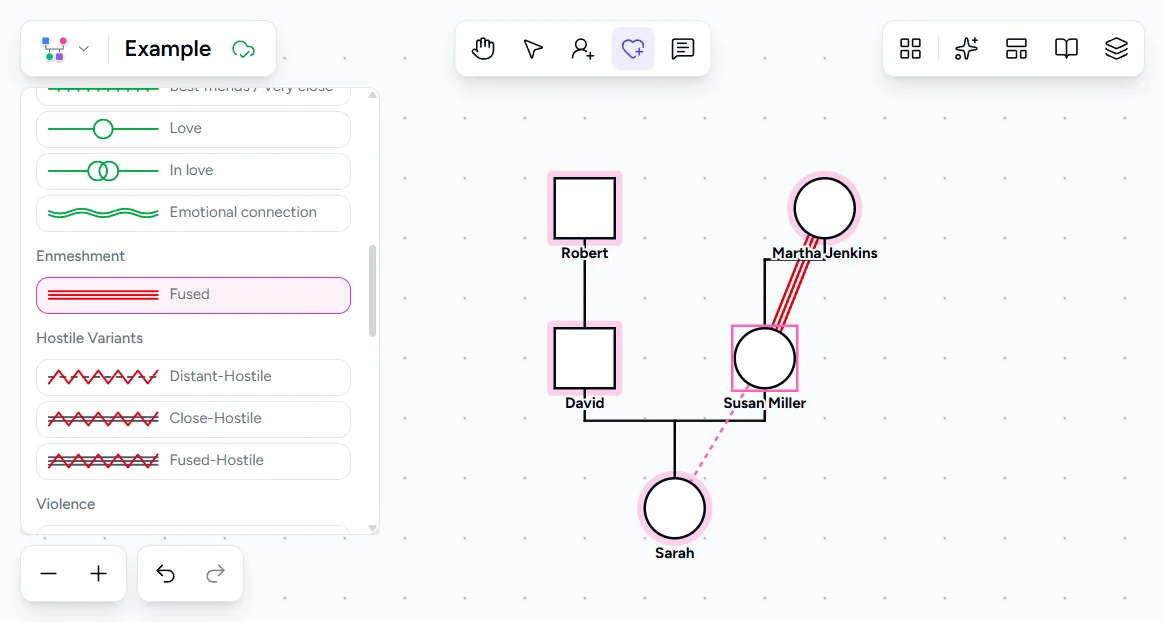
On a genogram, fused bonds are represented by triple parallel lines. When these triple lines appear in the same lineage across two or more generations, the pattern has structural depth. It is not one overly close pair. It is a family culture of enmeshment that equates love with merger and separation with betrayal.
Questions to explore:
- In which lineage do the fused bonds appear: maternal, paternal, or both?
- How many generations back does the pattern extend?
- Has anyone in this lineage differentiated without being cut off?
- Which relationships in this family model healthy closeness?
Draw fused and close bonds
Compare triple fused lines against healthy close bonds across generations in the free editor.
build it freeBehavioral markers of enmeshment
Enmeshment is a structural concept, but it produces observable behaviors. Adults who grew up in enmeshed systems struggle with independent decision-making. They experience guilt when prioritizing their own needs. They maintain daily contact patterns that function as emotional regulation rather than genuine connection. They abandon pursuits that would create distance from the fused family member.
The genogram captures the structure (fused bond lines). The clinical intake reveals the behaviors that give those lines meaning. Look for inability to sustain commitments outside the family, compulsive check-in behaviors, and difficulty articulating personal preferences without consulting the fused person.
Questions to explore:
- What life transitions has the enmeshed person attempted and abandoned?
- What is the frequency and function of contact between fused family members?
- Does the person report difficulty identifying their own preferences, separate from their parent's expectations?
- What contexts or relationships allow the enmeshed person to function most independently?
Differentiation contrast
Not all close relationships are enmeshed. A genogram becomes most informative when it shows both fused and healthy bonds in the same family. Differentiation, Bowen's term for the capacity to maintain a clear sense of self while remaining emotionally connected, does not mean distance. It means being close without losing boundaries.
Minuchin's structural framework distinguishes between diffuse boundaries (enmeshment), rigid boundaries (disengagement), and clear boundaries (healthy functioning). On a genogram, a double line indicating closeness looks different from a triple line indicating fusion. The distinction is not just visual. It reflects fundamentally different relational capacities.
Questions to explore:
- Are there relationships in this family that model healthy closeness without fusion?
- How does each partner's family of origin define "close"?
- Does the differentiated family member experience the enmeshed member's behavior as controlling, and vice versa?
- What strengths does the differentiated side of the family demonstrate that could inform treatment?
Decision-making paralysis
One of the most clinically significant consequences of enmeshment is the erosion of autonomous decision-making. When a person has been embedded in a fused system since birth, making a choice without consulting the fused other can feel genuinely dangerous. This is not indecisiveness as a personality trait. It is a structural deficit produced by growing up in a system that never required or rewarded independent thought.
On a genogram, decision-making paralysis does not have its own symbol. It is inferred from fused bond lines combined with the clinical narrative. When a client describes being unable to choose a meal, a career, or a partner without first calling their mother, and the genogram shows multigenerational fusion, the connection is clear. The paralysis is the symptom of a system that never built the architecture for separate selfhood.
Questions to explore:
- What happens emotionally when the client makes a decision without consulting the fused person?
- Does the client describe their own preferences, or do they describe what their parent would want?
- Has the fused parent ever supported the client's independent choices, or does autonomy trigger distress in the parent?
- What decisions has the client made independently, and what made those possible?
How to build this in Genogram Pro
Build the maternal and paternal lineages separately
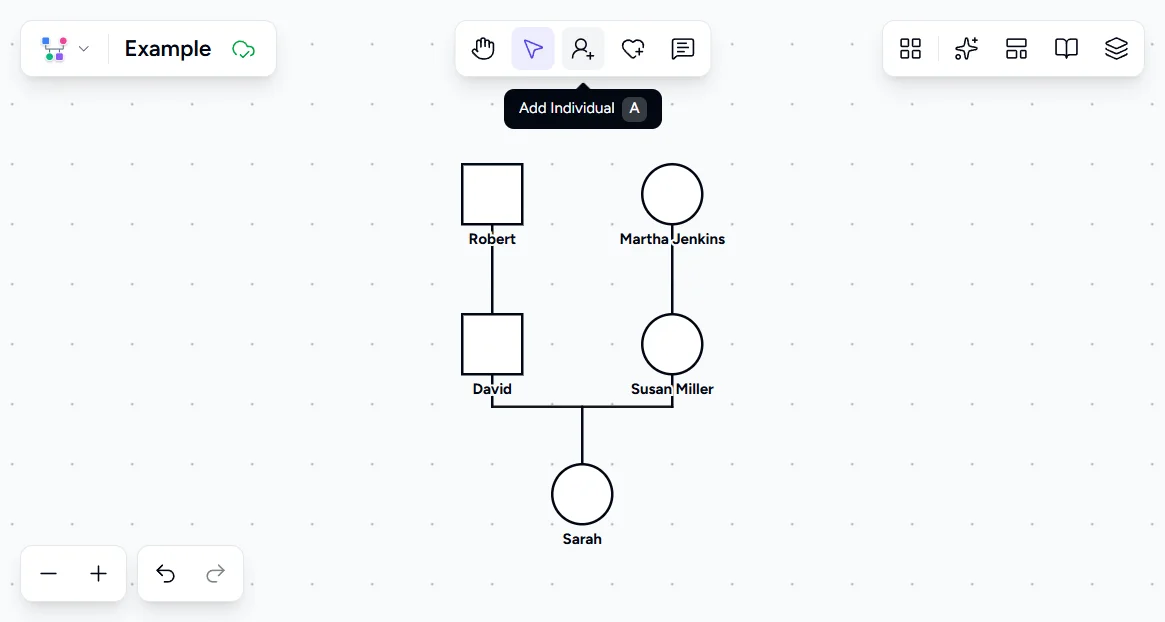
Add Martha Jenkins at the top of the maternal line, Susan Miller in the middle generation, and Sarah in the lowest generation. On the paternal side, add Robert at the top and David in the middle generation. This dual-line structure is the foundation for comparison.
Apply fused bond lines to the maternal lineage
Select Martha, click Emotional Bond in the selection toolbar, then click Susan. Choose fused from the bond type picker. Repeat between Susan and Sarah. These two fused bonds are the visual anchor of the genogram.
Apply a close bond to the paternal lineage
Select Robert, click Emotional Bond in the selection toolbar, then click David. Choose close from the bond type picker. This healthy bond provides the differentiation contrast.
Add the couple relationship
Select Sarah, click Emotional Bond in the selection toolbar, then click Mark. Choose discord from the bond type picker. This shows how enmeshed and differentiated family templates collide in the couple system.
Add behavioral annotations
Select Sarah, then click Note in the selection toolbar to attach a note with behavioral markers: "Abandoned college after 3 months," "Calls mother before daily decisions." These annotations connect the structural diagram to the clinical data.
Clinical context
This genogram draws on Salvador Minuchin's structural family therapy, which introduced family boundaries as a core unit of assessment. Minuchin's framework distinguishes enmeshed systems (diffuse boundaries, emotional merger) from disengaged systems (rigid boundaries, emotional isolation), with clear boundaries representing the adaptive middle. The genogram maps these boundary types visually, making it possible to compare different subsystems within the same family.
Enmeshment genograms are commonly used in family therapy assessment, couple therapy (when partners come from structurally different families of origin), and treatment planning for young adults who struggle with autonomy.
A genogram generates hypotheses for further exploration, not conclusions. McGoldrick writes that it "cannot be used in a cookbook fashion to make clinical predictions." The enmeshment pattern visible on a genogram is a starting point for clinical inquiry, not an automatic diagnosis.
McGoldrick emphasizes that every genogram assessment should include strengths and resilience alongside problems. A genogram that maps only dysfunction tells half the story. Even in enmeshed systems, some members maintain outside friendships, pursue independent goals, or find ways to stay connected without merging. Mapping these capacities alongside the fused bonds provides a fuller clinical picture.
A cultural caveat: enmeshment is a clinical construct developed in a Western, individualist framework. Many cultures value multigenerational closeness, collective decision-making, and daily family contact. What looks like enmeshment through a Minuchin lens may be healthy interdependence in another cultural context. Clinicians should assess whether the closeness causes distress and functional impairment before applying the enmeshment label. The genogram should prompt questions, not verdicts.
Frequently Asked Questions
What does enmeshment look like on a genogram?
How is enmeshment different from a close family relationship?
Can enmeshment affect adult romantic relationships?
Is enmeshment always harmful?
Ready to Create Your Own Genogram?
Build professional genograms online with standard notation, AI-powered generation, and end-to-end encryption.