
Table of Contents
Codependency genogram: mapping enabling patterns across generations
Codependency does not emerge from nowhere. It is learned across three or more generations, in families where someone is always in crisis and someone else is always managing that crisis. The caretaker-addict pair repeats with remarkable consistency: the substances and the people change, but the relational structure stays the same. A genogram traces this structure and shows that the person presenting with anxiety or depression may be the latest link in a chain of inherited caretaking.
Last updated March 2026 · Based on McGoldrick et al., Genograms: Assessment and Treatment (4th ed., 2020)
This example is designed to illustrate how to create and read genograms. It is not intended as clinical guidance.
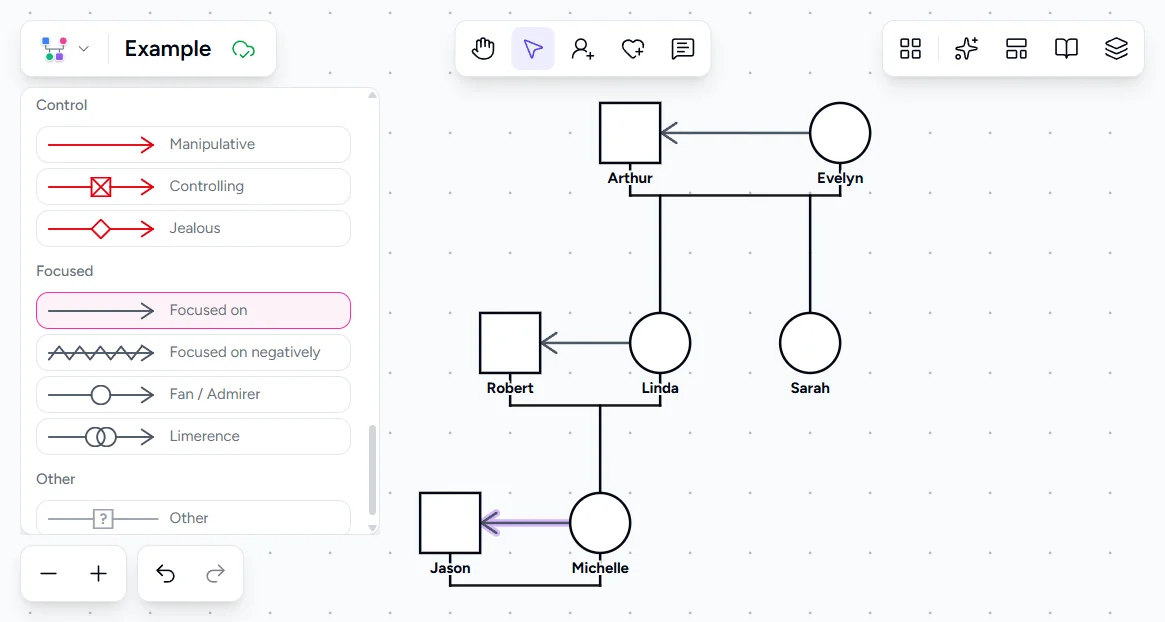
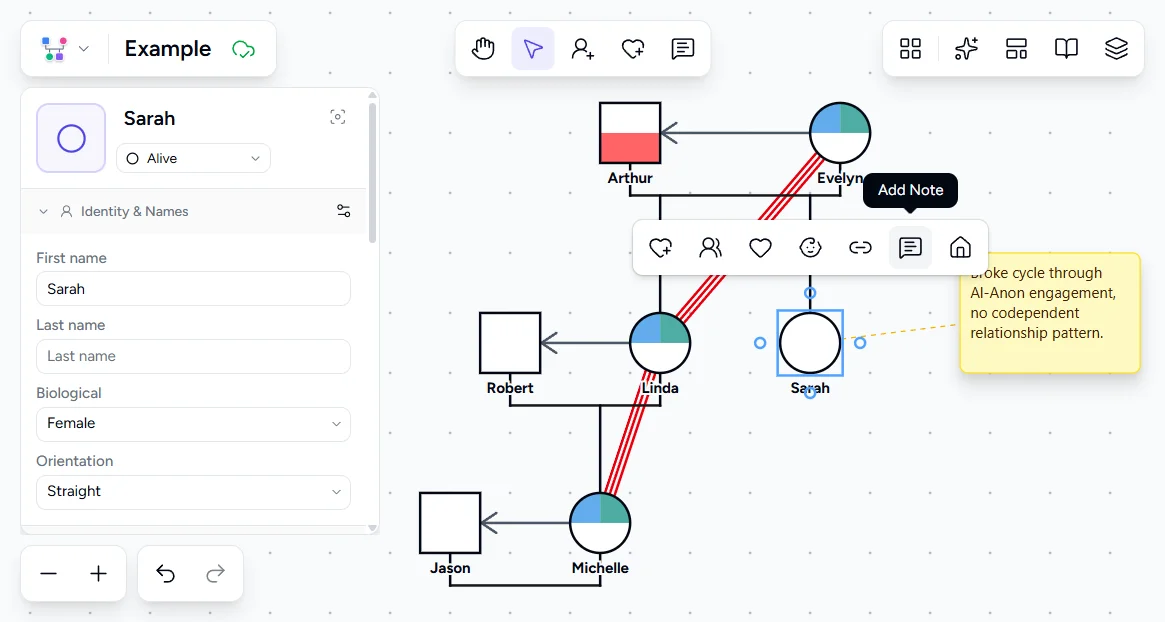
Follow the focused-on bonds across three generations: Evelyn to Arthur, Linda to Robert, Michelle to Jason. Anxiety and depression appear in each generation's caretaker, not in the person with the addiction. Sarah is the positive outlier who broke the cycle through Al-Anon.
Use as TemplatePatterns to look for
The caretaker-addict dyad
The core structure of codependency on a genogram is the focused-on bond, a relationship line indicating that one partner is chronically oriented toward managing, monitoring, or rescuing the other. In families with addiction, this bond connects the caretaker to the addicted member. The caretaker organizes their life around the other person's substance use: covering for them, managing consequences, and suppressing their own needs.
What makes this a genogram pattern rather than a single relationship dynamic is repetition. When the same focused-on bond appears in consecutive generations (grandmother to grandfather, mother to father, daughter to partner), the structure becomes visible as a family template. Each generation's caretaker did not independently decide to partner with someone in crisis. They inherited a relational blueprint that defines love as rescue and connection as management.
Questions to explore:
- In how many generations does the focused-on bond appear?
- Does the caretaker in each generation recognize their role, or do they describe it as "just helping"?
- What would happen to the relationship if the caretaker stopped managing the partner's behavior?
- Which family members have maintained their own well-being despite the addiction in the system?
Trace the enabling pattern
Open the free editor to draw focused-on bonds and see where the conditions cluster.
open the free genogram makerInherited caretaking identity
Codependency is often described as a relationship pattern, but for many individuals it functions as an identity. The caretaker in a codependent system learns early that their value comes from being needed. This learning happens not through explicit instruction but through observation and emotional reinforcement: a child watches her mother orient her entire life around managing her father's addiction. She absorbs the lesson that love means sacrifice, that selflessness is virtue, and that her own needs are secondary.
On a genogram, look for fused bonds between the caretaker and their same-sex parent, especially in the mother-daughter line. These fused bonds represent the transmission channel for caretaking identity. The daughter does not just learn to caretake. She fuses with a mother who caretakes, absorbing the role as part of her core self.
Questions to explore:
- How does the client describe their relationship with their same-sex parent?
- Does the client feel guilty or anxious when they are not caretaking someone?
- Can the client articulate personal goals that are not organized around another person's needs?
- What interests or abilities does the client have that exist outside the caretaking role?
Boundary erosion markers
Codependency erodes boundaries, the invisible lines that distinguish one person's emotional responsibility from another's. On a genogram, boundary erosion shows up as a combination of fused bonds and anxiety or depression in the caretaker. The fusion represents the structural erosion: where one person ends and the other begins has become unclear. The anxiety or depression represents the cost: the caretaker's emotional system is overloaded from carrying two people's worth of emotional labor.
This combination reframes the caretaker's symptoms. Linda does not have anxiety and depression because something is wrong with Linda. She has anxiety and depression because she has spent decades suppressing her own needs, monitoring another person's behavior, and maintaining the appearance of family normalcy. The symptoms are the body's response to an unsustainable relational position.
Questions to explore:
- Do mood or anxiety symptoms appear primarily in the caretaking partner across generations?
- When did the caretaker's symptoms first appear: before or after entering the codependent relationship?
- Does the caretaker minimize their own symptoms because "the real problem" is the other person?
- What coping strategies have helped the caretaker manage, even if imperfectly?
The health cost of caretaking
Chronic codependency is not emotionally neutral. Research consistently shows that long-term caretakers in addicted family systems experience higher rates of anxiety, depression, somatic complaints, and immune dysfunction. The genogram does not directly measure health outcomes, but it tracks where conditions cluster. When anxiety and depression appear in every generation's caretaker, and not in other family members in different structural positions, the genogram tells a health story.
This pattern goes unrecognized because the caretaker does not present as the focus person. They come to therapy because of their partner's behavior, their child's acting out, or a vague sense that something is wrong. The genogram redirects attention: the person whose symptoms have been invisible may actually be the one most in need of care.
Questions to explore:
- Has the caretaker ever been the focus of clinical attention, or have they always been "the one who's fine"?
- What physical health conditions does the caretaker carry, and when did they emerge?
- If the caretaker were to prioritize their own health, what would have to change in the family system?
- What sources of support exist for the caretaker outside the codependent relationship?
Breaking the cycle: the positive outlier
Not every family member replicates the pattern. On some codependency genograms, one person diverges. They recognize the pattern and take deliberate steps to break it. This positive outlier is clinically significant because they demonstrate that the cycle is not inevitable.
Questions to explore:
- What allowed the positive outlier to see the pattern that others could not?
- Did the positive outlier face family resistance or rejection when they changed their behavior?
- How can the positive outlier's experience inform treatment planning for the current focus person?
How to build this in Genogram Pro
Map three generations with couple relationships
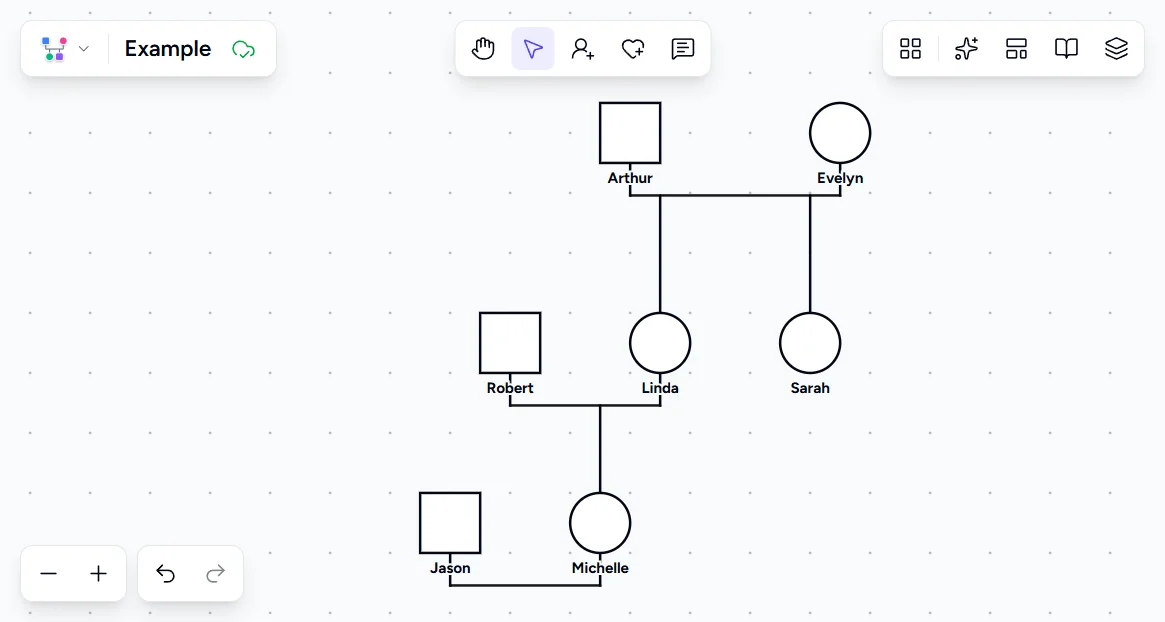
Add Evelyn and Arthur in the top generation, Linda and Robert in the middle, and Michelle and Jason in the current generation. Include Sarah as Evelyn's second daughter in the middle generation.
Draw focused-on bonds for each caretaker-addict dyad
Select Evelyn, click Emotional Bond in the selection toolbar, then click Arthur. Choose focused from the bond type picker. Repeat from Linda to Robert, and from Michelle to Jason.
Add fused mother-daughter bonds
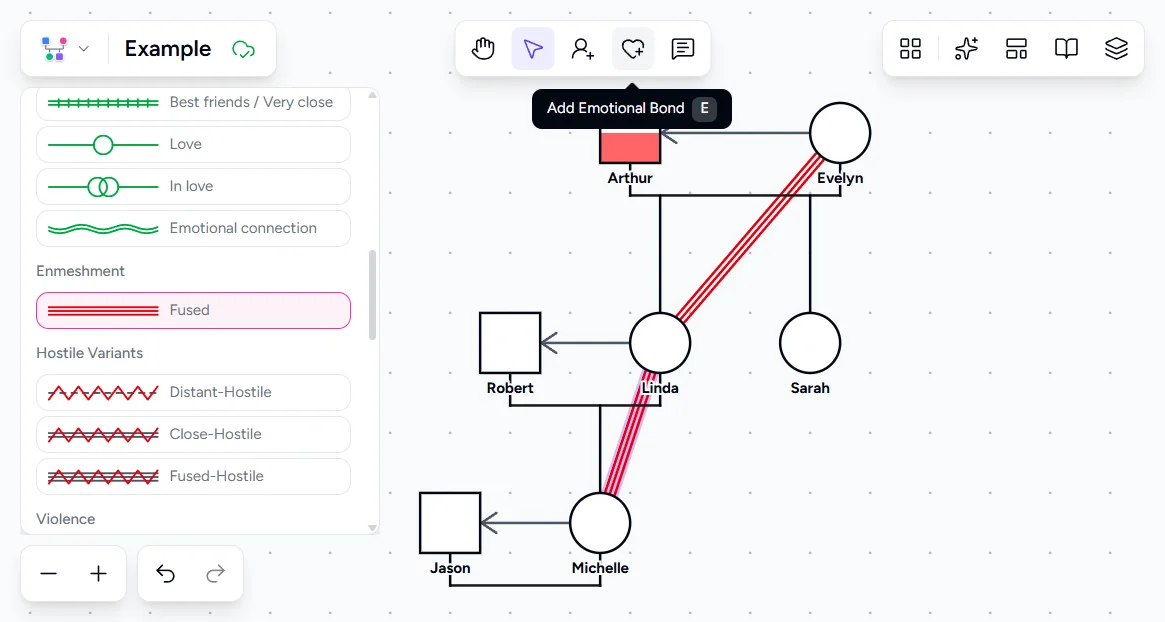
Select Evelyn, click Emotional Bond in the selection toolbar, then click Linda. Choose fused. Repeat between Linda and Michelle. These represent the transmission channel for the caretaking identity.
Assign conditions to caretakers
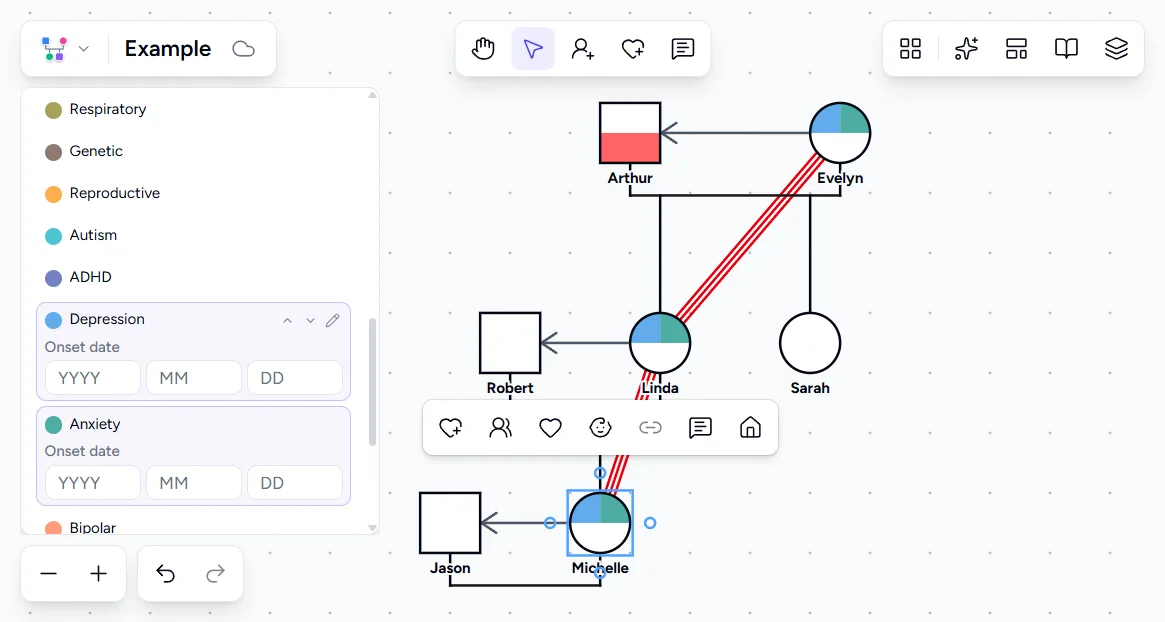
Select Arthur and add a condition from the addiction category. Select Linda, add "Anxiety" and "Depression" from the condition presets. Do the same for Michelle. Note that conditions cluster in the caretakers, not in random family members.
Mark the positive outlier
Select Sarah, then click Note in the selection toolbar to attach a note: "Broke cycle through Al-Anon engagement, no codependent relationship pattern."
Clinical context
Codependency genograms draw on both Bowenian concepts (multigenerational transmission, fusion) and addiction-informed family therapy frameworks. Bowen's observation that families transmit levels of differentiation across generations maps directly onto the codependency pattern: each generation's caretaker shows slightly less differentiation, slightly more fusion, and slightly more symptomatic distress than the last.
In clinical practice, codependency genograms are used in addiction treatment (to help family members see their own role in the system), individual therapy (to reframe anxiety and depression as systemic rather than purely individual), and family therapy (to identify the structural pattern that needs to change). Al-Anon and other family recovery programs align with the genogram's insights: recovery is not just for the addicted person but for the entire system.
McGoldrick, Gerson, and Petry note that genograms in addiction work should track who carries the emotional and physical health burden. That person is often not the addicted member but the partner or child who manages the fallout. This reframing can change treatment for caretakers who have never been the focus of clinical attention.
A genogram generates hypotheses for further exploration, not conclusions. The codependency pattern visible on a genogram is a starting point for clinical inquiry, not a definitive finding. Some caretaking behavior reflects genuine love rather than enmeshment, and the line between healthy support and codependency depends on context, cultural expectations, and whether the person experiences distress.
McGoldrick emphasizes that every genogram assessment should include strengths and resilience alongside problems. A genogram that maps only dysfunction tells half the story. In codependency work, the positive outlier (a family member who broke the cycle) is as clinically significant as the repeating pattern. Mapping recovery resources, outside support networks, and moments of healthy boundary-setting provides a more complete picture.
Cultural context matters here as well. Caretaking norms vary across cultures: what looks like codependency through a Western clinical lens may reflect culturally expected familial devotion. McGoldrick writes that "all genograms should be cultural genograms," tracking ethnic background, migration history, and cultural expectations alongside family structure. Clinicians should assess whether the caretaking causes functional impairment and distress before applying the codependency label.
Frequently Asked Questions
What does a codependency genogram show?
How do you represent enabling on a genogram?
Why does anxiety appear in the caretaker and not the addicted family member?
Can codependency patterns be broken?
Is codependency a formal diagnosis?
Ready to Create Your Own Genogram?
Build professional genograms online with standard notation, AI-powered generation, and end-to-end encryption.