
Table of Contents
Narcissistic family genogram: mapping role assignment and structural dynamics
In a narcissistic family system, love is not distributed freely. It is allocated based on function. One child receives idealization, another absorbs blame, a third becomes invisible, and a partner learns to accommodate. These are not personality types. They are structural positions created and maintained by the family system. A genogram makes these positions visible by showing how bond types from the same parent diverge toward different children.
Last updated March 2026 · Based on McGoldrick et al., Genograms: Assessment and Treatment (4th ed., 2020)
This example is designed to illustrate how to create and read genograms. It is not intended as clinical guidance.
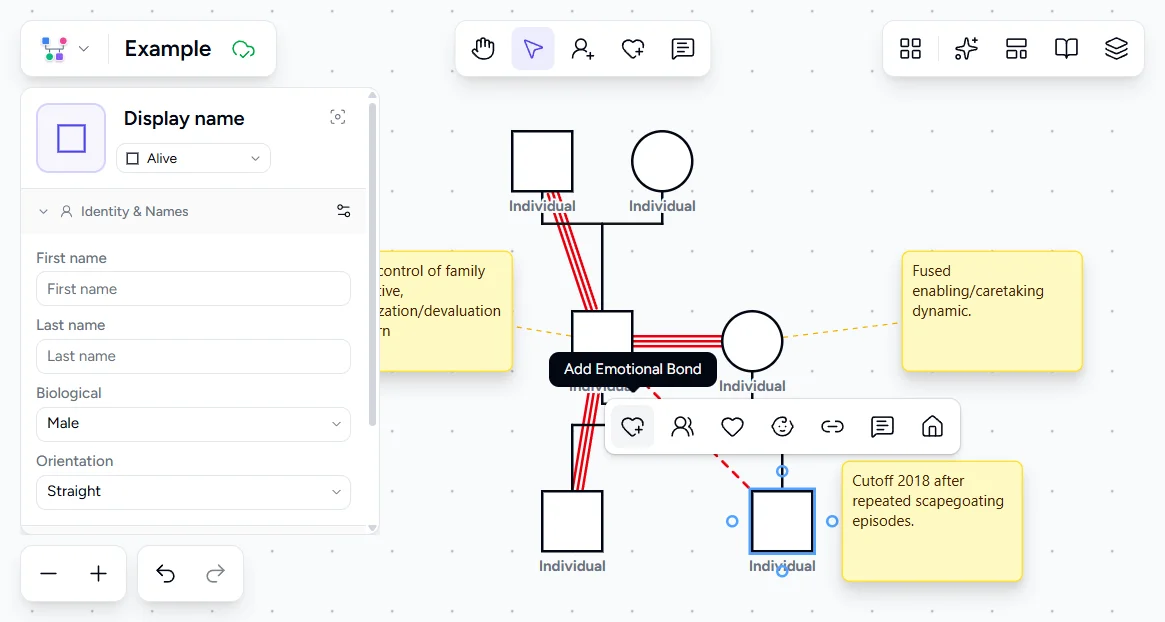
Look at how the parent's relationship lines differ across children: a fused bond to the golden child, a cutoff line to the scapegoat, and a distant line to the lost child. Notice the fused bond between the narcissistic parent and their partner.
Use as TemplatePatterns to look for
Role assignment as structural position
In families organized around a narcissistic parent's needs, children do not freely develop their identities. They are assigned roles. The "golden child" receives praise, privilege, and a fused bond with the narcissistic parent in exchange for performing as an extension of that parent's idealized self-image. The "scapegoat" receives blame, criticism, and a hostile or cutoff bond, serving as the repository for everything the narcissistic parent cannot tolerate in themselves. The "lost child" receives very little of either: a distant bond that signals invisibility.
These role labels (golden child, scapegoat, lost child, enabler) come from Wegscheider-Cruse's addiction family literature, not from McGoldrick's genogram framework. They are useful clinical observations that can be mapped onto a genogram, but they are not standard genogram notation. The genogram itself captures the pattern through contrasting bond types; the role labels are an interpretive overlay.
On a genogram, role assignment becomes visible through contrasting bond types from the same parent. When one parent shows a fused line to one child, a hostile line to another, and a distant line to a third, the pattern is structural. The bonds are not about the children. They are about the parent's needs.
This matters clinically because the presenting patient can occupy any of these positions. The golden child may present with perfectionism and an empty sense of self. The scapegoat may present with anger, substance use, or depression. The lost child may present with dissociation or chronic underachievement. The genogram shows that these different presentations share a common structural origin.
Questions to explore:
- Does the same parent show markedly different bond types toward different children?
- Do the children's clinical presentations correspond to their structural position?
- Have the roles shifted, and if so, what triggered the change?
- What strengths has each child developed despite their assigned role?
Map a narcissistic family system
Draw contrasting bonds for golden child, scapegoat, and enabler roles in the free editor.
build it in the free editorThe enabler position
The narcissistic family system requires more than a narcissistic parent and assigned children. It requires an enabler: a partner who maintains the system by accommodating the narcissistic parent's behavior, minimizing its impact, and serving as a buffer between the parent and the scapegoated child. The enabler is not passive. They actively participate in maintaining the system, often from their own unresolved attachment needs.
On a genogram, the enabler shows a fused bond with the narcissistic parent. This fusion is functionally different from the golden child's fusion: the enabler's bond is organized around caretaking and compliance rather than idealization. The enabler may also show a distant or weak bond with the scapegoated child, not because they do not care, but because proximity to the scapegoat threatens the system's stability.
Questions to explore:
- Does the partner consistently defer to the other parent's version of family events?
- Has the partner intervened to protect the scapegoated child, and what were the consequences?
- What was the enabler's role in their own family of origin?
- What relationships outside the nuclear family provide the enabler with support?
Generational replication
Narcissistic family dynamics are not contained to a single generation. The narcissistic parent was often the golden child or scapegoat in their own family of origin. The roles replicate: a person who was idealized may grow up expecting idealization from their own family. A person who was scapegoated may unconsciously re-create the dynamic, sometimes occupying the narcissistic position themselves, sometimes choosing a partner who does.
On a genogram with three or more generations, look for mirrored role structures. If the narcissistic parent was the golden child in their family, trace the fused bond with their own parent. If they were the scapegoat, look for a cutoff with their family of origin that was never resolved. The replication follows the logic of all multigenerational transmission: unresolved patterns repeat.
Questions to explore:
- What role did the narcissistic parent occupy in their own family of origin?
- Are there similar role-assignment patterns in the grandparent generation?
- Which generation first shows the narcissistic family structure?
- Who in the extended family has maintained healthy relationships, and what can be learned from them?
Cutoff as escape
In narcissistic family systems, the scapegoat or lost child may cut off from the family entirely. On a genogram, this cutoff line represents the most dramatic response to a system that has chronically failed to provide safety or validation. The cutoff is both self-preservation and a clinical concern: it resolves the immediate pain but does not resolve the internalized dynamics.
Adults who cut off from narcissistic families carry the assigned role internally. The scapegoat may continue to blame themselves. The lost child may continue to be invisible in other relationships. The cutoff removes the external system but not the internal template it created. These individuals benefit from genogram work because it externalizes the roles. It shows that "scapegoat" was a position in a system, not a truth about who they are.
Questions to explore:
- Did the person who cut off make the decision suddenly or gradually?
- What internal role (self-blame, invisibility, hypervigilance) does the cut-off member still carry?
- Has the cut-off member replicated any aspect of the narcissistic system in their current relationships?
- What relationships or resources has the cut-off member built outside the family?
How to build this in Genogram Pro
Position the narcissistic parent and their partner centrally
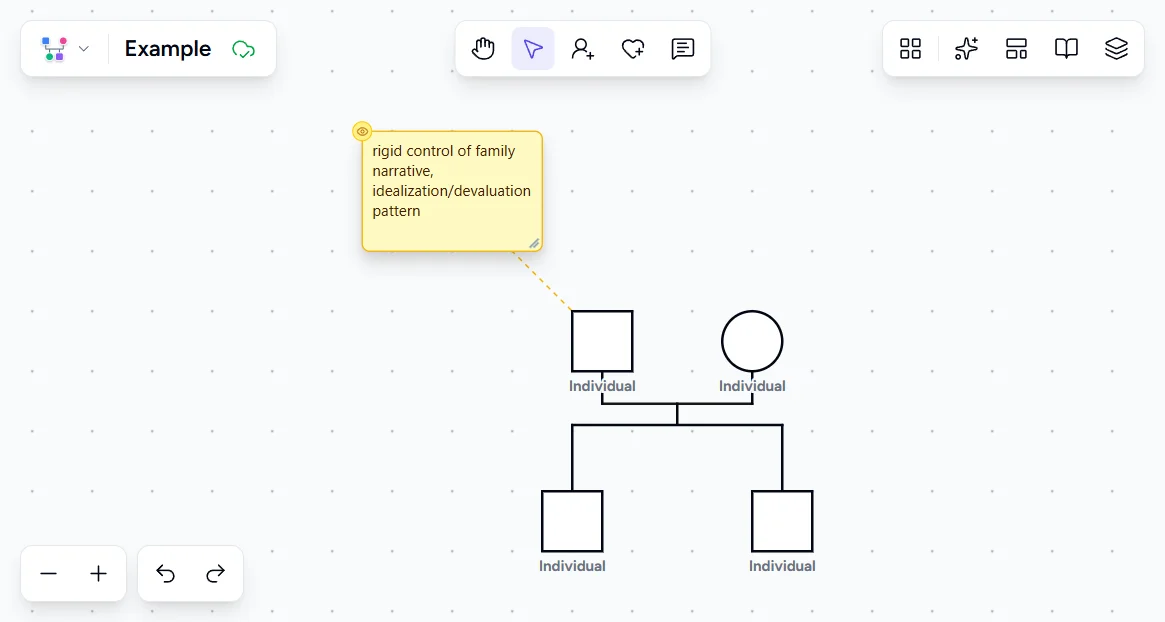
Place the couple at the center of the genogram. Select the narcissistic parent, click Note in the selection toolbar, and attach clinical notes (e.g., "rigid control of family narrative, idealization/devaluation pattern").
Add children and assign contrasting bond types
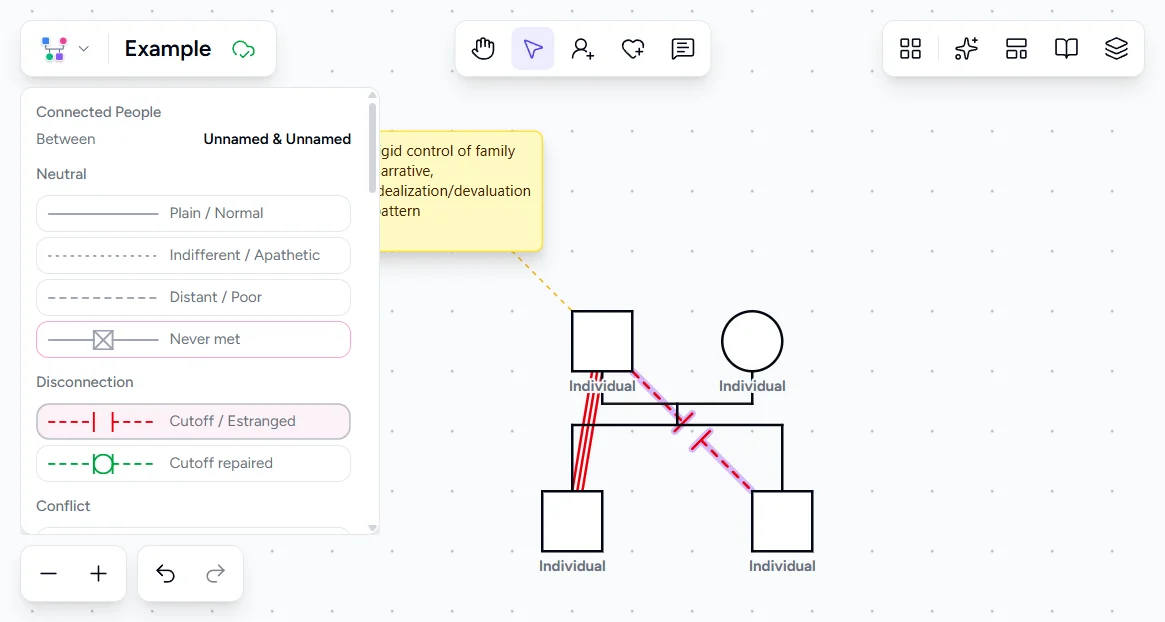
Add each child. Select the narcissistic parent, click Emotional Bond in the selection toolbar, then click the golden child. Choose fused. Repeat for the scapegoat (choose cutoff) and the lost child (choose distant). The visual contrast should be immediately striking.
Map the enabler bond
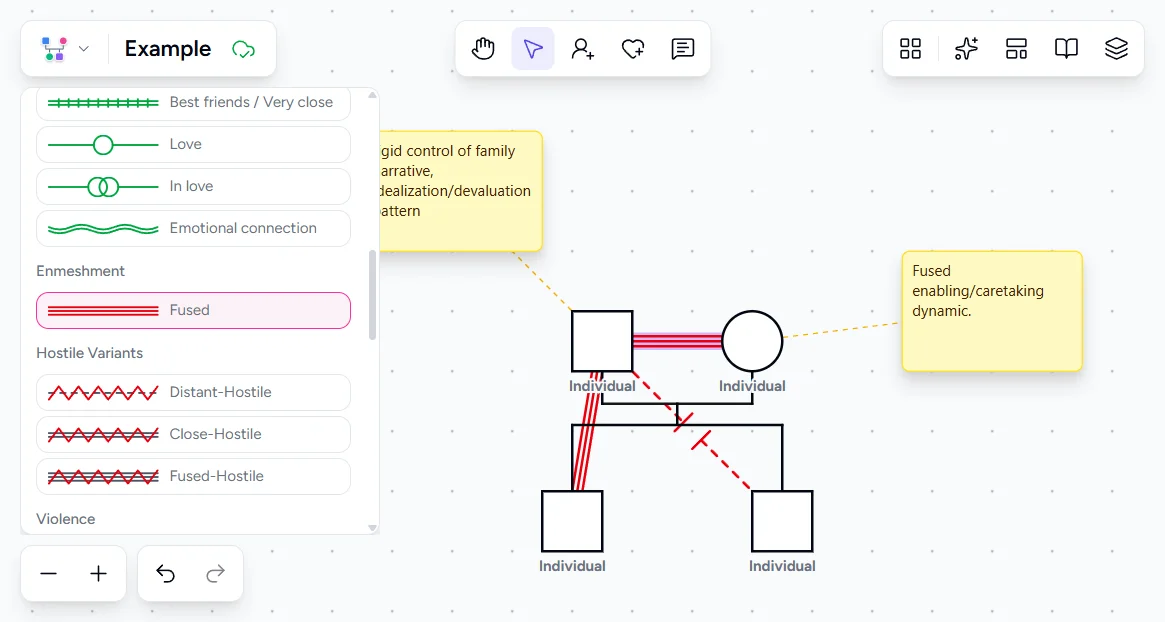
Select the narcissistic parent, click Emotional Bond in the selection toolbar, then click their partner. Choose fused. Then click Note in the toolbar to place a note distinguishing this fusion from the golden child's: "Fused enabling/caretaking dynamic."
Extend to the grandparent generation
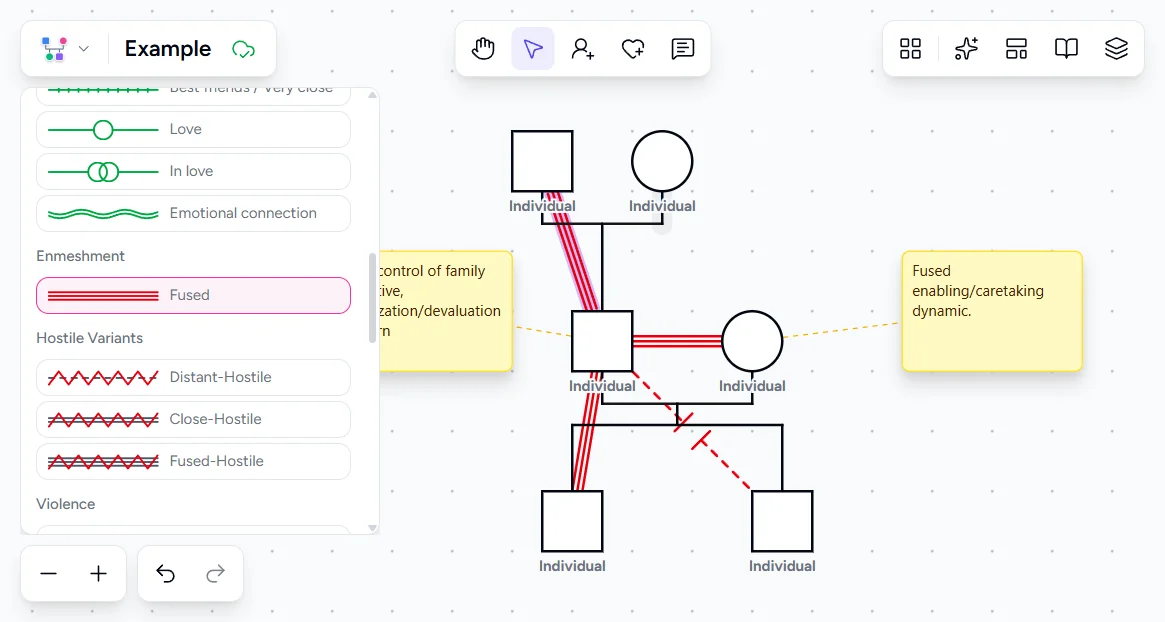
Add the narcissistic parent's parents and map the bond types they had with their children. Look for the same contrasting pattern (fused with one child, hostile with another) to show generational replication.
Add cutoff lines where applicable
If a family member has severed contact, select one person, click Emotional Bond in the selection toolbar, then click the other person. Choose cutoff. Then select the person and click Note to attach timing and context: "Cutoff 2018 after repeated scapegoating episodes."
Clinical context
The term "narcissistic family system" describes a relational structure, not a collection of DSM diagnoses. Mapping a family as a narcissistic system on a genogram does not constitute diagnosing any individual with Narcissistic Personality Disorder. The genogram maps dynamics (role assignment, bond contrasts, enabling structures), not pathology. Some families show these structural patterns without any member meeting criteria for a personality disorder.
This type of genogram draws on both Bowenian concepts (multigenerational transmission, cutoff, triangulation) and structural family therapy (boundary assessment, subsystem hierarchy). Clinicians working with adult children of narcissistic families use genograms in individual therapy to help clients externalize their assigned roles and recognize that those roles were system-created rather than self-chosen. This externalization can be profoundly therapeutic, particularly for former scapegoats who have internalized blame.
McGoldrick emphasizes that every genogram assessment should include strengths and resilience alongside problems. A genogram that maps only dysfunction tells half the story. Even in narcissistic family systems, some members develop coping strategies, maintain outside support networks, or build healthy relationships despite the structural dysfunction. Mapping these strengths alongside the role assignments provides a more complete and clinically useful picture.
Cultural considerations apply here as well. Family hierarchies, parental authority, and role expectations vary across cultures. Applying the label "narcissistic family system" to a family that operates within a cultural framework of strong parental authority requires careful clinical judgment. The genogram is most useful when it generates collaborative questions with the client rather than imposed interpretations.
Frequently Asked Questions
What is a narcissistic family genogram?
Can a genogram diagnose Narcissistic Personality Disorder?
What roles appear in a narcissistic family system?
Why would a scapegoated child cut off from the family?
Do narcissistic family patterns repeat across generations?
Ready to Create Your Own Genogram?
Build professional genograms online with standard notation, AI-powered generation, and end-to-end encryption.