
Dysfunctional family roles
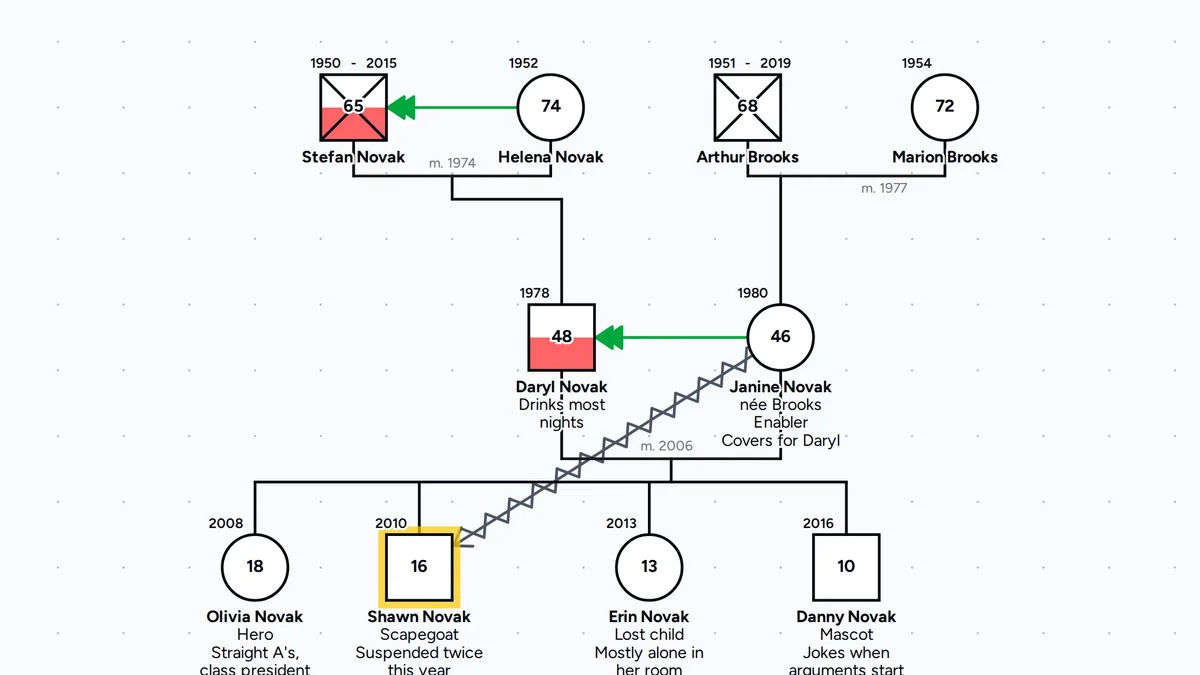
Dysfunctional family roles are patterns of behavior that family members can fall into when a family organizes itself around a problem such as a parent's drinking. This guide has the six roles Sharon Wegscheider-Cruse described, where the names come from, the roles other writers added, and the Novak family drawn with all six on one genogram.
Updated October 2026Role names follow Sharon Wegscheider-Cruse, Another Chance (1981), and notation follows McGoldrick, Gerson and Petry, Genograms: Assessment and Treatment (4th ed., 2020)
Cite this diagram
Genogram Pro. (2026, October 22). Dysfunctional family roles [Diagram]. https://genogrampro.com/guide/dysfunctional-family-roles
The dependent
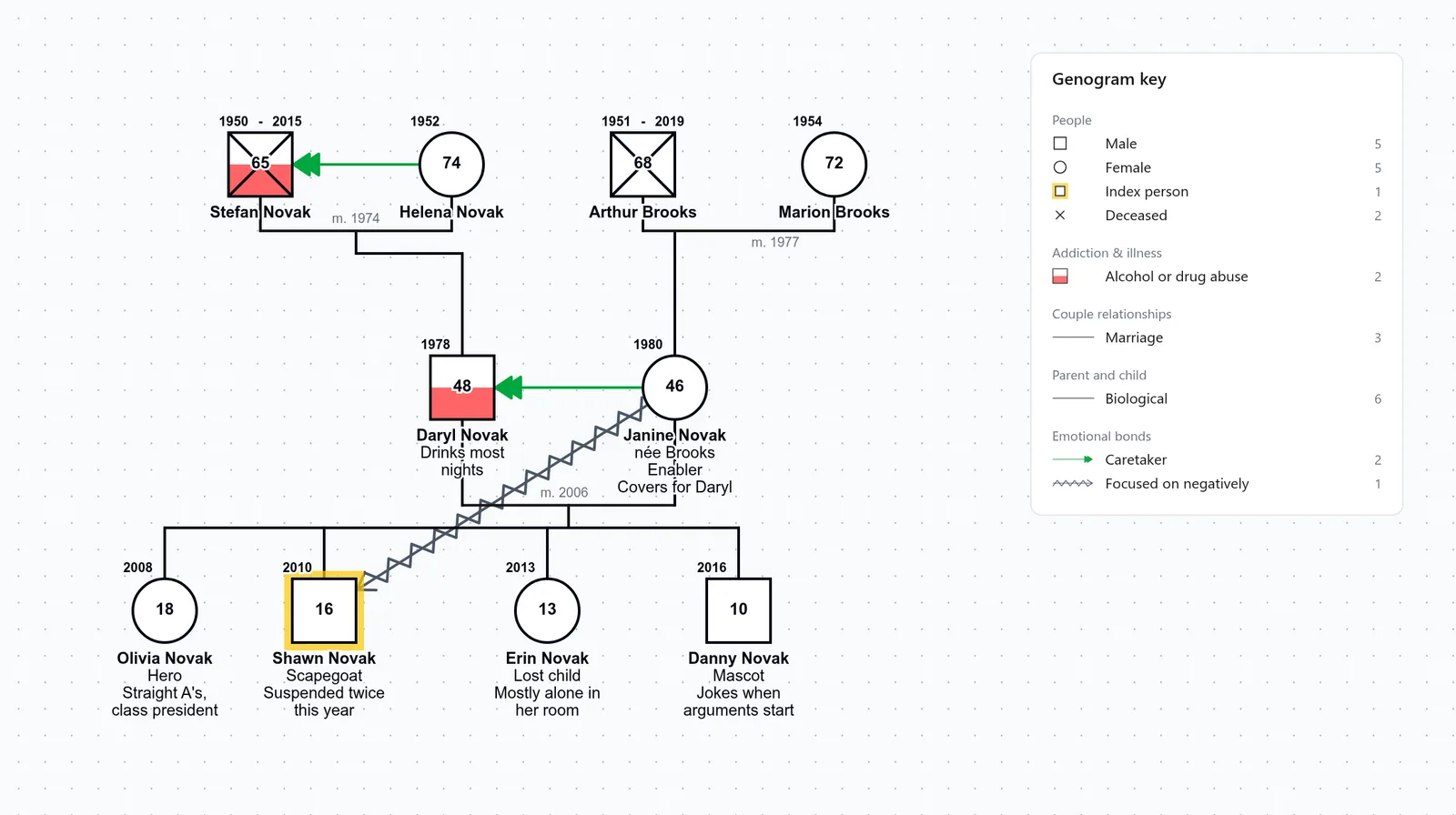
Daryl's symbol is filled for alcohol or drug abuse and his note is "Drinks most nights", and the symbol of his late father Stefan has the same fill.
The enabler
Janine has a green caretaker line to Daryl with the double arrowhead at him, and her note is "Covers for Daryl".
The hero
Olivia, the oldest, has no emotional lines, and her role and "Straight A's, class president" are written under her name.
The scapegoat
Shawn, the index person outlined in yellow, has a focused on negatively line from his mother, a gray zigzag with the chevron at him.
The lost child
Erin has no emotional lines, and her note is "Mostly alone in her room".
The mascot
Danny, the youngest, has "Jokes when arguments start" written under his name.
A generation earlier
Helena has the same caretaker line to her late husband Stefan that Janine has to Daryl.
What family roles are
Family roles are patterns of behavior that family members take on, and writers on these roles describe each role as a way of coping with a problem such as alcohol dependence in the family. They describe people in a family under less strain moving in and out of roles as the situation changes, and roles becoming rigid in a family under more strain, so that one child is always the one who copes and another is always the one who is blamed.
None of these roles is a diagnosis. The names come from clinical and self-help writing about families affected by alcohol, and in a 2011 review in Substance Use & Misuse, Peter Vernig found that attempts to measure the roles had run into difficulties, that the evidence for them was conflicting, and that there was little work on diverse families. A role name is a description of what someone did in a family, not of who that person is.
Where the role names come from
Sharon Wegscheider-Cruse described the roles in families with an alcohol-dependent parent in Another Chance: Hope and Health for the Alcoholic Family (1981), under the names dependent, enabler, hero, scapegoat, lost child and mascot. Vernig called the five roles other than the dependent the most popular classification of its kind taught in the United States, and most lists of dysfunctional family roles are built on them.
Claudia Black described four roles for children of alcohol-dependent parents in It Will Never Happen to Me (1981), the responsible one, the adjuster, the placater and the acting-out child. The scapegoat has the oldest academic use of these names, in Ezra Vogel and Norman Bell's 1960 paper on the emotionally disturbed child as the family scapegoat. Other writers added roles such as the golden child, and depending on the source, a list of dysfunctional family roles has anywhere from four to more than eight roles.
The dependent and the enabler
In Wegscheider-Cruse's model, the family organizes itself around one member's drinking or drug use, and she called that person the dependent.
The person in the enabler role, usually a partner, covers for the dependent, makes excuses and takes over their responsibilities, so the family can carry on as usual and the drinking can continue.
On a genogram. Daryl's symbol and his late father Stefan's are filled for alcohol or drug abuse, and Janine has a caretaker line to Daryl. The codependency genogram example has the same pair in two generations.
The hero
The child in the hero role is often the oldest, who does well at school and takes on adult jobs at home, so that from the outside the family looks as if it is doing fine.
Writers on these roles describe this success as coming at the cost of the child's own needs, and describe perfectionism and overwork in adults who grew up in this role. Claudia Black called a similar child the responsible one.
On a genogram. Genograms have no line for achievement, so Olivia's grades and her election as class president are written as a note under her name.
The scapegoat
The family blames the child in the scapegoat role for its problems and focuses on that child's trouble at school, defiance or early exit from home, while nobody names the drinking.
Writers also call this child the black sheep or the problem child, and the child in this role is often the family member brought to treatment, the person family therapists call the identified patient.
On a genogram. Shawn is the index person, as the identified patient often is, and his mother has a focused on negatively line to him. Bowen called the way parents pass their emotional problems on to a child, often through this kind of focus, the family projection process.
The lost child
The child in the lost child role withdraws, spends time alone and asks for little, and in a family busy with a crisis, that child is easy to overlook. Claudia Black's adjuster, the child who accepts whatever happens, is close to this role.
On a genogram. Like Olivia and Danny, Erin has no emotional lines, so on this genogram her role is visible only in the text under her name. A person with no emotional lines is still worth noticing on any genogram, as with Evan in the narcissistic family roles genogram example.
The mascot
The child in the mascot role, often the youngest, eases tension with jokes, clowning or getting attention, and writers on these roles describe the humor as a way of coping with fear that the child cannot put into words.
On a genogram. Genograms have no line for humor either, so Danny's jokes are written as a note under his name.
The golden child and other roles
The golden child. A parent favors the child in the golden child role, who can do no wrong in that parent's eyes. The name is common in writing about narcissistic parents but is not one of Wegscheider-Cruse's roles. Some writers treat the golden child and the hero as one role. In the narcissistic family roles genogram example, the favored daughter has a fused line to her mother.
The parentified child. A child in this role takes on a parent's jobs, such as caring for a parent or raising younger siblings. The term is usually credited to Ivan Boszormenyi-Nagy and Geraldine Spark's Invisible Loyalties (1973), and the parentification genogram example has the role drawn with caretaker lines.
The caretaker or peacemaker. Some writers add a caretaker who looks after everyone's feelings or a peacemaker who steps in during conflict, and others use caretaker as another name for the enabler.
Drawing family roles on a genogram
A genogram has no symbol for a family role, so draw each role with the usual lines, fills and notes:
- Draw the family first. Draw three generations with their couple and child lines, as in how to make a genogram, before you add any emotional lines.
- Use a line where a relationship fits. Use a caretaker line for a person in the enabler role or a parentified child, a focused on negatively line for a child in the scapegoat role, and fused, distant or cutoff lines where they fit. The guide to genogram relationship lines has every line.
- Fill the symbol for drinking or drug use. The editor has fills for alcohol or drug abuse, suspected abuse and recovery, and the substance abuse genogram example is drawn with the fills for abuse and recovery.
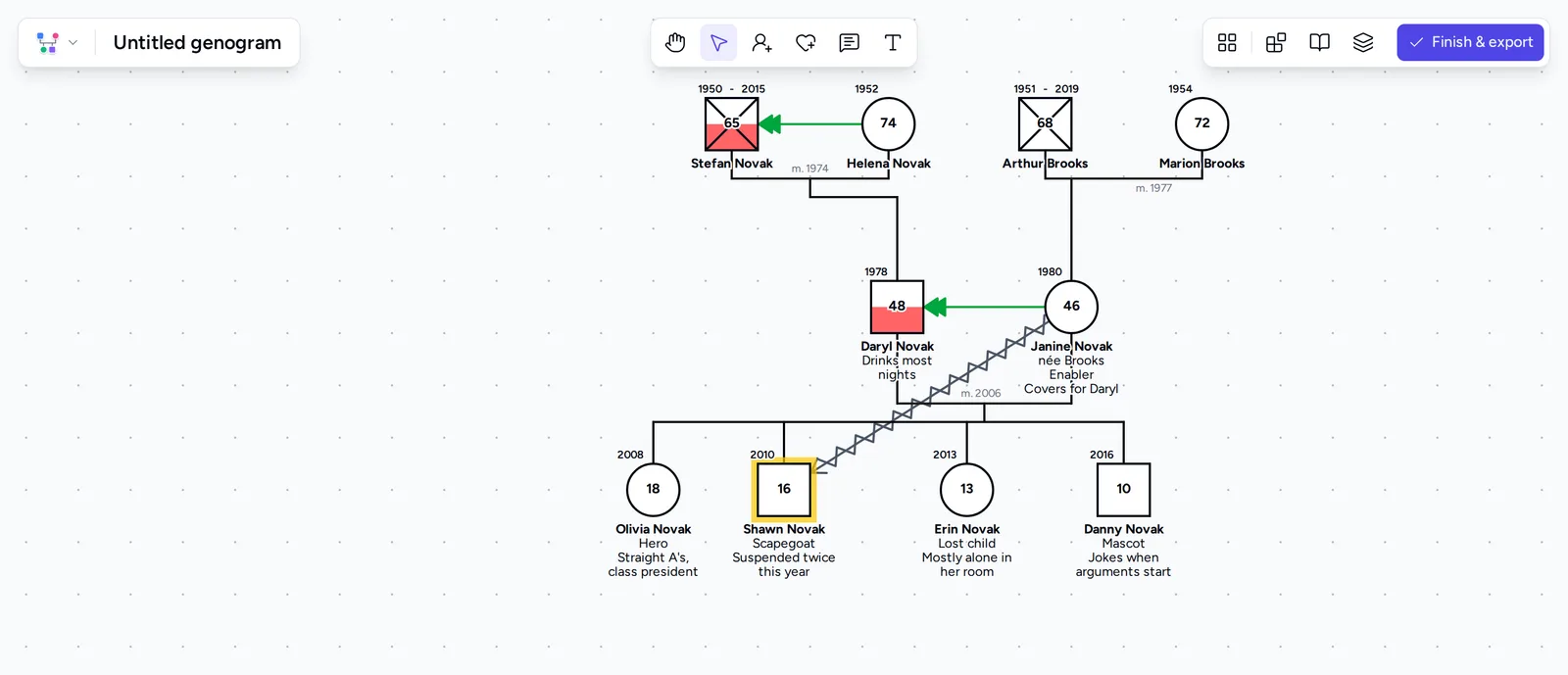
- Write what each person does. In Other information, add a property with Show in diagram turned on and write the behavior, such as "Covers for Daryl". Add the role name as another property only if it helps the reader, as on the Novak family genogram.
When roles change
A person can have more than one role, such as a child in the hero role at school and the caretaker role at home, and roles can shift when a sibling leaves home or a parent stops drinking. Writers on these roles describe some of them continuing into adulthood, in relationships and at work, and they also write about adults stepping out of a role they took on as children.
If you recognize your own family in these roles, a licensed therapist can help, and Al-Anon and Alateen hold meetings for the families and friends of someone who drinks.
Questions people ask
What are the roles in a dysfunctional family?
The most widely taught list comes from Sharon Wegscheider-Cruse's book on families affected by alcohol, Another Chance (1981), and has the dependent, the enabler, the hero, the scapegoat, the lost child and the mascot. Other writers add the golden child, the parentified child or the identified patient, and depending on the source, a list has anywhere from four to more than eight roles.
What are the five roles in a dysfunctional family?
The five roles are the enabler, the hero, the scapegoat, the lost child and the mascot, a list Peter Vernig described in 2011 as the most popular classification of family roles taught in the United States. Wegscheider-Cruse also named a sixth role, the dependent, the family member with the drinking or drug problem.
Are dysfunctional family roles a diagnosis?
No. The roles are descriptions from clinical and self-help writing, and none of them is a diagnosis in the DSM-5-TR. In a 2011 review in Substance Use & Misuse, Peter Vernig found conflicting evidence that families with an alcohol-dependent parent fall into these roles.
Can a person have more than one family role?
Yes. Writers on these roles describe a child who takes the hero role at school and the caretaker role at home, and roles that shift when a sibling leaves home or a parent stops drinking.
What is the difference between the golden child and the hero?
A child in the hero role earns approval through achievement and responsibility, while a child in the golden child role is favored by a parent and can do no wrong in that parent's eyes. The golden child is a name common in writing about narcissistic parents, not one of Wegscheider-Cruse's roles, and some writers treat the two as one role.
How do you show family roles on a genogram?
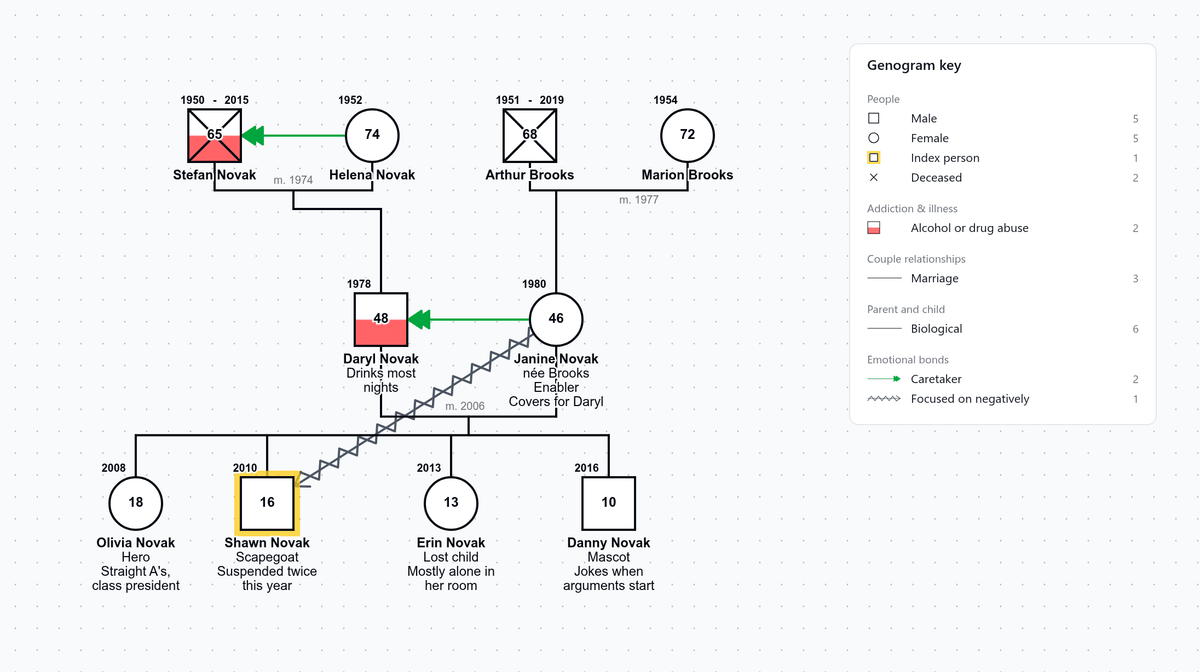
Genograms have no symbol for a role, so draw the relationships with lines such as caretaker or focused on negatively, fill the symbol of anyone with an alcohol or drug problem, and write what each person does as a property shown in the diagram. A role name can be added as another property, as on the Novak family genogram on this page.
Start your genogram from this example
Open it in the editor, swap in your own names and dates, and export it as a PNG or PDF.